
Israel still gives new immigrants and long-absent returnees ten years free of tax on foreign income. What it no longer gives, for anyone arriving from 2026, is ten years of not having to mention it.
Since 2007 Israel has offered one of the most generous welcomes anywhere. A person who becomes an Israeli tax resident for the first time, or who returns after a long absence, is exempt for ten years from Israeli tax on income generated or derived abroad, or originating from assets located abroad.
The breadth is what made it unusual. The exemption covers business income, salary, dividends, interest, rent, royalties and pensions arising abroad, and it applies whether the assets were acquired before or after the move. Foreign capital gains are covered too.
Alongside the tax exemption sat a reporting exemption of the same length. For a decade an oleh did not have to declare foreign income or assets to the Israel Tax Authority at all, which is what made Israel a genuinely quiet harbour for private capital rather than merely a cheap one.
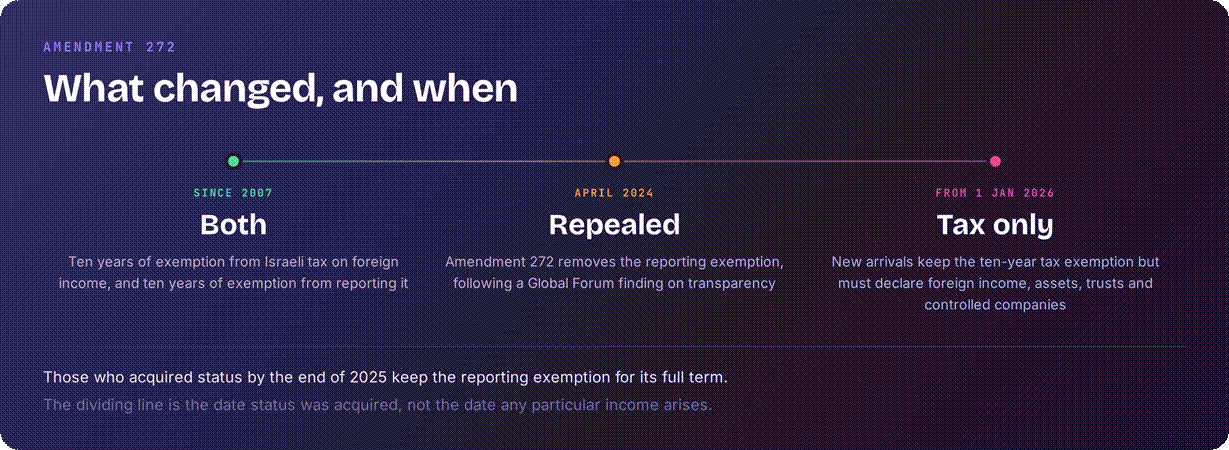
The tax exemption survived. The reporting exemption did not.
Your residency status is the first step
Israeli residence turns on the centre of life test, which weighs where your home is, where your family lives, where your habitual place of activity sits and where your economic interests are. Two day-count presumptions support it, and both are rebuttable: 183 days or more in the tax year, or 30 days in the tax year with 425 days across that year and the two preceding.
The two categories that qualify for the regime are defined by absence rather than nationality. A new immigrant is someone becoming an Israeli tax resident for the first time. A veteran returning resident is someone who was a foreign resident for at least ten consecutive years before returning.
Maintain accurate records of:
• The date you became, or will become, an Israeli tax resident;
• The years you were a foreign resident, and in which countries;
• Where your home, family and economic interests sat during that period;
• Days present in Israel across the tax year and the two preceding;
• A full inventory of foreign assets, income sources and structures; and
• Any trust you settled or benefit from.
What the exemption covers
Income or asset | Treatment during the ten years |
Foreign business income | Exempt |
Foreign salary | Exempt |
Foreign dividends and interest | Exempt |
Foreign rental income | Exempt |
Foreign royalties | Exempt |
Foreign pensions | Exempt |
Gains on foreign assets | Exempt |
Israeli-source income of any kind | Taxable on ordinary rules |
It makes no difference when the assets were acquired. A portfolio built over thirty years before the move produces exempt income for the ten years, which is the feature that distinguishes the Israeli regime from transitional windows elsewhere that only shelter income arising after arrival.
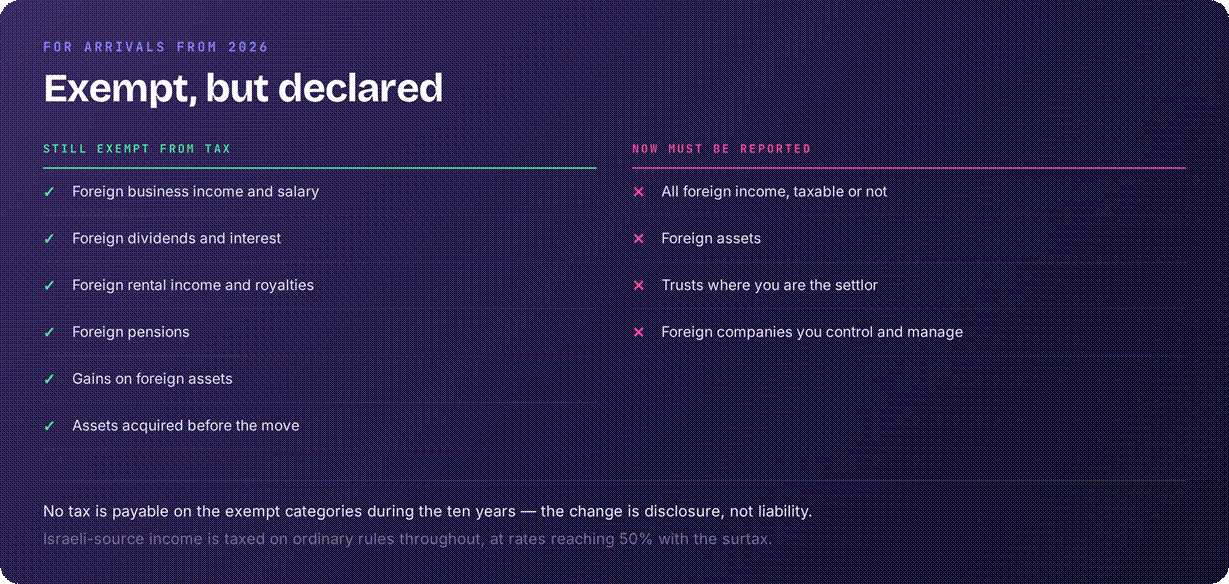
What stays exempt, and what must now be declared.
What Amendment 272 changed
The trigger was external. A review by the Global Forum on Transparency and Exchange of Information, the OECD-linked body, found Israel non-compliant with transparency standards, because information on the income and assets of new immigrants sat outside the automatic exchange system entirely.
Amendment 272 removed the reporting concession. For anyone acquiring status from 1 January 2026:
• Foreign income and assets must be declared in the annual return, even though no tax is payable on them for the ten years;
• The reporting exemption for a trust settlor who is a new immigrant or veteran returning resident was also cancelled; and
• Assessing officers may demand reports or information from a company controlled and managed by a new immigrant or veteran returning resident.
Those who became Israeli residents by the end of 2025 keep the reporting exemption. The dividing line is the date status was acquired, not the date of any particular income.
The 2026 earned income incentive
Separately, an incentive was introduced for individuals immigrating during 2026 specifically, giving an exemption on Israeli-sourced earned income on a tapering schedule — the largest amounts in 2026 and 2027, reducing each year through to 2030. Income above the thresholds is taxed at ordinary progressive rates with normal credits and deductions.
The design points at professionals expected to earn substantial Israeli income — physicians, engineers, software developers — rather than at passive investors, and it sits on top of the ten-year foreign income exemption rather than replacing it. Confirm the enacted figures and conditions before relying on it, as the detail was still settling when it was announced.
Case study: two arrivals, thirteen months apart
Daniel made aliyah in November 2025 with a portfolio of European holdings and a UK rental property. He gets ten years of exemption on that income and ten years of not having to report it.
Rachel arrives in January 2026 with an identical position. Her ten years of tax exemption are the same. But she must file returns disclosing her foreign income, assets, trusts and controlled companies from the outset, and that information enters the exchange system.
The tax bill is identical. The privacy position is not, and for some of the people the regime was designed to attract, that was a substantial part of the appeal.
Rates outside the exemption
Israeli-source income is taxed on the ordinary progressive scale reaching 47%, with an additional surtax on high incomes taking the effective top rate to 50%. The tax year follows the calendar year.
Two further benefits run alongside the main regime: an exemption on interest from foreign currency deposits for ten years, where the investment was first made after immigration or return, and reduced purchase tax rates for new immigrants acquiring a single residential property, subject to conditions.
Filing and the compliance calendar
The Israel Tax Authority administers the system, and Israel has a wide treaty network of around 57 agreements. Prepare in good time:
• Documentation of the date status was acquired, which decides the reporting position;
• Evidence of ten consecutive years abroad, for veteran returning residents;
• A complete inventory of foreign income and assets, whether taxable or not;
• Trust documentation, since the settlor concession has gone;
• Details of any foreign company you control and manage; and
• Records supporting the centre of life analysis.
Timing matters more than it used to
Model your position before you move, considering:
• Whether you qualify as a new immigrant or a veteran returning resident;
• Whether you acquired status before or after 1 January 2026;
• What reporting will require of you, if you are in the later cohort;
• How foreign structures and trusts will be disclosed;
• Whether the 2026 earned income incentive applies to your situation;
• What happens in year eleven, when worldwide taxation begins; and
• How a treaty with your former country interacts with the exemption.
Your Israel checklist
1. Establish whether you are a new immigrant or a veteran returning resident;
2. Confirm ten consecutive years of foreign residence if returning;
3. Identify the exact date Israeli tax residence was or will be acquired;
4. Determine which side of 1 January 2026 that date falls;
5. Inventory foreign income and assets whether or not tax is due;
6. Review any trust you settled, since the settlor concession has gone;
7. Identify foreign companies you control and manage;
8. Check whether the 2026 earned income incentive applies to you;
9. Keep evidence supporting the centre of life analysis; and
10. Plan for year eleven well before you reach it.
Frequently asked questions
Does Israel still exempt foreign income for ten years?
Yes. The ten-year exemption from Israeli tax on foreign-source income for new immigrants and veteran returning residents continues unchanged. What was repealed is the parallel exemption from reporting that income.
Who is affected by the reporting change?
Anyone who becomes an Israeli resident for the first time, or a veteran returning resident, on or after 1 January 2026. Those who acquired status by the end of 2025 keep the reporting exemption.
What has to be reported now?
Foreign income and assets in the annual return, even though no tax is payable on them. The reporting concession for trust settlors was also cancelled, and assessing officers may require reports from a company controlled and managed by a qualifying individual.
Why did the rule change?
A review by the Global Forum on Transparency and Exchange of Information found Israel non-compliant with transparency standards, because information on new immigrants’ income and assets sat outside the automatic exchange system.
Who qualifies as a veteran returning resident?
Someone who was a foreign resident for at least ten consecutive years before returning to Israel. A shorter absence does not qualify for the ten-year regime.
Does it matter when I acquired my foreign assets?
No. The exemption applies to income from assets held or activities conducted abroad regardless of whether they were acquired before or after you became an Israeli resident, which distinguishes it from many transitional regimes.
How is Israeli residence decided?
By the centre of life test — home, family, habitual activity and economic interests — supported by two rebuttable day-count presumptions: 183 days in the tax year, or 30 days in the year with 425 days across that year and the two preceding.
What happens after ten years?
Worldwide taxation applies on ordinary rules, with rates reaching 50% including the surtax. Because the transition is a cliff rather than a taper, it is worth planning for well before year eleven.
Official sources and further reading
Important information
This article is general information and does not constitute tax, legal, immigration or financial advice, and does not create a client relationship. Tax outcomes depend on travel history, income sources, treaty status and the law applying to the relevant year. Rates, thresholds and regimes change, and some measures described may be proposed rather than enacted; this article reflects our understanding as at the date of publication. Obtain advice from a suitably qualified professional before acting or refraining from action.
