
Côte d’Ivoire replaced three separate salary taxes with a single ITS from January 2024. A great deal of published guidance still shows the old structure, and it produces the wrong answer.
Until recently, salary income in Côte d’Ivoire was subject to three distinct taxes operating alongside one another — the IS, the Contribution Nationale and the IGR.
Ordinance No. 2023-718 of 13 September 2023, effective 1 January 2024, merged all three into a single simplified payroll tax: the ITS, the Impôt sur les Traitements et Salaires. Six progressive brackets, with a 0% entry band covering annual income to XOF 600,000 per part.
This matters more than most reforms, because the old structure is still widely published. Guides showing an eight-band IRPP scale reaching 40% predate the merger and will produce a wrong figure if used for any period from 2024 onward.
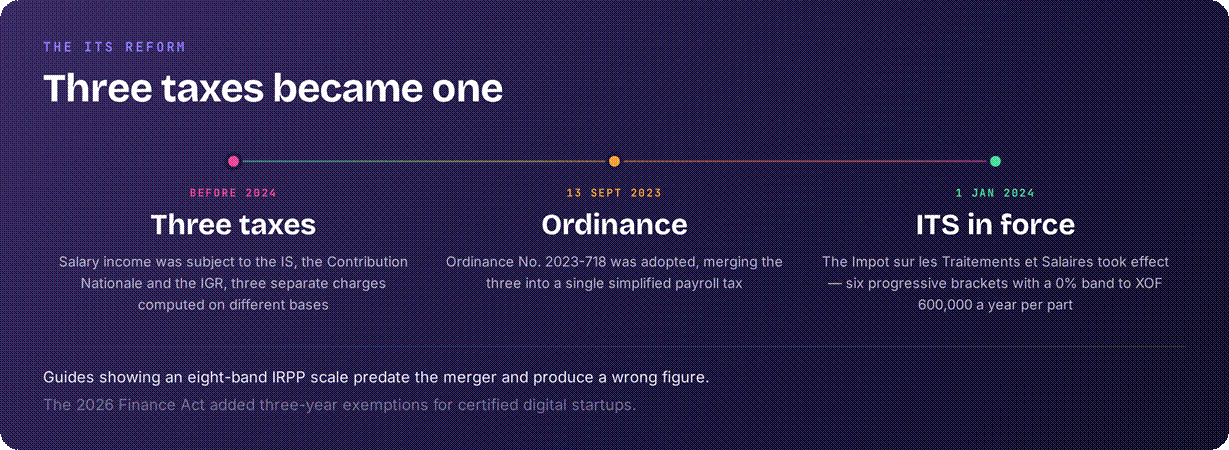
Three taxes, one reform, one scale.
What the reform actually did
Before 2024, an Ivorian payslip carried three separate deductions computed on different bases. The reform consolidated them into one charge with one scale, which removed a considerable amount of complexity from both payroll and personal planning.
The practical consequences for anyone modelling a position:
• There is now one salary tax, not three, and one scale to apply;
• The 0% band covers annual income to XOF 600,000 per part;
• The quotient familial still divides income by family parts before the bands are applied;
• Sources disagree on the top marginal rate — 32% in some, 36% in others; and
• Any guide showing IS, CN and IGR separately, or an eight-band IRPP table, is out of date.
Maintain accurate records of:
• Which period you are computing, since 2024 is the dividing line;
• Your family circumstances, for the number of parts;
• Annual net taxable income per part;
• CNPS contributions deducted;
• Whether any activity qualifies as a certified digital startup; and
• The current ITS scale confirmed with the DGI.
The tax rates
Item | Position |
The tax | ITS — Impôt sur les Traitements et Salaires |
Introduced by | Ordinance No. 2023-718 of 13 September 2023 |
Effective from | 1 January 2024 |
Replaced | IS, Contribution Nationale and IGR |
Structure | Six progressive brackets |
Entry band | 0% to XOF 600,000 a year per part |
Top marginal rate | Sources differ — 32% or 36% |
Family mechanism | Quotient familial applies |
Confirm the top rate with the DGI before relying on a calculation at that level. The band structure and the entry threshold are consistent across sources; the ceiling is not, and the difference between 32% and 36% is material for a higher earner.
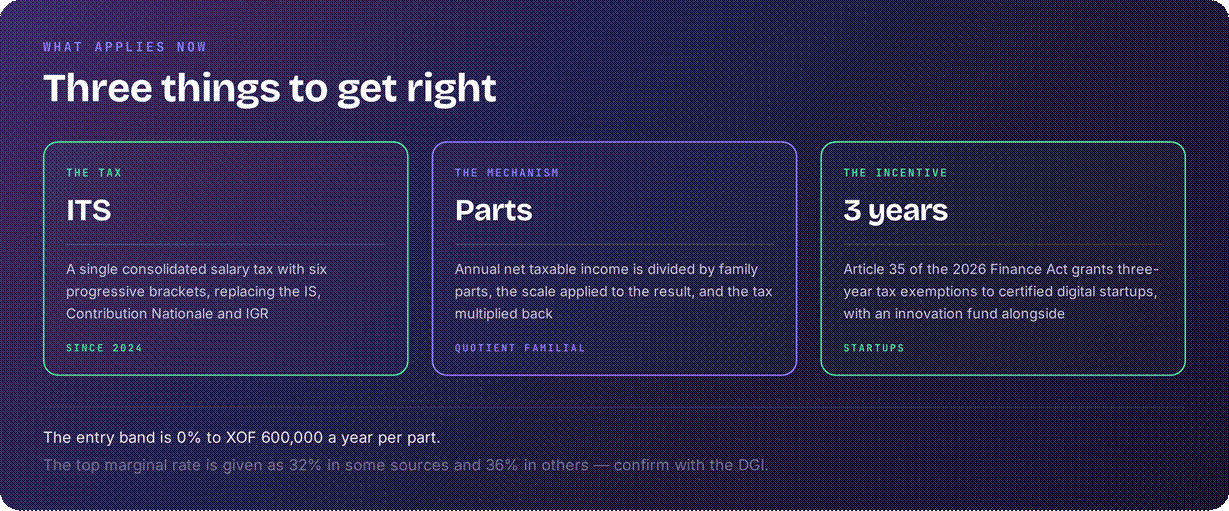
What applies now, and what does not.
The startup exemption
The 2026 Finance Act, Article 35, introduced three-year tax exemptions for certified digital startups, accompanied by an innovation fund. For a founder or early-stage technology business, that is the most directly relevant provision in the Ivorian system.
The qualifying conditions, the certification process and the scope of the exemption all need establishing directly, since a sector-specific relief of this kind lives or dies on its detail. But the existence of a three-year exemption is worth knowing about before dismissing the jurisdiction on its headline rate.
Côte d’Ivoire enters 2026 as the largest economy in the West African Economic and Monetary Union, accounting for around 40% of the zone’s GDP, with a well-developed financial sector by regional standards.
What makes Côte d’Ivoire attractive
The case is stronger since the reform:
• A single consolidated salary tax replacing three, which materially simplifies compliance;
• A 0% entry band to XOF 600,000 a year per part;
• The quotient familial, which reduces the bill substantially for a household with children;
• Three-year exemptions for certified digital startups under the 2026 Finance Act;
• An innovation fund alongside that exemption;
• The largest economy in the UEMOA zone, with the financial infrastructure that implies; and
• The CFA franc, pegged to the euro, giving currency stability.
The honest qualifications are that the top rate is disputed between sources, that CNPS contributions run at 6.3% for the employee and 14% for the employer, and that the abundance of outdated published guidance makes independent verification more important here than in most jurisdictions.
Case study: the guide that gives the wrong answer
Someone researching a move finds a detailed table showing eight IRPP bands running from 0% to 40% above XOF 3,000,000 per part. It looks authoritative and it is internally consistent.
It is also superseded. That scale belongs to the structure that Ordinance 2023-718 abolished with effect from 1 January 2024. Applying it to a 2026 salary produces a figure with no relationship to what would actually be due.
The test is simple: if a source describes IS, CN and IGR as separate taxes, or shows eight bands, it predates the merger. Anything current describes a single ITS with six brackets.
Filing and the compliance calendar
The ITS is administered by the Direction Générale des Impôts. CNPS pension contributions are 6.3% from the employee and 14% from the employer. The quotient familial operates by dividing annual net taxable income by the number of parts, applying the scale to the result, then multiplying back.
Prepare in good time:
• Registration with the DGI;
• Documentation of family circumstances for the parts calculation;
• Records of CNPS contributions deducted;
• Confirmation of the current ITS scale and top rate;
• Certification documentation, if claiming the startup exemption; and
• Awareness of which period each figure relates to.
Check the date on every source
Consider:
• That the ITS replaced three taxes from 1 January 2024;
• That any source showing IS, CN and IGR separately is out of date;
• That an eight-band IRPP table predates the merger;
• That the quotient familial still applies;
• That the top rate is disputed and needs confirming;
• Whether the digital startup exemption is available to you; and
• That CNPS runs at 6.3% and 14%.
Your Ivory Coast checklist
1. Check the date of every source you rely on;
2. Discard anything showing IS, CN and IGR separately;
3. Discard any eight-band IRPP table;
4. Apply the single ITS scale for periods from 2024;
5. Establish how many family parts you qualify for;
6. Divide income by parts before applying the scale;
7. Confirm the top marginal rate with the DGI;
8. Check whether the digital startup exemption applies;
9. Record CNPS at 6.3% employee and 14% employer; and
10. Note the CFA franc is pegged to the euro.
Frequently asked questions
What changed in Côte d’Ivoire in 2024?
Ordinance No. 2023-718 of 13 September 2023 merged three separate salary taxes — the IS, the Contribution Nationale and the IGR — into a single simplified payroll tax, the ITS, with effect from 1 January 2024.
Why do published guides disagree?
Because many still show the pre-merger structure. Any source describing IS, CN and IGR as separate taxes, or showing an eight-band IRPP scale, predates the reform and will produce a wrong figure for any period from 2024.
What is the ITS structure?
Six progressive brackets with a 0% entry band covering annual income to XOF 600,000 per part. Sources disagree on the top marginal rate, giving either 32% or 36%.
Does the quotient familial still apply?
Yes. Annual net taxable income is divided by the number of family parts, the scale is applied to the result, and the tax is multiplied back — the same mechanism used in Senegal.
What is the startup exemption?
Article 35 of the 2026 Finance Act grants three-year tax exemptions to certified digital startups, accompanied by an innovation fund. The certification process and scope should be confirmed directly.
What social contributions apply?
CNPS pension contributions at 6.3% from the employee and 14% from the employer.
How does Côte d’Ivoire compare regionally?
It is the largest economy in the West African Economic and Monetary Union, accounting for around 40% of the zone’s GDP, with better financial infrastructure than most of its neighbours and a currency pegged to the euro.
What should I verify before relying on a figure?
The date of the source and the top marginal rate. The band structure and entry threshold are consistent across sources; the ceiling is not, and the gap between 32% and 36% matters at higher incomes.
Official sources and further reading
• Direction Générale des Impôts, Côte d’Ivoire
Important information
This article is general information and does not constitute tax, legal, immigration or financial advice, and does not create a client relationship. Tax outcomes depend on travel history, income sources, treaty status and the law applying to the relevant year. Rates, thresholds and regimes change, and some measures described may be proposed rather than enacted; this article reflects our understanding as at the date of publication. Obtain advice from a suitably qualified professional before acting or refraining from action.
