
Jamaica has no capital gains tax at all, and a non-domiciled individual is generally taxed on foreign income only when it is brought into the island. Neither feature gets much attention.
Jamaica is usually described by its rates — 25% and 30% — and left there. Two features that matter far more to an internationally mobile person rarely make the summary: there is no capital gains tax in Jamaica, and a non-Jamaican domiciled individual is generally not taxable on foreign-sourced income unless it is remitted to Jamaica.
That second point is a remittance basis in the same family as the one the UK operated for two centuries, and it operates automatically on the basis of domicile rather than through an election or an annual charge.
The qualification is important. A non-domiciled individual working in Jamaica is taxed on the compensation attributable to services rendered in and in relation to Jamaica, along with any Jamaican-sourced income. The remittance treatment covers foreign-sourced income, not work performed on the island.
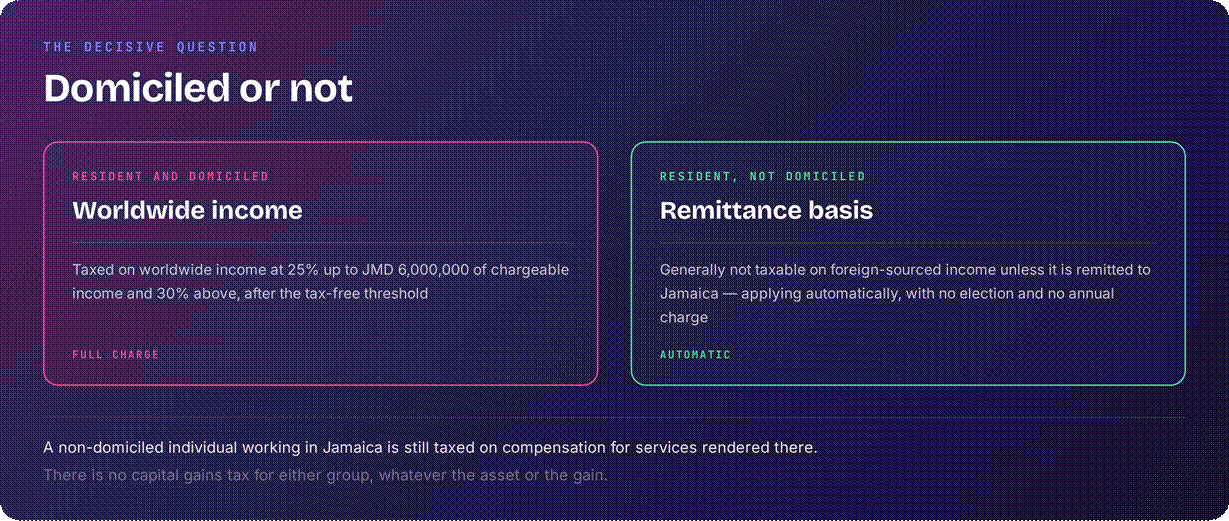
Domicile, not residence, decides how foreign income is treated.
Your residency status is the first step
An individual is treated as resident in Jamaica by being present for 183 days or more in the year. Jamaican resident and domiciled individuals are taxed on worldwide income; non-resident individuals on Jamaican-sourced income.
The decisive concept for an expatriate, though, is domicile rather than residence. Domicile is a separate legal concept from residence, broadly reflecting the place a person regards as their permanent home, and it is not changed simply by moving to Jamaica or by spending a given number of days there.
Someone who is resident but not domiciled in Jamaica sits in the remittance position: foreign-sourced income falls outside the Jamaican charge unless and until it is brought into the island.
Maintain accurate records of:
• Days present in Jamaica in each year;
• Your domicile position, and the evidence supporting it;
• Foreign-sourced income, kept separately from Jamaican-sourced income;
• Every remittance of foreign income into Jamaica, with dates and amounts;
• Where services were physically rendered, since that overrides the remittance treatment; and
• Any other country that may also treat you as resident.
The tax rates
Item | Position |
Chargeable income up to JMD 6,000,000 a year | 25% |
Chargeable income above JMD 6,000,000 a year | 30% |
Tax-free threshold from 1 April 2026 | JMD 1,902,360 a year |
Effective threshold for calendar 2026 | JMD 1,876,614 |
Pensioner exemption | A further JMD 250,040 |
Aged 65 or over | A further JMD 250,040 |
Capital gains | Not taxed |
Resident dividends from Jamaican companies | 15%, a final tax |
Both exemptions stack. Someone receiving a pension from an approved scheme who is also 65 or over benefits from a combined tax-free amount of JMD 2,376,654 in 2026 before any income tax applies — a materially better position than the headline threshold suggests.
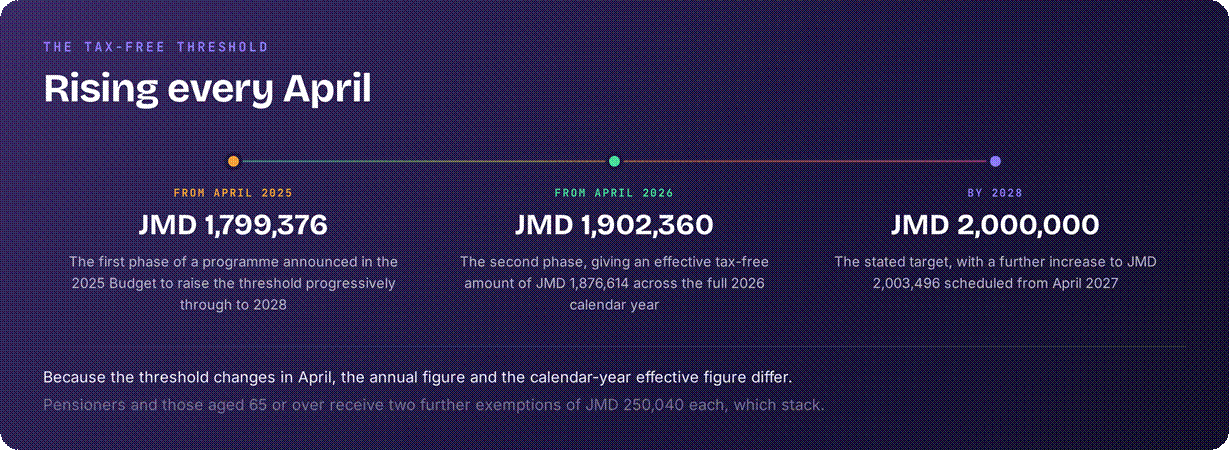
The threshold rises every April through to 2028.
What Jamaica does not tax
The absences are the most useful part of the system:
• There is no capital gains tax in Jamaica. A transfer tax applies to the market value of certain assets transferred, and stamp duty on transfers of shares or real property, but there is no charge on the gain itself;
• Foreign-sourced income of a non-domiciled individual is outside the charge unless remitted; and
• Dividends from Jamaican companies to resident shareholders are taxed at 15% as a final tax, deducted on payment, so there is nothing further to pay at the 25% or 30% rates.
Two qualifications on the dividend point. Income on which that 15% is payable cannot be offset by tax losses, and expenses incurred to earn the dividend are no longer deductible in arriving at chargeable income. It is a clean, low, final charge rather than a preferential rate within the ordinary computation.
Interest paid to Jamaican residents by a prescribed person — commercial banks and other financial institutions — has 25% deducted at source, and is then taxable at the applicable 25% or 30% rates with credit for the withholding borne. Interest is therefore not treated as favourably as dividends.
What makes Jamaica attractive
For an internationally mobile individual the case is considerably stronger than a 30% top rate implies:
• No capital gains tax, which is rare outside the traditional offshore centres and valuable for anyone holding appreciating assets;
• A remittance basis for non-domiciled individuals, applying automatically rather than by election and with no annual charge attached;
• A rising tax-free threshold on a published schedule, increasing each April through to 2028 with a stated target of JMD 2,000,000;
• Two additional exemptions of JMD 250,040 each for pensioners and for those aged 65 or over, which stack;
• Dividends at a final 15% for residents receiving them from Jamaican companies;
• Residence reached at 183 days, with no minimum investment, property purchase or capital requirement; and
• Employment income collected through PAYE, so most employees have nothing to prepare.
The honest qualification is that the remittance treatment depends on domicile, which is a legal question rather than a matter of choice, and that it does nothing for income from work physically performed in Jamaica. Anyone planning around it should establish their domicile position properly rather than assuming it.
Case study: Nadine keeps her portfolio offshore
Nadine moves to Kingston from Toronto to run the Caribbean operations of her employer. She retains Canadian investments producing dividends and interest, and she is not Jamaican domiciled.
Her Jamaican salary is taxable in full, because the services are rendered in and in relation to Jamaica. Her Canadian investment income is foreign-sourced and, as a non-domiciled individual, falls outside the Jamaican charge unless she remits it.
When she later sells a long-held Canadian holding at a substantial gain, Jamaica does not tax the gain at all — there is no capital gains tax. What she must not do is casually transfer the proceeds into a Jamaican account without first understanding how the remittance rules treat it.
Filing and the compliance calendar
The Jamaican tax year follows the calendar year, and the system is administered by Tax Administration Jamaica. A Taxpayer Registration Number is required, and employment income is collected through PAYE withholding, so most employees have no return to prepare.
The threshold changes on 1 April each year rather than at the start of the tax year, which is why the published annual figure and the effective figure for a calendar year differ. For 2026 the threshold rose to JMD 1,902,360 on 1 April, giving an effective calendar-year amount of JMD 1,876,614.
Prepare in good time:
• A Taxpayer Registration Number;
• Day-count records for the year;
• Evidence supporting your domicile position;
• Foreign income records kept separate from Jamaican income;
• A log of every remittance into Jamaica; and
• Documentation of any pensioner or age-based exemption claimed.
Establish domicile before anything else
Consider:
• Whether you are Jamaican domiciled, since that decides the remittance position;
• That the remittance treatment covers foreign-sourced income, not Jamaican work;
• How and when you bring foreign funds into the island;
• That there is no capital gains tax, whatever the asset;
• Which threshold figure applies — the April one or the calendar-year effective one;
• Whether the pensioner and age exemptions apply and stack for you; and
• That dividends from Jamaican companies carry a final 15% charge.
Your Jamaica checklist
1. Establish your domicile position before planning anything else;
2. Keep foreign-sourced income entirely separate from Jamaican income;
3. Log every remittance of foreign funds into Jamaica;
4. Remember work performed in Jamaica is taxable regardless of domicile;
5. Note that there is no capital gains tax on any asset;
6. Use the April threshold or the calendar-year effective figure as appropriate;
7. Claim the pensioner and age exemptions if both apply;
8. Treat dividends from Jamaican companies as bearing a final 15%;
9. Obtain a Taxpayer Registration Number; and
10. Expect PAYE to handle employment income without a return.
Frequently asked questions
Does Jamaica tax capital gains?
No. There is no capital gains tax in Jamaica. A transfer tax applies to the market value of certain assets transferred, and stamp duty on transfers of shares or real property, but the gain itself is not charged.
What is the remittance basis?
A non-Jamaican domiciled individual is generally not taxable on foreign-sourced income unless it is remitted to Jamaica. It applies automatically on the basis of domicile, with no election to make and no annual charge.
Does that cover my salary?
No. A non-domiciled individual working in Jamaica is taxed on the compensation attributable to services rendered in and in relation to Jamaica, along with Jamaican-sourced income. The remittance treatment covers foreign-sourced income only.
What are the rates?
25% on chargeable income up to JMD 6,000,000 a year and 30% on the excess, applied after deducting the tax-free threshold. Non-residents are not entitled to the threshold.
What is the tax-free threshold?
JMD 1,902,360 a year from 1 April 2026, up from JMD 1,799,376, giving an effective calendar-year amount of JMD 1,876,614 for 2026. It rises again in April 2027 toward a stated target of JMD 2,000,000 by 2028.
Are there extra exemptions for older people?
Yes, and they stack. A further JMD 250,040 applies for someone receiving a pension from an approved scheme, and another JMD 250,040 for anyone aged 65 or over, giving a combined tax-free amount of JMD 2,376,654 in 2026 where both apply.
How are dividends and interest taxed?
Dividends from Jamaican companies to resident shareholders bear 15% deducted on payment, which is a final tax. Interest paid by a prescribed person has 25% deducted at source and is then taxable at 25% or 30% with credit for the withholding.
When am I Jamaican tax resident?
By being present in Jamaica for 183 days or more in the year. Residence determines whether you are in the Jamaican system at all; domicile determines how your foreign income is treated once you are.
Official sources and further reading
Important information
This article is general information and does not constitute tax, legal, immigration or financial advice, and does not create a client relationship. Tax outcomes depend on travel history, income sources, treaty status and the law applying to the relevant year. Rates, thresholds and regimes change, and some measures described may be proposed rather than enacted; this article reflects our understanding as at the date of publication. Obtain advice from a suitably qualified professional before acting or refraining from action.
