
If you are considering moving to Japan, two questions matter: where will you pay tax, and how much foreign income will Japan tax?
The answer depends on your residency status, the source of your income, how long you have lived in Japan, and whether foreign income is paid or remitted into Japan. For some expats the non-permanent resident regime provides meaningful flexibility — certain foreign-source income may stay outside Japanese taxation while it is kept genuinely offshore.
This is not an exemption for offshore income. It is a limited remittance basis with a time limit and a set of conditions. You must classify your status correctly, keep proper records and report what is taxable.
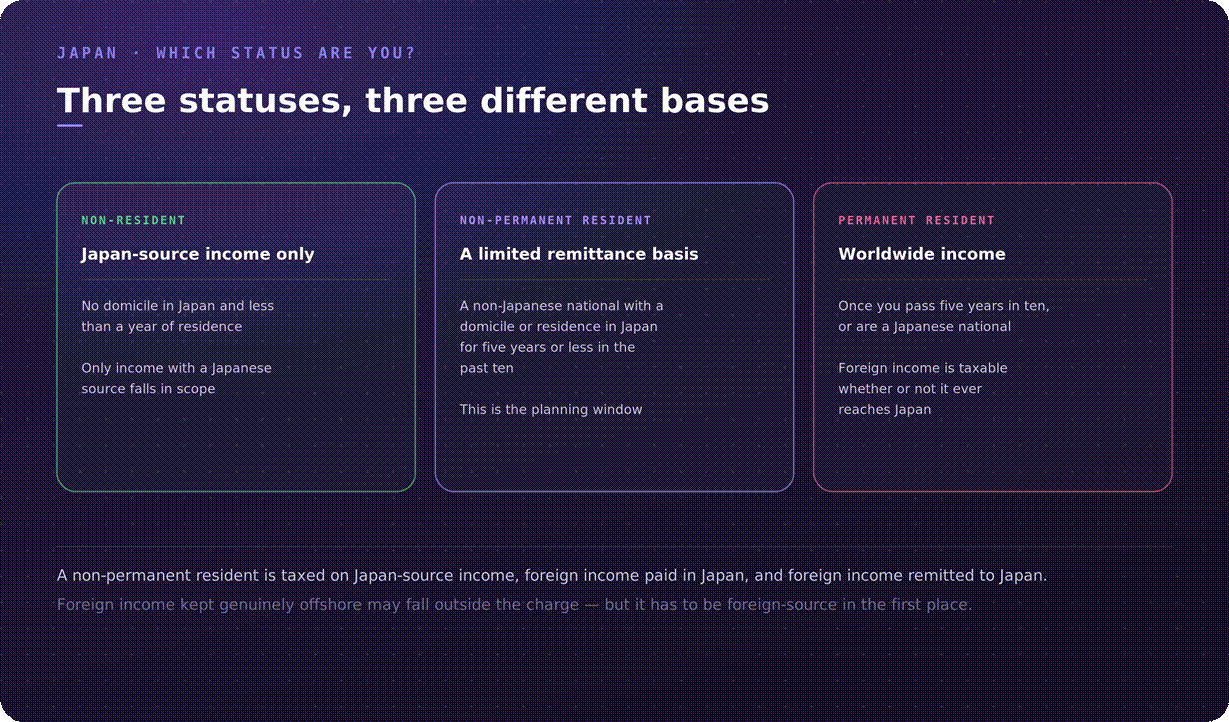
Which status you hold decides what Japan can reach.
Residency comes first
Japan classifies individuals as residents or non-residents. You are generally treated as a resident if you have a domicile in Japan — meaning Japan is the principal base and centre of your life — or if you have had a residence in Japan for one year or more.
This is not settled by passport stamps alone. Accommodation, employment, family, business activities, assets and your intention to remain can all be relevant, and in some cases a person may be treated as having a Japanese domicile before completing a full year.
Establish the date your status changes. A move that begins as a short stay often develops into something longer. The point at which you become resident, and later cease to be non-permanent, both need identifying in advance rather than in hindsight.
What a non-permanent resident is
A non-permanent resident is generally a non-Japanese national who has had a domicile or residence in Japan for five years or less within the preceding ten years.
You can be a Japanese tax resident and a non-permanent resident at the same time — the two are not contradictory. You may become resident after establishing a domicile or residing in Japan for around a year, and then qualify as non-permanent until you exceed five years within any ten-year window. After that, broader worldwide taxation applies.
The calculation is affected by earlier periods of residence and by nationality, so review your history as a continuous timeline rather than by reference to your current status.
How the remittance basis works
The central feature is that certain foreign-source income may not be taxed in Japan if it is neither paid in Japan nor remitted to Japan while you qualify as a non-permanent resident.
Your status | What Japan taxes |
Non-resident | Japan-source income only |
Non-permanent resident | Japan-source income |
Non-permanent resident | Foreign income paid in Japan |
Non-permanent resident | Foreign income paid abroad and then remitted |
Resident (not non-permanent) | Worldwide income, wherever it is held |
Foreign-source income kept outside Japan may therefore fall outside the charge. But the income must genuinely be foreign-source in the first place, which is where most people go wrong.
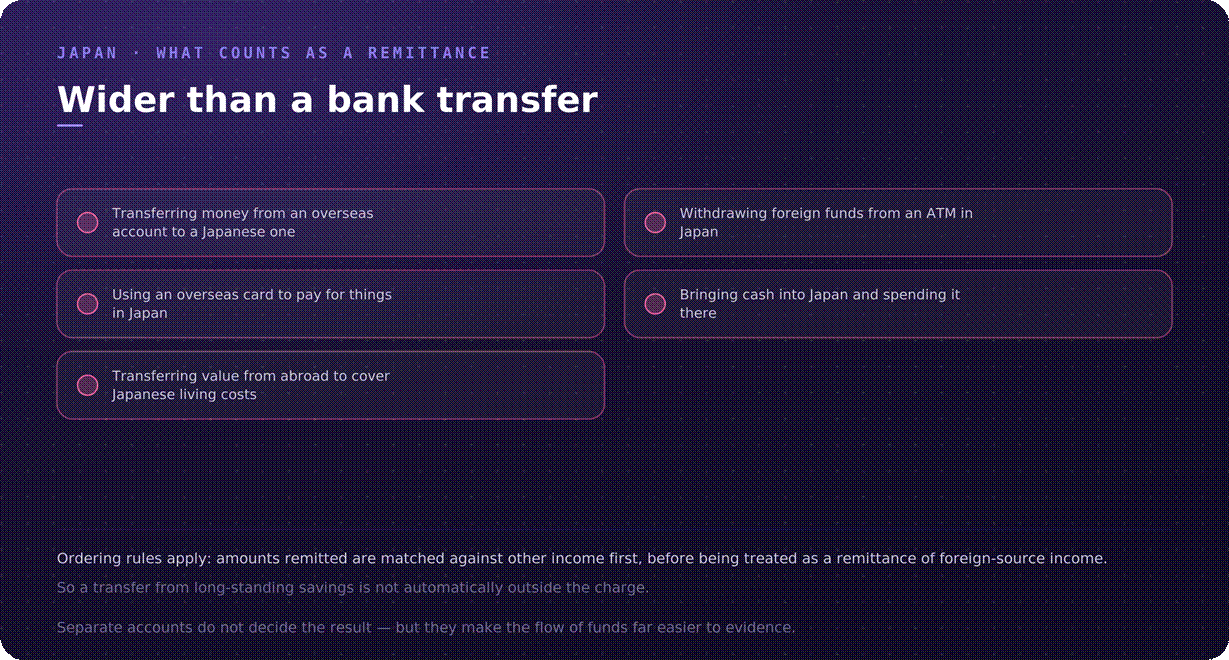
A remittance covers considerably more than a bank transfer.
Ordering rules apply. Japanese guidance indicates that amounts remitted from abroad are first matched against income other than foreign-source income paid abroad, before the balance is treated as a remittance of foreign-source income. So a transfer from long-standing savings is not automatically outside the charge.
Track the source and nature of each receipt, the date and location of payment, the account it was paid into, transfers between overseas and Japanese accounts, card spending and ATM withdrawals in Japan, and evidence of pre-existing savings.
Case study: Mark
Mark moves to Japan in April and qualifies as a non-permanent resident. He receives dividends from a foreign portfolio into an overseas account, keeps them offshore, and uses a separate Japanese salary for living costs.
In principle the dividends may remain outside Japanese taxation if they are foreign-source and are neither paid in Japan nor remitted. If he transfers them into Japan or uses them to fund Japanese expenses, the analysis changes. A separate account does not determine the result, but it makes the flow of funds far easier to document.
Remote work needs particular care
Where you physically perform your work carries real weight.
Case study: Felicity
Felicity works for a company based outside Japan, paid into a foreign bank account, then moves to Tokyo and performs all her work from there.
💡 The most important point in this article. Employment income is generally connected to where the services are performed. Work carried out physically in Japan may be Japanese-source income even where the employer and the bank account are overseas. The remittance basis is not a general exemption for offshore-paid income — the source has to be established first.
If you are a freelancer, consultant or remote employee, consider where the work is performed, whether you have a Japanese employer or business presence, whether your activities create a permanent establishment or other local obligation, whether your home-country rules continue to apply, and whether a treaty changes the result. Japan has an extensive treaty network, and treaty provisions can modify domestic outcomes.
Rates and other obligations
Japan's national individual income tax is progressive, with a top rate of 45%. That is a headline marginal rate, not a universal one.
The 45% is not the whole cost. Local inhabitant tax and the reconstruction income surtax apply alongside national income tax, with further charges outside all of them. Individual enterprise tax may also apply. Your total burden on high earnings is meaningfully above 45%.
Advance payments may also be required: if your liability reaches the relevant threshold you may receive estimated payment obligations for the following year, which belongs in your cash-flow planning.
Filing
Japan uses the calendar year. For residents required to file, the final return and payment are generally due by 15 March of the following year, with the filing period running from 16 February, subject to adjustment where the date falls on a weekend or public holiday.
Not every resident must file. Some employment income is settled through withholding and a year-end adjustment. Additional foreign income, freelance income, investment income or remittances may create an obligation.
Case study: Sarah
Sarah becomes a Japanese resident and qualifies as a non-permanent resident. She has foreign investment income, consulting income from work performed in Japan, and transfers funds from overseas to cover rent.
She should prepare a residence timeline, separate schedules of Japanese-source and foreign-source income, a record of overseas transfers and Japanese spending funded from abroad, evidence supporting the source of investment income, details of tax withheld in Japan or overseas, and the information needed to assess treaty relief or foreign tax credits.
A practical approach
1. Map your residence history and establish which status applies;
2. Classify your income, separating Japanese-source from genuinely foreign-source;
3. Review where your work is physically performed — offshore payment proves nothing;
4. Plan your banking flows and identify which funds will be transferred or spent in Japan;
5. Keep contemporaneous records rather than reconstructing them at the deadline;
6. Check treaty protection where another country may also tax you;
7. Prepare for advance payments if estimated obligations may arise; and
8. Take advice covering residence status, income source and remittance history together.
Frequently asked questions
How long does non-permanent resident status last?
Up to five years of domicile or residence in Japan within any preceding ten-year period. Once you exceed that, worldwide taxation applies. The window is measured across ten years, not from your arrival date.
Does it apply to Japanese nationals?
No. The status is for non-Japanese nationals. A Japanese national who is resident is taxed on worldwide income from the outset.
My employer and bank account are abroad. Is my salary foreign-source?
Probably not, if you perform the work in Japan. Employment income generally follows where the duties are carried out, so remote work from Japan for an overseas employer can be Japanese-source regardless of where you are paid.
What counts as a remittance?
More than a bank transfer. ATM withdrawals in Japan from a foreign account, spending on an overseas card in Japan, bringing in cash, and transferring value to cover Japanese living costs can all count.
Can I remit my pre-move savings tax-free?
Not automatically. Ordering rules match remittances against other income first before treating the balance as foreign-source income, so evidence of what the funds actually are matters.
Is 45% really the top rate?
It is the top national rate. Local inhabitant tax and the reconstruction surtax apply on top, with further charges separate again, so the combined burden is higher.
When do I file?
The filing period generally runs from 16 February to 15 March following the calendar year end, with payment due by the same date.
Do I always have to file a return?
Not necessarily. Some employment income is dealt with through withholding and a year-end adjustment. Foreign income, freelance income, investment income or remittances commonly create a filing obligation.
Official sources and further reading
• National Tax Agency of Japan
• National Tax Agency guidance for individuals on income tax
Important information
This article is general information and does not constitute tax, legal, immigration or financial advice, and does not create a client relationship. Tax outcomes depend on travel history, income sources, treaty status and the law applying to the relevant year. Rates, thresholds and regimes change, and some measures described may be proposed rather than enacted; this article reflects our understanding as at the date of publication. Obtain advice from a suitably qualified professional before acting or refraining from action.
