
Jordan taxes only income arising in or from Jordan, for residents and non-residents alike. A resident family can shelter JOD 23,000 of that before any rate applies, and dividends carry no withholding at all.
Jordan is territorial, and unusually clearly so. Any income incurred in or from Jordan, for any person, regardless of the place of payment, is subject to tax in Jordan — and residents and non-residents alike are taxed only on income sourced in Jordan.
Foreign income is therefore outside the charge. That puts Jordan in the same category as Guatemala and Costa Rica rather than with most of its regional neighbours.
The rate structure is progressive but the early bands are narrow and cheap: 5%, 10%, 15% and 20% on successive slices of JOD 5,000, then 25% from JOD 20,000 all the way to JOD 1,000,000, and 30% above that. A 1% national contribution tax applies to annual taxable income above JOD 200,000.
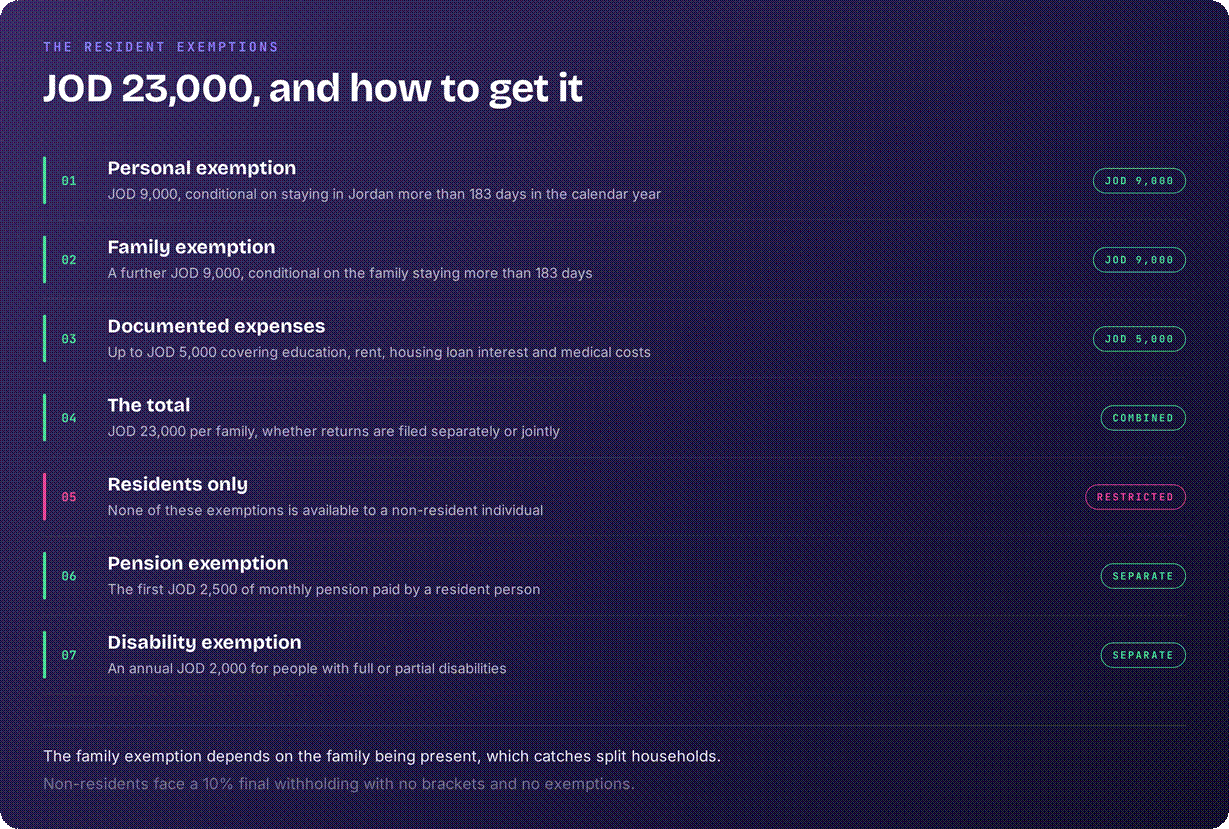
Every condition for the resident exemptions.
Your residency status is the first step
A resident natural person is one who has effectively resided in the Kingdom for not less than 183 days during the tax period, whether consecutively or sporadically. Residence also attaches to a Jordanian working for the government or a public corporation outside the Kingdom for any period in the tax period.
Because the system is territorial, residence does not change the scope of the charge. What it changes is access to the exemptions and the method of collection.
Maintain accurate records of:
• Days effectively resided in Jordan during the tax period;
• Where each item of income arises, since source is the whole test;
• Whether your family resides in Jordan for more than 183 days, for the family exemption;
• Documented educational, rental, housing loan interest and medical expenses;
• Registration with the Department and your tax identification number; and
• Any withholding suffered at source, which is a payment on account.
The tax rates
Taxable income (JOD) | Rate |
First 5,000 | 5% |
Second 5,000 | 10% |
Third 5,000 | 15% |
Fourth 5,000 | 20% |
Over 20,000 to 1,000,000 | 25% |
Above 1,000,000 | 30% |
National contribution tax above JOD 200,000 | A further 1% |
Non-residents | 10% withheld, a final tax in ordinary cases |
Non-residents are treated simply. 10% is withheld from non-exempt income arising in Jordan and treated as a final tax in ordinary cases, with no brackets and no personal or family exemptions, since those attach to the resident individual. Real estate disposals, registered business activity and share disposals may be treated differently.
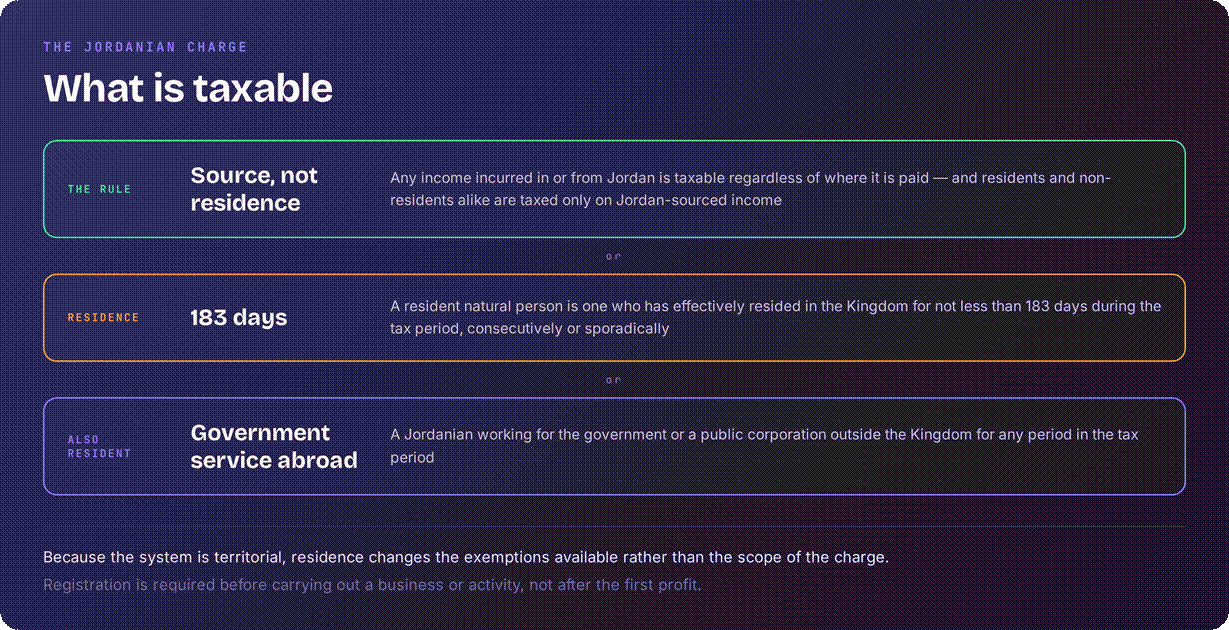
What brings you into the Jordanian charge.
The exemptions
A resident can shelter a substantial amount before any rate applies:
• A personal exemption of JOD 9,000, provided the individual stays in Jordan for more than 183 days during the calendar year, continuously or interrupted;
• A family exemption of JOD 9,000, provided the family stays in Jordan for more than 183 days on the same basis; and
• Up to JOD 5,000 of documented deductible expenses covering educational expenses, rental cost, interest on housing loans and medical expenses.
That totals JOD 23,000 per family, and it applies whether the couple files separately or jointly. These exemptions are awarded to the resident person only — a non-resident gets none of them.
Separately, the first JOD 2,500 of monthly pension paid by a resident person is exempt, and an annual exemption of JOD 2,000 applies for people with full or partial disabilities.
What makes Jordan attractive
The combination is better than the 30% headline implies:
• Territorial taxation for residents and non-residents alike, so foreign income is outside the charge;
• JOD 23,000 of exemptions per resident family before any rate applies;
• No withholding tax on dividends, in cash or in kind, resident or non-resident;
• A 25% band running from JOD 20,000 to JOD 1,000,000, so the 30% top rate is genuinely remote;
• The first JOD 2,500 of monthly pension from a resident person exempt;
• Non-resident treatment as a simple 10% final withholding; and
• A clean 183-day residence test with no investment or property requirement.
The honest qualification is that the 1% national contribution tax applies above JOD 200,000, and that the exemptions depend on both you and your family being present for more than 183 days — a condition that catches split households.
Case study: Rania and the family exemption
Rania works in Amman and earns JOD 40,000. Her husband and children live in Jordan with her throughout the year, and she has documented rental and medical expenses.
She claims the JOD 9,000 personal exemption, the JOD 9,000 family exemption and JOD 5,000 of deductible expenses — JOD 23,000 in total. Only JOD 17,000 of her income reaches the bands at all, taxed at 5%, 10%, 15% and 20% on successive slices of JOD 5,000.
Had her family remained abroad, the JOD 9,000 family exemption would not be available, because it is conditional on the family staying in Jordan for more than 183 days.
Filing and the compliance calendar
Registration comes first. Every resident person whose income is taxable must register with the Department and obtain a tax identification number before carrying out their business or activity, not after the first profit arrives. The return and balancing payment are due within four months of the end of the tax period.
Where a legal person withheld 5% on paying a service fee, that is a payment on account rather than a final tax and is credited against the assessment.
Source decides everything
Consider:
• That only income incurred in or from Jordan is taxable, for anybody;
• That residence changes the exemptions, not the scope;
• Whether your family will be present for more than 183 days;
• That JOD 23,000 is available per family, not per person;
• That dividends carry no withholding at all;
• That older 7%, 14% and 20% brackets are wrong; and
• That registration is required before activity begins, not after.
Your Jordan checklist
1. Establish the source of every item of income;
2. Count days effectively resided in Jordan during the tax period;
3. Check whether your family will be present for more than 183 days;
4. Claim the JOD 9,000 personal and JOD 9,000 family exemptions;
5. Document education, rent, housing loan interest and medical costs;
6. Discard any guidance quoting 7%, 14% or 20% brackets;
7. Note that dividends carry no withholding at all;
8. Register with the Department before beginning any activity;
9. Treat 5% withheld on service fees as a payment on account; and
10. File within four months of the end of the tax period.
Frequently asked questions
Does Jordan tax foreign income?
No. Any income incurred in or from Jordan is taxed regardless of where it is paid, and residents and non-residents alike are taxed only on Jordan-sourced income. Foreign income is outside the charge.
What are the rates?
5%, 10%, 15% and 20% on successive slices of JOD 5,000, then 25% from JOD 20,000 to JOD 1,000,000 and 30% above. A 1% national contribution tax applies to annual taxable income above JOD 200,000.
What exemptions can a resident claim?
A JOD 9,000 personal exemption, a JOD 9,000 family exemption and up to JOD 5,000 of documented expenses covering education, rent, housing loan interest and medical costs — JOD 23,000 per family, whether filing separately or jointly.
Are dividends taxed?
In-kind and in-cash dividends are not subject to withholding tax, whether paid to a resident or a non-resident party. That is unusual and materially valuable for anyone holding shares in Jordanian companies.
How are non-residents taxed?
10% is withheld from non-exempt income arising in Jordan and treated as a final tax in ordinary cases, with no brackets and no personal or family exemptions. Real estate disposals, registered business activity and share disposals may differ.
How do I become tax resident?
By effectively residing in the Kingdom for not less than 183 days during the tax period, consecutively or sporadically. A Jordanian working for the government or a public corporation abroad is also resident.
Why do some guides show different rates?
Because they are out of date. Rates of 7%, 14% and 20% belong to the pre-2018 brackets, replaced by Law No. 38 of 2018 with effect from 1 January 2019. Any calculation built on them is wrong.
When do I register and file?
Registration must happen before carrying out your business or activity, not after the first profit. The return and balancing payment are due within four months of the end of the tax period.
Official sources and further reading
Important information
This article is general information and does not constitute tax, legal, immigration or financial advice, and does not create a client relationship. Tax outcomes depend on travel history, income sources, treaty status and the law applying to the relevant year. Rates, thresholds and regimes change, and some measures described may be proposed rather than enacted; this article reflects our understanding as at the date of publication. Obtain advice from a suitably qualified professional before acting or refraining from action.
