
Kenya has three residence tests and only one of them counts days the way you would expect. A home available to you plus a single day of presence is enough.
Anyone building a day-tracking habit around the number 183 will get Kenya wrong. The definition in section 2 of the Income Tax Act, Cap 470 contains three alternative limbs, and the first one does not involve a meaningful day count at all.
You are resident if you have a permanent home in Kenya and were present in the country for any period during the year of income. Not 183 days. Any period. One day, if the home is there.
Only if there is no permanent home do the arithmetic tests come into play: presence for 183 days or more in the year, or presence in the year plus each of the two preceding years averaging more than 122 days a year.
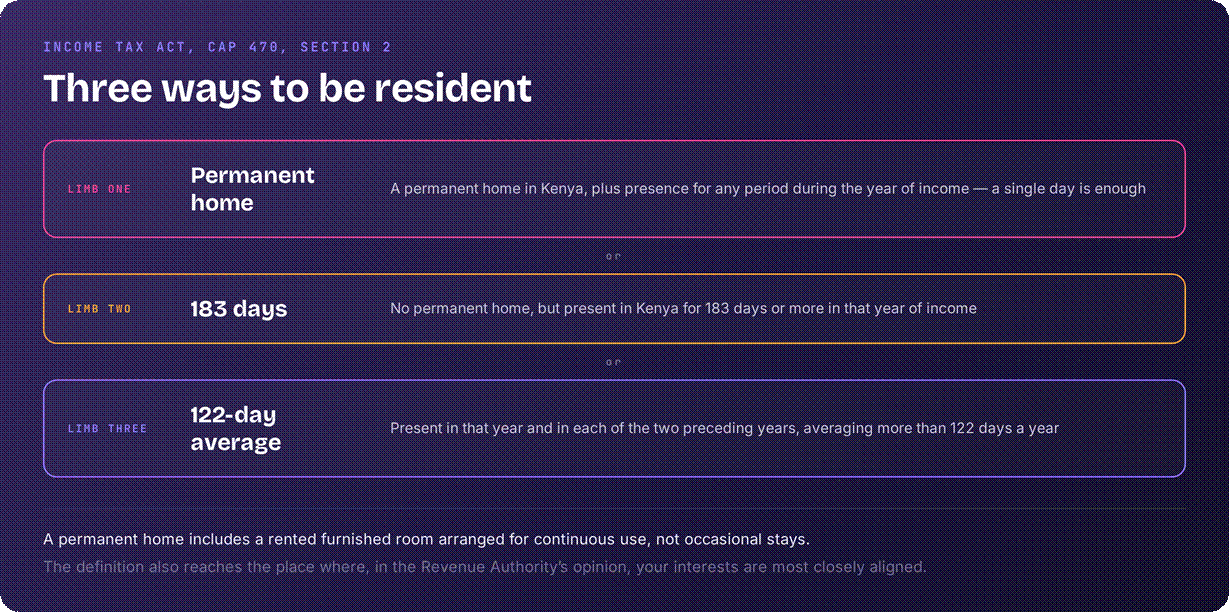
Only one of the three limbs involves the day count people track.
Your residency status is the first step
The permanent home limb is the one that surprises people, and the Finance Act 2022 made it wider rather than narrower. A permanent home means a place where you reside, or a place available to you for residential purposes in Kenya — a house, an apartment, or a rented furnished room, owned or rented.
What matters is permanence in the sense of arrangement rather than ownership. The dwelling must be set up for continuous use. Occasional stays for business, leisure, educational travel or a short course do not create a permanent home on their own.
The averaging test catches a different pattern. Someone spending four months a year in Kenya over three consecutive years never approaches 183 days in any single year, but comfortably exceeds an average of 122. It is assessed looking backwards, so residence can crystallise in a year when nothing about your behaviour changed.
Maintain accurate records of:
• Arrival and departure dates for the current year and the two preceding ones;
• Whether any dwelling in Kenya was continuously available to you, and from when;
• Lease start and end dates, and whether the property was furnished;
• Where your personal and economic interests are centred;
• Workdays physically performed in Kenya; and
• Any other country that may also treat you as resident.
What Kenya taxes once you are resident
Kenya charges tax on income accrued in or derived from Kenya. For employment income, the charge extends further: a resident is taxable on employment income wherever it is earned, which is a wider reach than the general source rule suggests.
Income | Kenyan treatment for a resident |
Employment income earned in Kenya | Taxable |
Employment income earned abroad | Taxable for residents |
Business income from Kenyan operations | Taxable |
Rent from Kenyan property | Taxable |
Gains on Kenyan property and shares | Capital gains tax at 15% |
Foreign investment income | Generally outside the charge |
Income of non-residents | Kenyan-source only, at 30% with no personal relief |
The employment income point matters for remote workers. Someone who becomes Kenyan resident — perhaps through the permanent home limb, without ever intending to — and continues drawing a salary from an overseas employer is within the Kenyan charge on that salary.
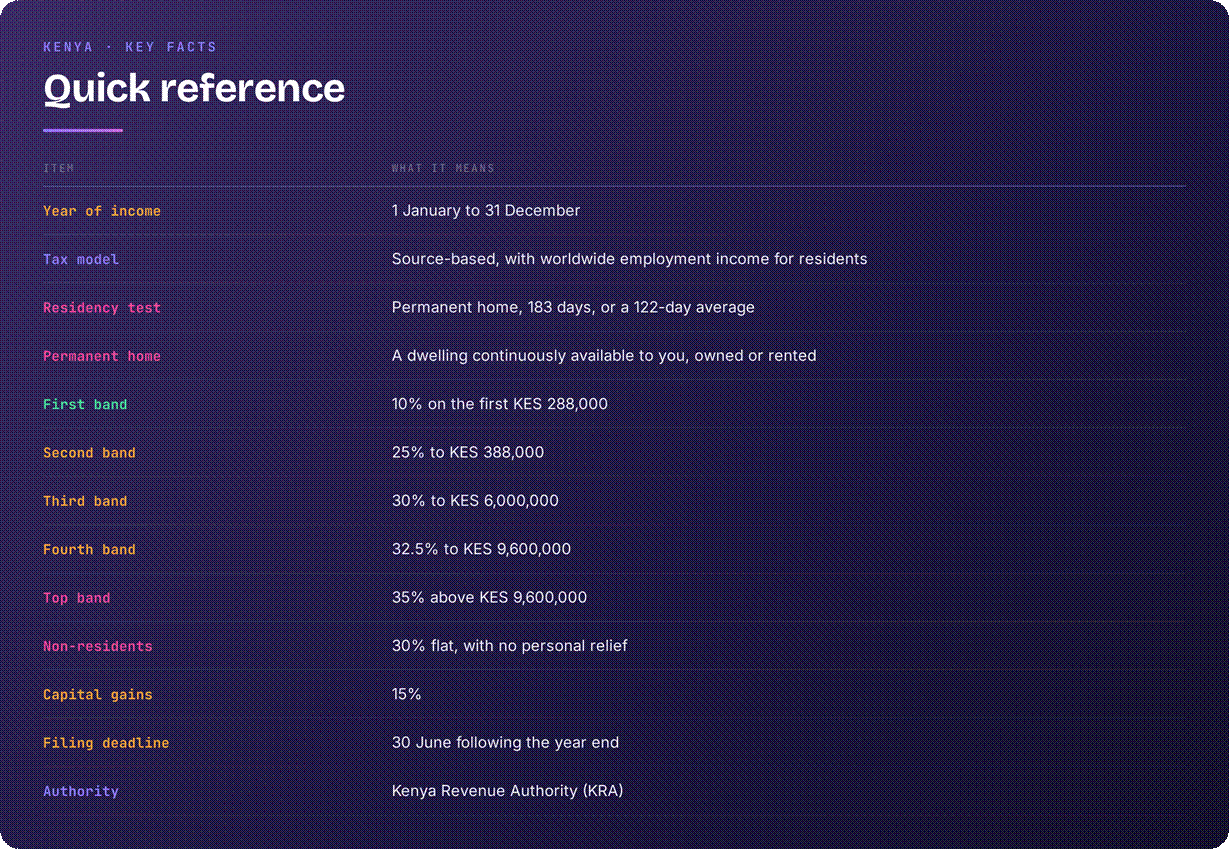
The Kenyan position at a glance.
The tax rates
Kenya applies a progressive scale with a top rate of 35%, introduced for the highest band. The annual bands run 10% on the first KES 288,000, 25% to KES 388,000, 30% to KES 6,000,000, 32.5% to KES 9,600,000, and 35% above that. A personal relief is available to residents and not to non-residents.
Non-residents are taxed at a flat 30% on Kenyan-source income with no personal relief, so the resident position is not automatically the worse one. Capital gains are charged at 15%, and withholding applies to dividends, interest and royalties at rates that a treaty may reduce — though Kenya’s treaty network is narrow.
Case study: Aisha never counted 183 days
Aisha runs a regional consultancy and keeps a serviced apartment in Nairobi on a rolling annual lease, because flying in and out of hotels became tedious. She spends roughly ninety days a year in Kenya and the rest across three other countries.
She has never approached 183 days in a year and believed that settled the question. It does not. The apartment is continuously available to her, which is capable of being a permanent home, and she was present during the year. On that basis she can be Kenyan resident, and her worldwide employment income falls inside the charge.
She would also meet the averaging test, at ninety days a year across three years, if the home argument failed. Two of the three limbs catch her, and the one she was tracking catches nobody.
Filing and the compliance calendar
The Kenyan year of income follows the calendar year. The annual self-assessment return is due by 30 June of the following year, filed through the Revenue Authority’s online system. A KRA PIN is required first, and employers are obliged to ensure employees hold one.
Employment income is taxed monthly through PAYE, and the annual return reconciles it. Taxpayers with business or rental income have their own instalment obligations during the year.
The Finance Act 2025 also broadened the Revenue Authority’s powers to collect from non-residents by requiring third parties who hold or owe money to a non-resident to pay it over. That makes an unresolved Kenyan residence position harder to simply leave behind.
Timing matters less than accommodation
Model your position before you commit to a base, considering:
• Whether any Kenyan dwelling is continuously available to you;
• Whether a rolling lease could be replaced with genuinely occasional accommodation;
• Your day counts for the current year and the two preceding years;
• Whether the 122-day average catches you even if 183 days does not;
• Whether your employment income would fall into the Kenyan charge;
• Whether a treaty exists with your other country, since the network is narrow; and
• What the non-resident 30% position would look like by comparison.
Your Kenya checklist
1. Establish whether any Kenyan dwelling is continuously available to you;
2. Check lease arrangements before assuming occasional-stay treatment;
3. Count days for the current year and each of the two preceding years;
4. Test the 122-day average separately from the 183-day threshold;
5. Consider where your personal and economic interests are centred;
6. Assume worldwide employment income is in charge once resident;
7. Compare the resident position against the flat 30% non-resident charge;
8. Register for a KRA PIN before any filing obligation arises;
9. Diarise the 30 June self-assessment deadline; and
10. Check whether a treaty exists with your other country of residence.
Frequently asked questions
Is 183 days the Kenyan residence test?
It is only one of three alternatives, and not the one that catches most people. If you have a permanent home in Kenya and were present for any period during the year, you are resident regardless of the day count.
What counts as a permanent home?
A place where you reside, or one available to you for residential purposes — a house, an apartment or a rented furnished room, owned or rented. It must be arranged for continuous use; occasional stays for business, leisure or study do not create one.
How does the 122-day test work?
You are resident if you were present in Kenya in the year of income and in each of the two preceding years, for periods averaging more than 122 days a year. It looks backwards, so residence can arise in a year when nothing about your pattern changed.
Does Kenya tax my foreign salary?
For residents, employment income is taxable wherever it is earned. That is wider than the general source rule and it catches remote workers who became resident without intending to.
What is the top rate?
35%, applying to annual income above KES 9,600,000, with bands beneath it at 10%, 25%, 30% and 32.5%. Residents can claim a personal relief; non-residents cannot.
Is being non-resident always better?
Not necessarily. Non-residents pay a flat 30% on Kenyan-source income with no personal relief, so someone with modest Kenyan income may be better off resident. The comparison is worth running rather than assuming.
When do I file?
The year of income follows the calendar year and the annual self-assessment return is due by 30 June of the following year, filed online. A KRA PIN is needed first.
Can I just leave if my residence position is unresolved?
It is harder than it was. The Finance Act 2025 broadened the Revenue Authority’s powers to require third parties holding or owing money to a non-resident to pay it over, which makes an unresolved position more likely to follow you.
Official sources and further reading
Important information
This article is general information and does not constitute tax, legal, immigration or financial advice, and does not create a client relationship. Tax outcomes depend on travel history, income sources, treaty status and the law applying to the relevant year. Rates, thresholds and regimes change, and some measures described may be proposed rather than enacted; this article reflects our understanding as at the date of publication. Obtain advice from a suitably qualified professional before acting or refraining from action.
