
Kosovo has the lowest top rate of personal income tax anywhere in Europe, a flat 10% corporate rate to match, and it uses the euro without being in the eurozone. For a remote worker or a small business owner the arithmetic looks very attractive, and for the right income profile it is.
Start by discarding the table you have probably already seen. Kosovo amended its personal income tax bands in 2024. The four-band structure running 0%, 4%, 8% and 10%, with a tax-free threshold of €960 a year, no longer applies — but it is still reproduced across most international tax summaries and comparison sites. If the figure €960 appears anywhere in what you are reading, the source is out of date.
This guide covers the current bands, how residence is determined, what the worldwide basis actually means in a country with no special regimes, the treaty position, and the practical recognition problem that sits behind treaty claims.
The bands, as they stand
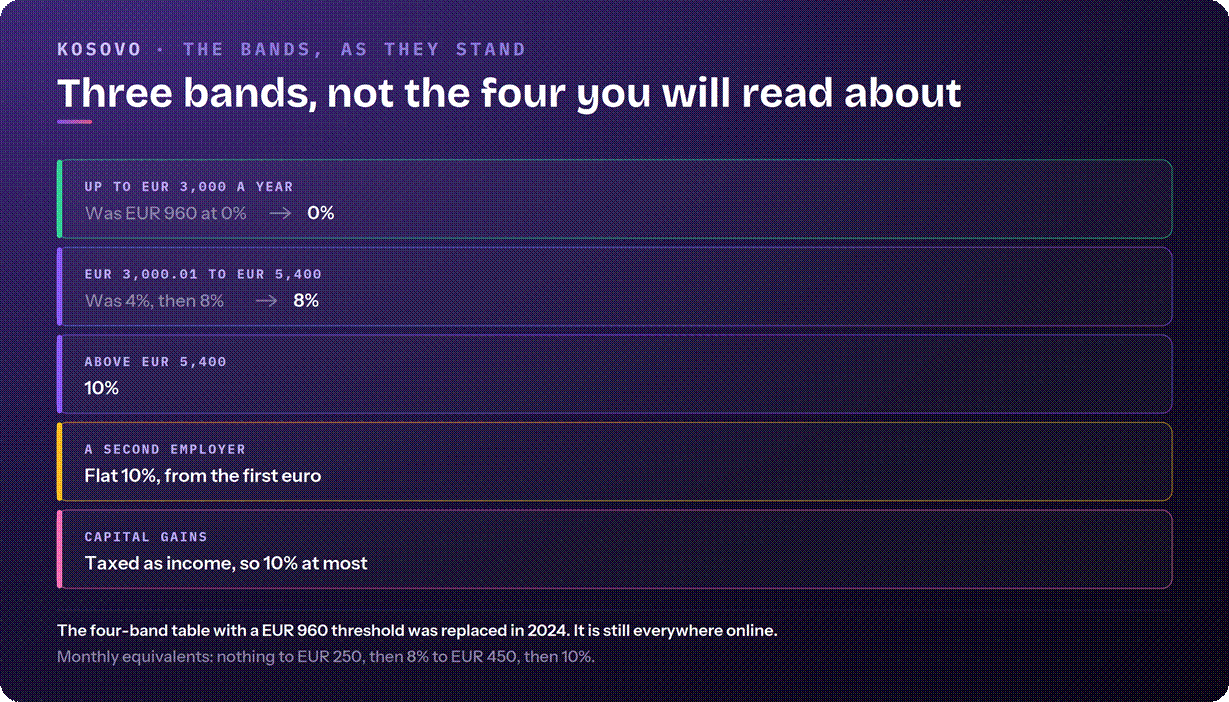
Three bands since the 2024 amendment, not the four still published elsewhere.
The zero-rate band now covers the first €3,000 of annual gross income, equivalent to €250 a month. Income between €3,000.01 and €5,400 is taxed at 8%, and everything above €5,400 at 10%. The upper-band rates apply only to income within each band, so the effective rate on a typical salary is materially below 10%.
A second employer is taxed differently. Wages from a primary employer are taxed through the progressive bands. Wages from a secondary employer are withheld at a flat 10% from the first euro, with no zero-rate band. If you hold two engagements, the arithmetic is not what the headline table implies.
Capital gains are taxed as ordinary income, so they fall within the same bands and top out at 10%. VAT is 18% standard with an 8% reduced rate. Corporate income tax is a flat 10%.
Self-employment and small business
Kosovo runs a two-track system for individual business income. Below a statutory annual turnover threshold, tax is charged on gross turnover rather than profit — broadly 3% for trade, production, transport and similar activities, and 9% for services and professional activities. Above the threshold, or by election, the taxpayer moves to real-income taxation at the ordinary rates.
Check the threshold before you plan around it. The published turnover figure differs between sources, and the tax administration’s own guidance has moved. Confirm the current threshold with ATK directly rather than relying on a comparison site — the difference between gross-turnover and real-income taxation is large enough to change which structure makes sense.
For a consultant billing foreign clients, the 9% gross-turnover rate is deceptively simple. It is charged on receipts with no deduction for costs, so a business with meaningful expenses can pay more under it than under real-income taxation at 10%. Model both.
How you become resident
An individual is treated as Kosovo tax resident where they have a principal residence in Kosovo, or where they are present in Kosovo for 183 days or more in the tax period. The tax period is the calendar year. Centre-of-interests factors — significant personal, financial and social connections — also feed into the assessment.
Residents are taxed on income with a source in Kosovo and outside Kosovo. Non-residents are taxed only on Kosovo-source income.
What the worldwide basis really means here
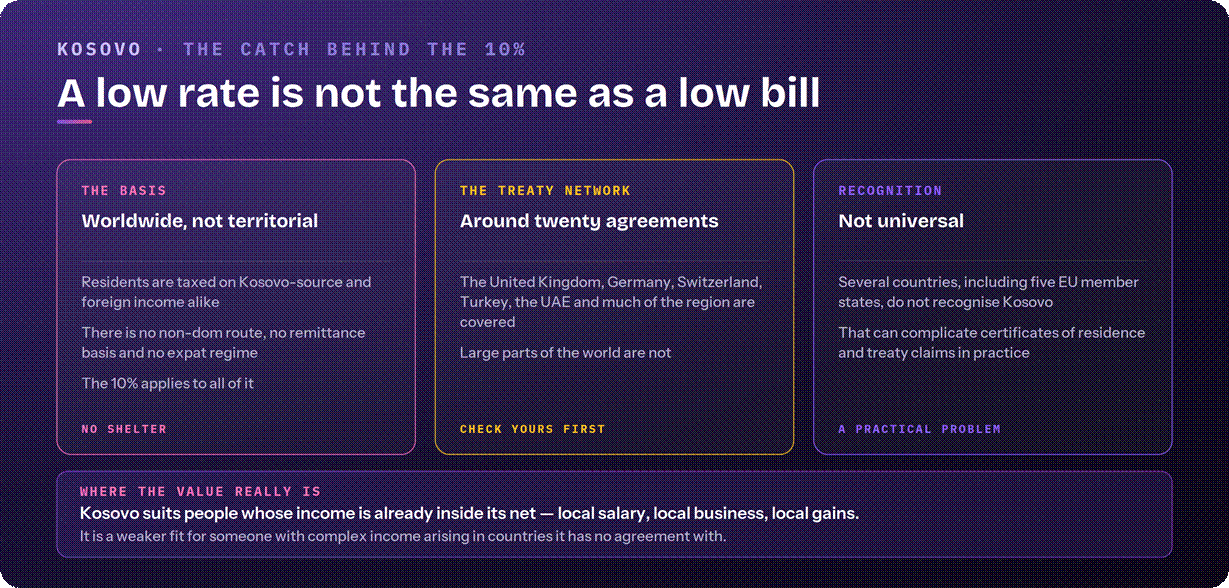
A low rate applied to everything is a different proposition from a low rate applied to some of it.
This is the point that separates Kosovo from the jurisdictions it is often compared against. There is no non-dom status, no remittance basis, no impatriate regime, no time-limited exemption for new arrivals and no territorial carve-out. Whatever you earn, wherever it arises, falls within the same bands from the year you become resident.
That makes Kosovo unusually clean, and unusually inflexible. There is nothing to structure around and nothing to lose by getting a filing wrong. But there is also no mechanism that shelters foreign investment income, foreign rental income or a foreign business — all of it is simply taxed. Compare that honestly against a higher-rate country with a regime you would actually qualify for.
Treaties and the recognition problem
Kosovo has around twenty double taxation agreements in force, covering the United Kingdom, Germany, Switzerland, Turkey, the United Arab Emirates, Austria, Hungary and much of the immediate region. For anyone whose other country of connection is on that list, the position is straightforward.
Outside it, two problems arise. The first is the ordinary one: no agreement means no tie-breaker for dual residence and no treaty article compelling a credit. The second is particular to Kosovo.
Not every country recognises Kosovo as a state. Several do not, including five EU member states. That can complicate practical matters that treaty relief depends on — obtaining and having accepted a certificate of tax residence, for instance. It is rarely fatal, but it is a source of friction that does not arise elsewhere, and it is worth establishing in advance rather than discovering at the point of a claim.
Kosovo also uses the euro unilaterally, outside the eurozone and without a seat at the European Central Bank. For day-to-day purposes this is a convenience — no exchange risk against euro income, no currency conversion on most transactions. It is not the same as monetary union membership, and it does not carry EU banking or regulatory access with it.
Your checklist
• Use the current three-band table, not the pre-2024 structure with a €960 threshold;
• Count days in the calendar year, and watch the principal residence test separately;
• Accept that residence brings worldwide income into the charge, with no regime to soften it;
• If self-employed, model gross-turnover taxation against real-income taxation before choosing;
• Confirm the current turnover threshold directly with ATK;
• Remember a second employer withholds at a flat 10% from the first euro;
• Remember capital gains are taxed as ordinary income, so they top out at 10%;
• Check whether Kosovo has an agreement with each country your income arises in;
• Establish early whether those countries will accept a Kosovo residence certificate; and
• Take local advice on the year of arrival, since the whole year’s worldwide income may be in scope.
Frequently asked questions
Is Kosovo’s income tax really a flat 10%?
No. It is progressive, with three bands: 0% up to €3,000 a year, 8% to €5,400, and 10% above. 10% is the top marginal rate, not a flat rate, so the effective rate on most salaries is lower.
Why do other sites show a €960 threshold and a 4% band?
Because they have not been updated. Kosovo amended the bands in 2024, replacing the four-band structure. If you see €960, the source predates the change.
How many days make me tax resident?
183 days or more in the calendar year. You can also be resident by having a principal residence in Kosovo, and centre-of-interests factors are taken into account.
Does Kosovo tax my foreign income?
Yes. Residents are taxed on Kosovo-source and foreign income alike. There is no remittance basis, no non-dom route and no expat regime.
What about self-employment?
Below a statutory turnover threshold, tax is charged on gross turnover — broadly 3% for trade and production, 9% for services and professional work. Above it, or by election, real-income taxation applies at the ordinary rates. Confirm the current threshold with ATK.
How are capital gains taxed?
As ordinary income, so they fall within the same three bands and top out at 10%. There is no separate capital gains regime and no preferential rate for long holdings.
Does Kosovo have a treaty with my country?
There are around twenty agreements, including the UK, Germany, Switzerland, Turkey, the UAE and much of the region. Large parts of the world are not covered, so check yours specifically.
Does the recognition issue affect me in practice?
It can. Several countries, including five EU member states, do not recognise Kosovo, which may complicate acceptance of a Kosovo certificate of tax residence when claiming treaty relief. Establish the position before you need to rely on it.
Official sources and further reading
• Tax Administration of Kosovo (ATK) — general information on taxes
• Kosovo Investment and Enterprise Support Agency — taxation overview
Important information
This article is general information and does not constitute tax, legal, immigration or financial advice, and does not create a client relationship. Tax outcomes depend on travel history, income sources, treaty status and the law applying to the relevant year. Rates, thresholds and regimes change, and some measures described may be proposed rather than enacted; this article reflects our understanding as at the date of publication. Obtain advice from a suitably qualified professional before acting or refraining from action.
