
Kuwait charges individuals nothing. It also has no domestic residency test for expatriates — your status is determined by the terms of your own country’s treaty with Kuwait, which is unusual and consequential.
Kuwait applies one of the broadest zero-tax positions for individuals anywhere. There is no personal income tax, no capital gains tax on individuals, no wealth tax and no inheritance tax. Salary arrives without a domestic income tax charge of any kind, and there is no personal return to file.
What makes Kuwait genuinely distinctive is not the rate. It is how tax residency is established. Kuwait’s own submission to the OECD sets out the position in two lines: for Kuwaiti nationals, all Kuwaiti nationals are tax resident. For expatriates in Kuwait, residency is determined as per their country’s signed double taxation agreement with Kuwait.
Read that again, because it is not how most systems work. Kuwait does not apply a domestic day count, a permanent home test or a centre-of-interests analysis to expatriates. It defers entirely to the treaty. Your Kuwaiti tax residency is whatever Article 4 of the relevant agreement says it is.
Two consequences follow, and they run in opposite directions. If your country has a treaty with Kuwait, the treaty is the whole of the analysis. If it does not, there is no domestic test to fall back on — which leaves your position resting almost entirely on your former country’s rules.
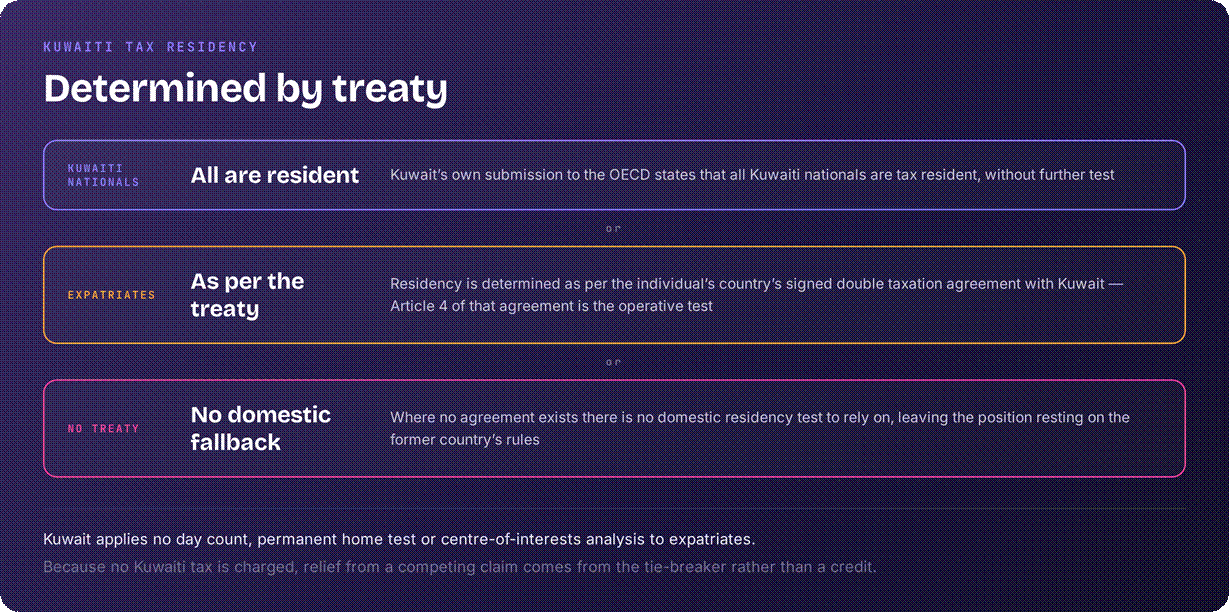
How residency is actually determined here.
What Kuwait does not charge
Every category of personal income sits outside the charge:
• Employment income, whether paid in Kuwait or from abroad;
• Self-employment and freelance earnings;
• Dividends, interest and investment distributions;
• Rental income;
• Pension income;
• Capital gains, on any asset; and
• Foreign-source income of any kind.
There is no wealth tax, no gift tax and no estate duty. No annual personal return exists, and no source analysis is required, because the origin of the income makes no difference to the Kuwaiti position.
The certificate of residence
Because Kuwait charges no income tax, the practical document that matters is not a tax return but a certificate of residence. It is what you produce to a foreign revenue authority to demonstrate where you are resident, and for a jurisdiction with no domestic residency test it carries unusual weight.
The certificate is issued by the Ministry of Finance, through the Tax Liability and Planning Department. Applications are made in person at the Ministries Complex in ElMerqab, Block 1, Building 14, first floor.
The documents required are:
• A copy of the civil ID;
• A copy of the passport, for residents;
• A copy of the work contract, for foreigners;
• A copy of the nationality certificate, for Kuwaiti citizens only;
• A power of attorney and the agent’s civil ID, where an agent acts; and
• The Beneficiary Data form and the Declaration form.
The fixed fee is nominal, at around 1 KD. The service is listed on Kuwait Government Online as Residence Certificates for Government Entities, Private Sector and Individuals.
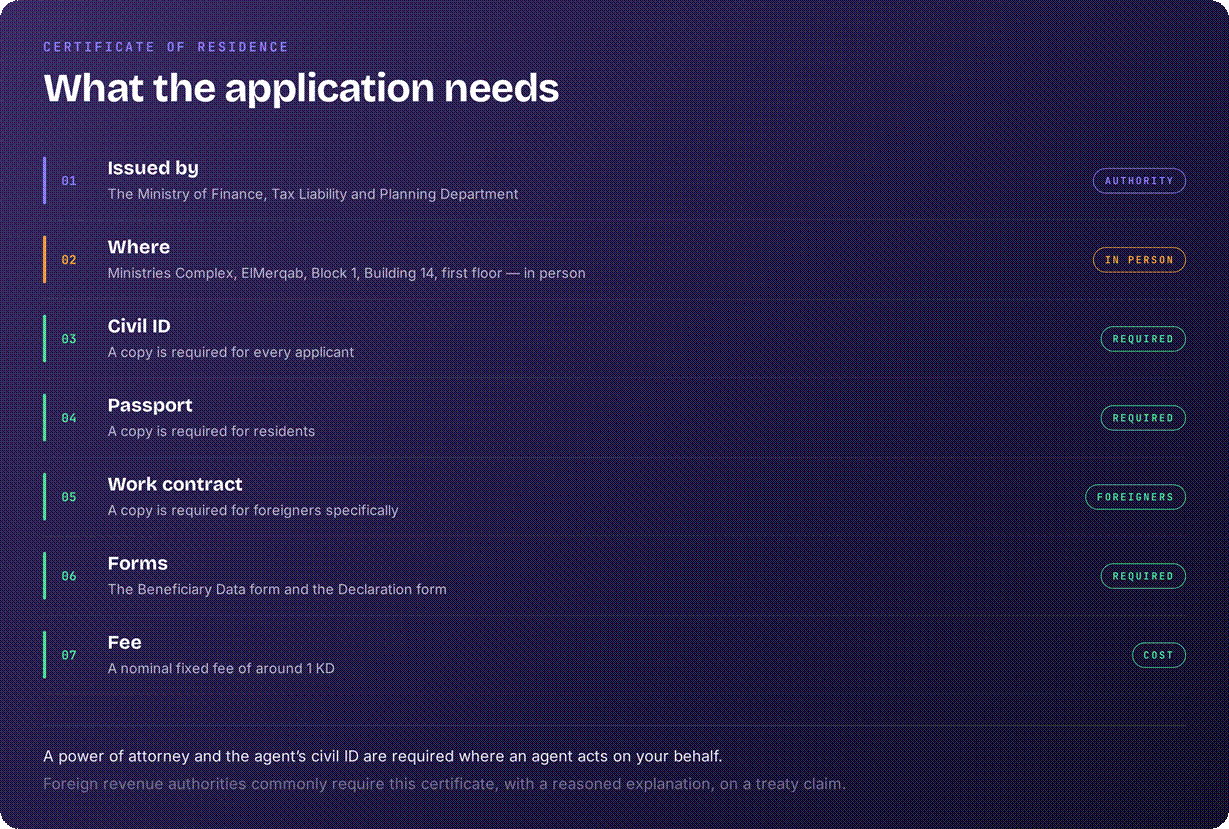
Everything the certificate application requires.
Why the certificate matters more here than elsewhere
This is not a formality. Several revenue authorities single out zero-tax jurisdictions for special certification on a double taxation claim, precisely because the usual evidence of residency does not exist.
A claim form will typically require two things together. A copy of the Kuwait certificate of residence must be enclosed. And the claimant must set out, in their own words, why they consider themselves resident in Kuwait — commonly addressing their nationality status and their total days of presence in Kuwait in the year concerned, since those are the factors Kuwait’s treaties tend to turn on.
The provision to read before making any claim is Article 4 of the specific agreement between Kuwait and the other country. That article defines who counts as a resident of each state, and in agreements with zero-tax jurisdictions it is often drafted differently from the standard model — sometimes by reference to nationality, sometimes to presence. Do not assume the wording matches another treaty you have seen.
The reason for the special treatment is straightforward. In a country that taxes income, residency is evidenced by the fact of being taxed. In Kuwait there is no such evidence, so the certificate and a reasoned explanation have to do the work instead.
The treaty network
Kuwait has concluded double taxation agreements with a substantial number of countries across Europe, Asia and the Middle East. That network is more valuable to a Kuwait resident than it would be elsewhere, precisely because it supplies the residency test that domestic law does not.
What a treaty gives you here:
• The definition of residence that actually applies to you, under Article 4;
• A tie-breaker where two countries both claim you;
• Allocation of taxing rights over employment income, pensions, directors’ fees and other categories;
• Reduced withholding at source on dividends, interest and royalties from the other state; and
• A mutual agreement procedure where a dispute arises.
What it cannot give you is a credit. Because Kuwait levies no personal income tax, there is never any Kuwaiti tax to set against a foreign assessment. Relief from a competing claim has to come from the tie-breaker, not from a credit — which is why the certificate and the supporting explanation matter so much.
Case study: Daniel and the claim he could not evidence
Daniel moves to Kuwait City from a country that taxes worldwide income, on a three-year contract. His Kuwaiti income tax is nil and there is nothing for him to file locally.
His former country continues to treat him as resident for the year of departure under its own statutory test, and he wants to claim relief under the treaty. He assumes his residence permit and employment contract will be enough.
They are not. The authority requires a copy of his Kuwait certificate of residence, together with a reasoned explanation of his position. Without the certificate the claim is incomplete — and obtaining one requires an in-person application in Kuwait that is considerably harder to arrange after he has left.
What makes Kuwait attractive
For the right person the case is very strong:
• No personal income tax on any category of income, local or foreign;
• No capital gains tax on individuals, on any asset;
• No wealth tax, gift tax or inheritance tax;
• No annual personal return and no source analysis;
• No domestic residency test to fall foul of as an expatriate;
• A substantial treaty network supplying the residency definition that applies to you; and
• A certificate of residence available from the Ministry of Finance at nominal cost.
The honest qualifications are that there is no Kuwaiti tax to credit abroad, that the absence of a domestic residency test cuts both ways, and that the certificate must be obtained in person — which is far easier to do while you are still living there.
Filing and the compliance calendar
For personal income there is nothing to file. What replaces the filing obligation is evidence, and the sensible approach is to build that evidence while it is easy to obtain.
Keep in good order:
• A current certificate of residence from the Ministry of Finance;
• Records of your total days of presence in Kuwait, year by year;
• Your employment contract and civil ID;
• Documentation of your permanent home and family location;
• The text of the treaty between Kuwait and your former country; and
• Copies of any claim forms submitted to a foreign revenue authority.
Get the certificate before you need it
Consider:
• That Kuwait charges individuals nothing on any category of income;
• That expatriate residency is determined by treaty, not by domestic law;
• That Article 4 of the relevant agreement is therefore the operative test;
• That without a treaty there is no domestic test to rely on;
• That a certificate of residence is the practical evidence of your status;
• That a foreign authority will want it alongside a reasoned explanation; and
• That obtaining it in person is much easier before you leave.
Your Kuwait checklist
1. Note that no statute charges individual income in Kuwait;
2. Establish whether your former country has a treaty with Kuwait;
3. Read Article 4 of that treaty — it is your residency test;
4. Recognise there is no domestic fallback if no treaty exists;
5. Apply for a certificate of residence while still in Kuwait;
6. Gather the civil ID, passport and work contract copies;
7. Complete the Beneficiary Data and Declaration forms;
8. Keep year-by-year records of days present in Kuwait;
9. Expect to explain your position, not just produce a document; and
10. Remember there is no Kuwaiti tax to credit against a foreign charge.
Frequently asked questions
Does Kuwait tax personal income?
No. There is no personal income tax, no capital gains tax on individuals, no wealth tax and no inheritance tax. There is no annual personal return and no source analysis required.
How is my tax residency determined?
By treaty. Kuwait’s submission to the OECD states that for expatriates, residency is determined as per their country’s signed double taxation agreement with Kuwait. Kuwait applies no domestic day count or permanent home test to expatriates.
What if my country has no treaty with Kuwait?
Then there is no domestic residency test to fall back on, and your position rests almost entirely on your former country’s rules. That makes the evidence of your actual circumstances more important, not less.
How do I get a certificate of residence?
In person at the Ministry of Finance, Tax Liability and Planning Department, at the Ministries Complex in ElMerqab, Block 1, Building 14, first floor. You need a copy of your civil ID, passport and work contract, plus the Beneficiary Data and Declaration forms, for a nominal fee of around 1 KD.
Why do foreign authorities ask for extra information?
Because Kuwait charges no income tax, there is no assessment or return to evidence your residency. A claim therefore usually requires the certificate plus a reasoned explanation of your position, commonly addressing nationality status and total days of presence in Kuwait.
Which article of the treaty matters?
Article 4, which defines who counts as a resident of each state. In agreements with zero-tax jurisdictions it is often drafted differently from the standard model — sometimes by reference to nationality, sometimes to presence — so read the specific agreement rather than assuming the wording.
Can I credit Kuwaiti tax against a foreign bill?
No, because none is charged. Relief from a competing residence claim has to come from the treaty tie-breaker rather than from a credit, which is why the certificate and supporting explanation carry so much weight.
When should I apply for the certificate?
While you are still living in Kuwait. The application must be made in person, which is considerably harder to arrange once you have left the country.
Official sources and further reading
Important information
This article is general information and does not constitute tax, legal, immigration or financial advice, and does not create a client relationship. Tax outcomes depend on travel history, income sources, treaty status and the law applying to the relevant year. Rates, thresholds and regimes change, and some measures described may be proposed rather than enacted; this article reflects our understanding as at the date of publication. Obtain advice from a suitably qualified professional before acting or refraining from action.
