
Lesotho has only two rates and no tax-free band at all. Relief comes through a non-refundable credit applied against the tax, a mechanism that behaves quite differently from an allowance.
Lesotho runs one of the shortest personal tax structures anywhere: two rates, 20% and 30%, and no tax-free band. The 20% applies from the first maloti of taxable income.
Relief arrives afterwards, as a non-refundable tax credit set against the tax calculated. From 1 April 2026 that credit is M1,020 per month, up from M970, and the lower monthly bracket rose to M6,480, up from M6,170.
The credit creates the effective tax-free point rather than a band doing it. At 20%, a credit of M1,020 absorbs the tax on roughly M5,100 of monthly income — below that, no tax is payable in practice.
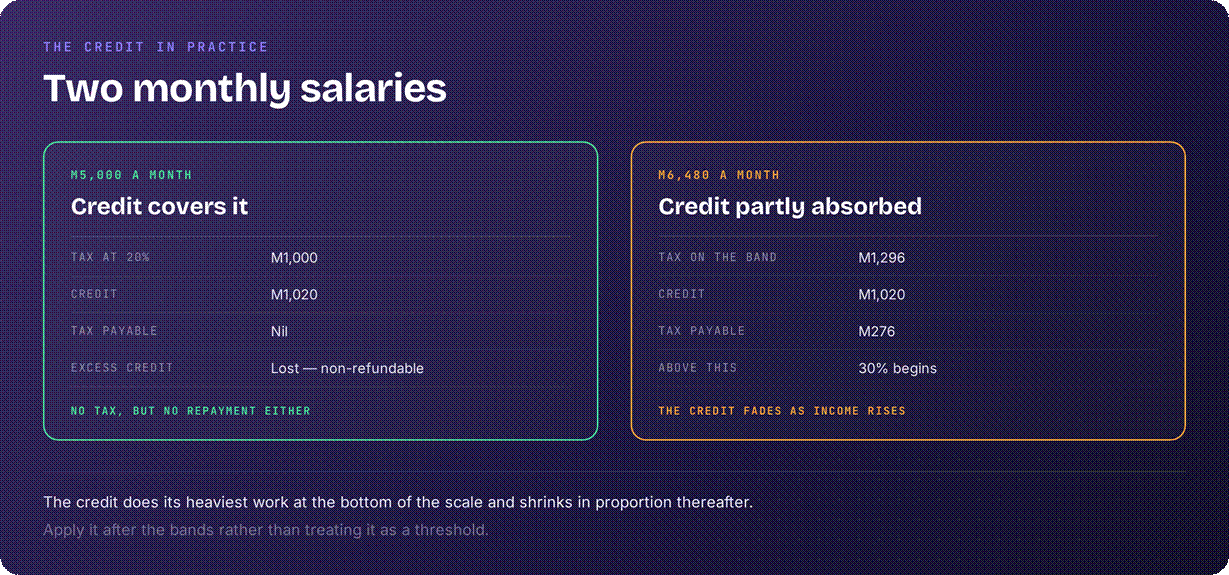
Where the credit helps, and where it fades.
How the calculation works
The structure is governed by Section 73 and the Second Schedule of the Income Tax Act No. 9 of 1993, updated each year by Income Tax (Amendment of Monetary Amounts) Regulations. For 2026/27 the amendment was published on 27 March 2026 as Legal Notice No. 24.
The monthly calculation runs:
• 20% on monthly income up to M6,480;
• 30% on monthly income above M6,480, after M1,296 of tax on the first band; then
• Deduct the M1,020 monthly credit from the resulting figure.
The same structure applies to resident individuals including sole traders for annual liabilities, and to employees and pensioners through PAYE.
Maintain accurate records of:
• Monthly income against the M6,480 bracket;
• Whether the credit has been applied, and only once;
• Any second employment, where credit handling needs checking;
• Your residence status, since the credit is for resident individuals;
• The regulations applying to the year in question; and
• The tax year, which runs April to March.
The tax rates
Item | Position from 1 April 2026 |
Lower monthly bracket | M6,480, taxed at 20% |
Previous lower bracket | M6,170 |
Tax on the first band | M1,296 |
Above the bracket | 30% |
Monthly tax credit | M1,020, non-refundable |
Previous credit | M970 |
Effective tax-free point | Around M5,100 a month |
Tax year | 1 April to 31 March |
Two rates is unusually few. Most systems in the region run four or five bands. The trade-off is that the jump from 20% to 30% happens at a single point rather than being spread, so the marginal position changes sharply at M6,480.
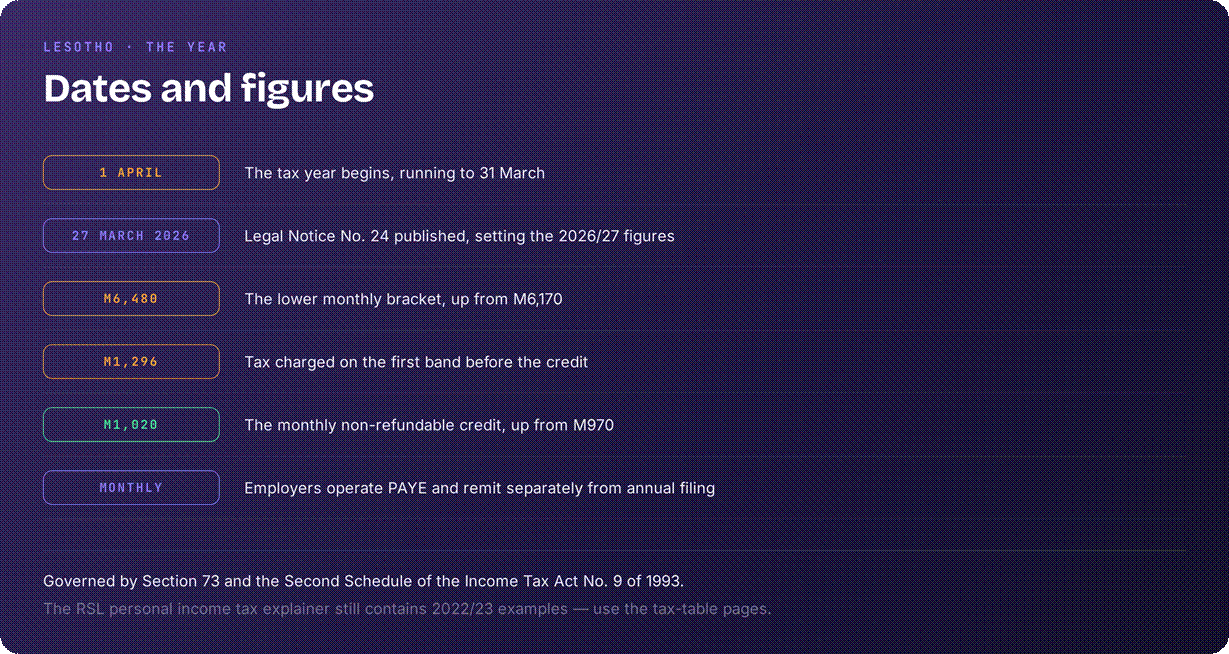
The year, and what changes when.
What makes Lesotho workable
The structure has genuine merits:
• Only two rates, which makes the position easy to model and hard to get wrong;
• A tax credit worth its full face value against the tax, rather than an allowance worth only the marginal rate;
• An effective tax-free point around M5,100 a month, created by the credit;
• A 30% top rate, moderate by regional standards, with no higher band above it;
• Annual updates through published Legal Notices, so changes are traceable; and
• A common monetary area arrangement with South Africa, giving currency stability.
The honest qualifications are that the credit is non-refundable, that the 30% rate engages at a low monthly figure, and that the Revenue Services Lesotho personal income tax explainer still carries older 2022/23 examples — so the current tax-table pages should be used instead.
Case study: where the credit runs out
Someone earning M5,000 a month faces 20% — M1,000 of tax. The credit of M1,020 exceeds that, so the tax is reduced to nil. Because the credit is non-refundable, the excess M20 is simply lost rather than repaid.
Someone on M6,480 faces M1,296 of tax, reduced by the credit to M276. Above that point the 30% rate begins and the credit becomes a progressively smaller proportion of the bill.
The credit therefore does its heaviest work at the bottom of the scale and fades quickly. Anyone modelling a Lesotho position should apply it after the bands rather than treating it as a threshold.
Filing and the compliance calendar
The tax year runs 1 April to 31 March, and the system is administered by Revenue Services Lesotho. Employers operate PAYE monthly; employees file annually where required, and employer remittance is a separate obligation from employee annual filing.
Prepare in good time:
• Registration with Revenue Services Lesotho;
• Payroll records showing the credit applied once;
• Confirmation of which year’s Legal Notice applies;
• Monthly income figures against the bracket;
• Details of any second employment; and
• The current tax-table pages rather than older explainer examples.
Apply the credit after the bands
Consider:
• That there is no tax-free band — 20% starts immediately;
• That the credit creates the effective tax-free point instead;
• That the credit is non-refundable, so excess is lost;
• That it applies once per eligible resident individual;
• That the bracket and credit both changed on 1 April 2026;
• That 30% engages at M6,480 a month; and
• That the RSL explainer page still shows older examples.
Your Lesotho checklist
1. Note there is no tax-free band;
2. Apply the 20% from the first maloti;
3. Deduct the credit after calculating the tax;
4. Remember the credit is non-refundable;
5. Apply it once per eligible resident individual;
6. Check the handling if you have a second employment;
7. Use the figures from the current year’s Legal Notice;
8. Note the bracket rose to M6,480 on 1 April 2026;
9. Note the credit rose to M1,020 at the same time; and
10. Use the RSL tax-table pages, not the older explainer.
Frequently asked questions
Does Lesotho have a tax-free band?
No. The 20% rate applies from the first maloti. What creates an effective tax-free point is a non-refundable tax credit applied against the tax calculated, currently M1,020 a month.
What are the rates?
Two only — 20% on monthly income up to M6,480, and 30% above that after M1,296 of tax on the first band. The credit is then deducted from the result.
What changed in April 2026?
The lower monthly bracket rose from M6,170 to M6,480 and the monthly non-refundable credit rose from M970 to M1,020, under Legal Notice No. 24 published on 27 March 2026.
What does non-refundable mean here?
The credit can reduce the tax to nil but never produces a repayment. Someone whose tax is below the credit simply pays nothing — the unused portion is lost rather than refunded.
What is the effective tax-free point?
Around M5,100 a month. At 20%, that level of income produces roughly M1,020 of tax, which the credit absorbs entirely.
Can I claim the credit twice?
No. It is applied once per eligible resident individual in the payroll calculation, so anyone with a second employment should check how it is being handled across both.
When does the tax year run?
1 April to 31 March. The monetary amounts are updated each year by Income Tax (Amendment of Monetary Amounts) Regulations published shortly before.
Where should I check current figures?
The Revenue Services Lesotho tax-table and PAYE pages. The RSL personal income tax explainer still contains older 2022/23 examples, so it should not be used for current rates.
Official sources and further reading
Important information
This article is general information and does not constitute tax, legal, immigration or financial advice, and does not create a client relationship. Tax outcomes depend on travel history, income sources, treaty status and the law applying to the relevant year. Rates, thresholds and regimes change, and some measures described may be proposed rather than enacted; this article reflects our understanding as at the date of publication. Obtain advice from a suitably qualified professional before acting or refraining from action.
