
Lithuania replaced a two-rate system with three on 1 January 2026, and started pooling almost every kind of income before applying them. The second change matters more than the first.
On 26 June 2025 the Lithuanian Parliament approved amendments introducing three progressive rates in place of two. From 1 January 2026, personal income tax runs at 20%, 25% and 32% rather than 20% and 32%.
The new middle band softens a cliff. Under the old structure, income crossing the threshold jumped straight from 20% to 32%; the 25% band now sits between them, which reduces the burden for people in the range the cliff used to hit hardest.
The more consequential change is structural. From 2026 Lithuania applies full income aggregation — salary, bonuses, self-employment income, rental income, investment income and certain capital gains are combined into one annual total before the progressive rates are applied.
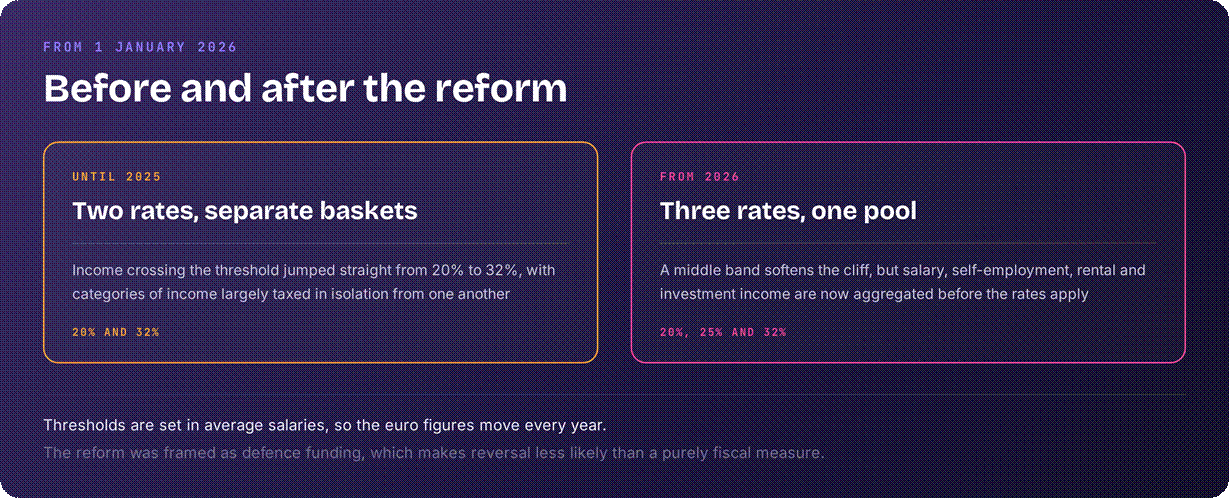
Two rates became three, and the middle band softens a cliff.
Your residency status is the first step
You are Lithuanian tax resident if you have a permanent place of residence in Lithuania, or your centre of personal, social or economic interests is there, or you are present for 183 days or more in a tax year, or for 280 days or more across two consecutive years with at least 90 days in one of them.
That two-year limb catches a pattern of roughly half-year stays that never reaches 183 days in a single year. Residents are taxed on worldwide income; non-residents on Lithuanian-source income.
Maintain accurate records of:
• Days present in each tax year, and across consecutive pairs of years;
• Whether a permanent place of residence exists in Lithuania;
• Where your centre of interests lies;
• Each income stream, and whether it aggregates or is taxed separately;
• Self-employment revenue against the relevant thresholds; and
• Any other country that may also treat you as resident.
The new scale
Annual income (aggregated) | Rate from 2026 |
Up to 36 average salaries, around EUR 83,000 | 20% |
From 36 to 60 average salaries, to around EUR 138,000 | 25% |
Above 60 average salaries | 32% |
Dividends and distributed profits | 15%, taxed separately |
Certain pension fund payouts | 15%, taxed separately |
Long-held share gains, on conditions | 15%, taxed separately |
Self-employed income up to EUR 20,000 | 5% |
Self-employed income to EUR 42,500 | Progressive, then aggregated above |
The thresholds are expressed in average salaries, not in euros. They move each year with the average wage, so a figure quoted in euros is a snapshot rather than a rule. For 2026 the average monthly salary used is around EUR 2,300.
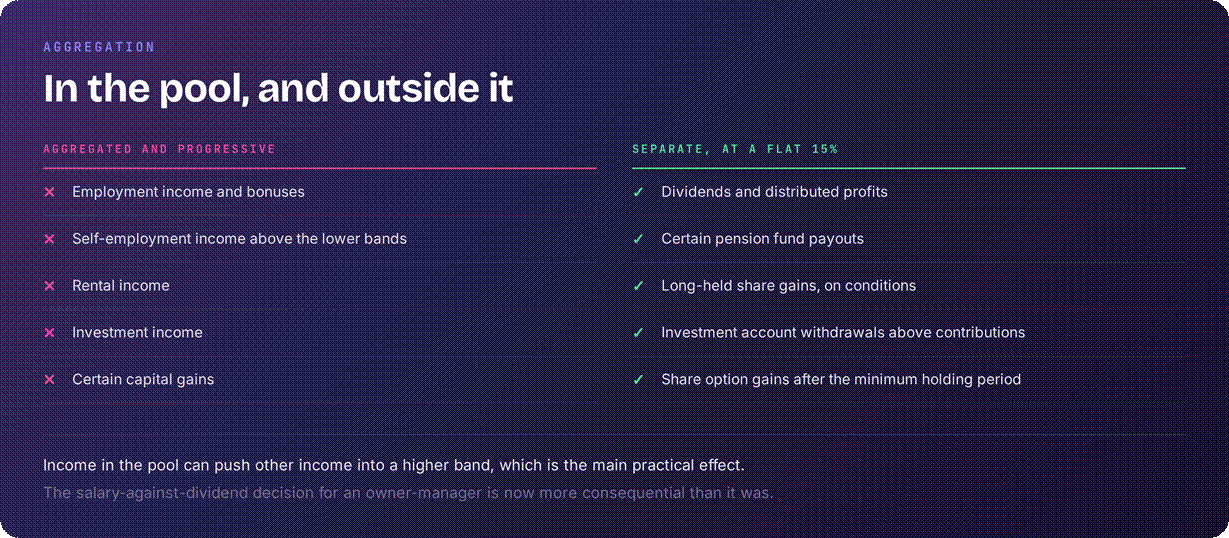
What is pooled, and what is taxed on its own.
What aggregation changes
Before 2026, different categories of income were taxed largely in isolation. From 2026 they are pooled, which means income that would previously have been taxed at a low rate in its own right can now push other income into a higher band.
For someone with a salary near the first threshold plus rental income and some investment income, the combined total may now cross into 25% where each stream taken alone would have stayed at 20%. That is the practical effect of aggregation and it is easy to underestimate.
The exclusions matter correspondingly more. Dividends stay outside the pool at a flat 15%, which makes the choice between salary and dividend for an owner-manager a more consequential decision than it was.
The individual activity route
Self-employed individuals operating under individual activity have their own treatment at the lower end: income up to EUR 20,000 is taxed at 5%, with a progressive band up to EUR 42,500, above which income is aggregated with everything else.
For a freelancer with modest earnings that remains among the more attractive arrangements in the EU. For one approaching the upper threshold, aggregation means the marginal position deteriorates faster than the headline bands suggest.
Case study: Rasa crosses a band she did not expect
Rasa earns EUR 75,000 in employment income in Vilnius and receives around EUR 12,000 a year in rent from an apartment she inherited. Under the old rules both were taxed largely in their own right.
From 2026 they aggregate. Her combined total of EUR 87,000 crosses the first threshold of roughly EUR 83,000, so part of her income falls into the 25% band even though neither stream alone would have reached it.
Nothing about her circumstances changed. The pooling did, and it is the kind of change that does not announce itself until a return is prepared.
What else changed in 2026
The reform package went wider than personal income tax. Corporate income tax rose from 16% to 17%, the reduced rate for small businesses with revenue under EUR 300,000 from 6% to 7%, and the 0% rate for newly registered small companies was extended from one year to two.
Real estate taxation was also restructured, with primary residences below a value threshold exempted. Mandatory contributions to Sodra continue at around 19.5% for employees and follow their own rules.
Filing and the compliance calendar
The Lithuanian tax year follows the calendar year. The annual return is generally due by 1 May of the following year, filed with the State Tax Inspectorate, with employment income withheld through payroll during the year.
Prepare in good time:
• A personal identification number and electronic declaration access;
• Records of each income stream by category;
• A clear split between aggregated and separately taxed income;
• Individual activity registration and revenue records;
• Holding periods for shares, where the 15% treatment is claimed; and
• Foreign income and any foreign tax paid.
Model the pool, not the pieces
Consider:
• Your total aggregated income rather than each stream separately;
• Which of your income falls outside the pool at a flat 15%;
• That thresholds move annually with the average salary;
• Whether the individual activity route suits your earnings level;
• Whether a salary or dividend mix produces a better outcome;
• That the reform is tied to defence funding and is unlikely to reverse; and
• Whether the two-year residence limb catches your travel pattern.
Your Lithuania checklist
1. Model your total aggregated income, not each stream separately;
2. Identify which income falls outside the pool at a flat 15%;
3. Convert thresholds from average salaries for the year in question;
4. Check whether rental or investment income pushes you into 25%;
5. Reconsider the salary and dividend mix if you control it;
6. Check the individual activity thresholds if self-employed;
7. Track holding periods where the 15% share treatment is claimed;
8. Test the two-year residence limb against your travel pattern;
9. Note the corporate rate rose to 17% from 2026; and
10. Diarise the 1 May filing deadline.
Frequently asked questions
What are the Lithuanian income tax rates now?
20%, 25% and 32% from 1 January 2026, replacing the previous two-rate 20% and 32% structure. The bands are set at 36 and 60 times the average monthly salary, which is roughly EUR 83,000 and EUR 138,000 for 2026.
What is income aggregation?
From 2026 most types of income — salary, self-employment income, rental income, investment income and certain capital gains — are combined into one annual total before the progressive rates apply, rather than being taxed largely in isolation.
What stays outside the pool?
Dividends and distributed profits, certain pension fund payouts, long-held share gains subject to conditions, investment account withdrawals above contributions, and share option gains after a minimum holding period. These are taxed separately at a flat 15%.
Why does aggregation matter?
Because income that would previously have been taxed in its own right can now push other income into a higher band. Someone with a salary near the first threshold plus rental income may cross into 25% when neither stream alone would have.
How are the self-employed taxed?
Individual activity income up to EUR 20,000 is taxed at 5%, with a progressive band up to EUR 42,500. Above that, income is aggregated with other income and taxed on the general scale.
Do the thresholds change each year?
Yes. They are expressed as multiples of the average monthly salary — 36 times for the first threshold and 60 times for the second — so the euro equivalents move annually.
When am I Lithuanian tax resident?
With a permanent place of residence in Lithuania, a centre of personal, social or economic interests there, 183 days or more in a tax year, or 280 days or more across two consecutive years with at least 90 in one of them.
What else changed in 2026?
Corporate income tax rose from 16% to 17%, the small business rate from 6% to 7%, and the 0% rate for newly registered small companies was extended from one year to two. Real estate taxation was also restructured.
Official sources and further reading
Important information
This article is general information and does not constitute tax, legal, immigration or financial advice, and does not create a client relationship. Tax outcomes depend on travel history, income sources, treaty status and the law applying to the relevant year. Rates, thresholds and regimes change, and some measures described may be proposed rather than enacted; this article reflects our understanding as at the date of publication. Obtain advice from a suitably qualified professional before acting or refraining from action.
