
Luxembourg scrapped its bonus-and-costs structure at the end of 2024 and replaced it with something far simpler: half your pay exempt, up to EUR 400,000, for up to nine years.
Luxembourg has had an impatriate regime for years, but until recently it was awkward. It worked through a partial exemption of an impatriation premium plus a full exemption of certain relocation costs, and navigating the conditions took more effort than the outcome justified.
The law of 20 December 2024 repealed that structure. From tax year 2025 the regime provides a straightforward 50% exemption of gross annual remuneration, including benefits in kind, capped at EUR 400,000 a year. The design was explicitly modelled on the French and Italian regimes.
Luxembourg taxes residents on worldwide income at progressive rates reaching 42%, with a solidarity surcharge on top and a class-based system that varies the burden by family situation. Residence follows from having a domicile or habitual abode in Luxembourg, broadly a stay of more than six months.
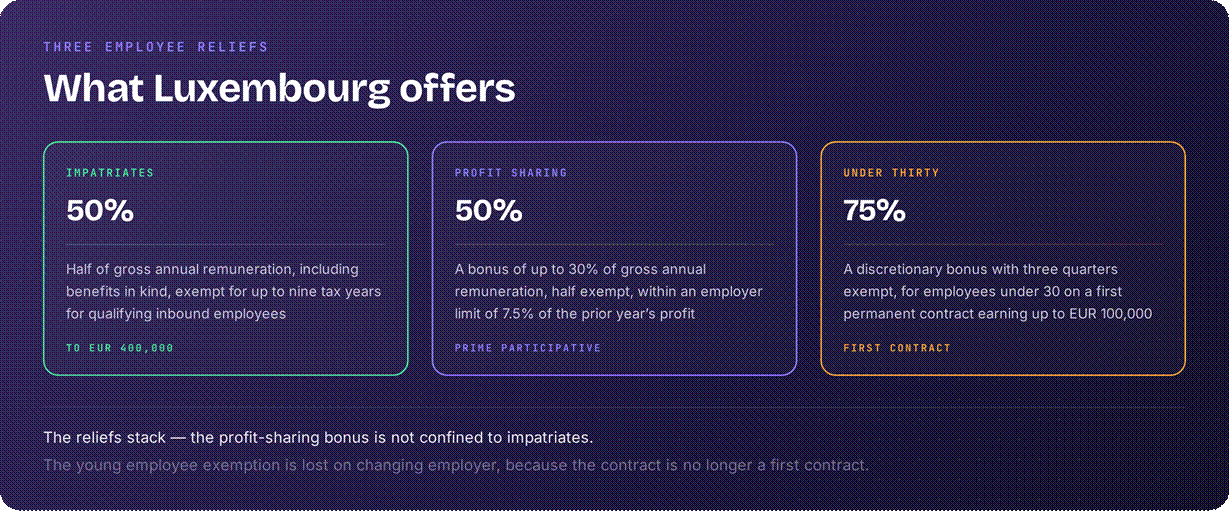
Three reliefs, aimed at three different employees.
The impatriate regime
For a qualifying employee, 50% of gross annual remuneration is exempt from income tax, with the exempt portion calculated on remuneration up to EUR 400,000. Benefits in kind are included in the base, which is more generous than a cash-only calculation.
The exemption runs until the end of the eighth tax year following the year in which the employee started working in Luxembourg — so up to nine tax years in practice.
An impatriate is defined as either an employee usually working abroad who is seconded from an undertaking of an international group outside Luxembourg to work for a Luxembourg undertaking in the same group, or an employee recruited directly from abroad by a Luxembourg undertaking.
The conditions
Condition | Requirement |
Prior distance | Not resident within 150 km of the Luxembourg border for five years |
Prior taxation | Not otherwise subject to Luxembourg income tax in that period |
Minimum salary | Annual fixed remuneration of at least EUR 75,000 |
Specialisation | In-depth specialisation in the sector or the role |
Recruitment | Intra-group secondment, or direct hire from abroad |
Exemption | 50% of gross annual remuneration, including benefits in kind |
Cap | Calculated on remuneration up to EUR 400,000 |
Duration | To the end of the eighth year following the start of work |
The 150 kilometre condition mirrors the Dutch rule and catches the same people. It excludes much of Belgium, the German border region and eastern France — precisely the population that already commutes into Luxembourg in large numbers.
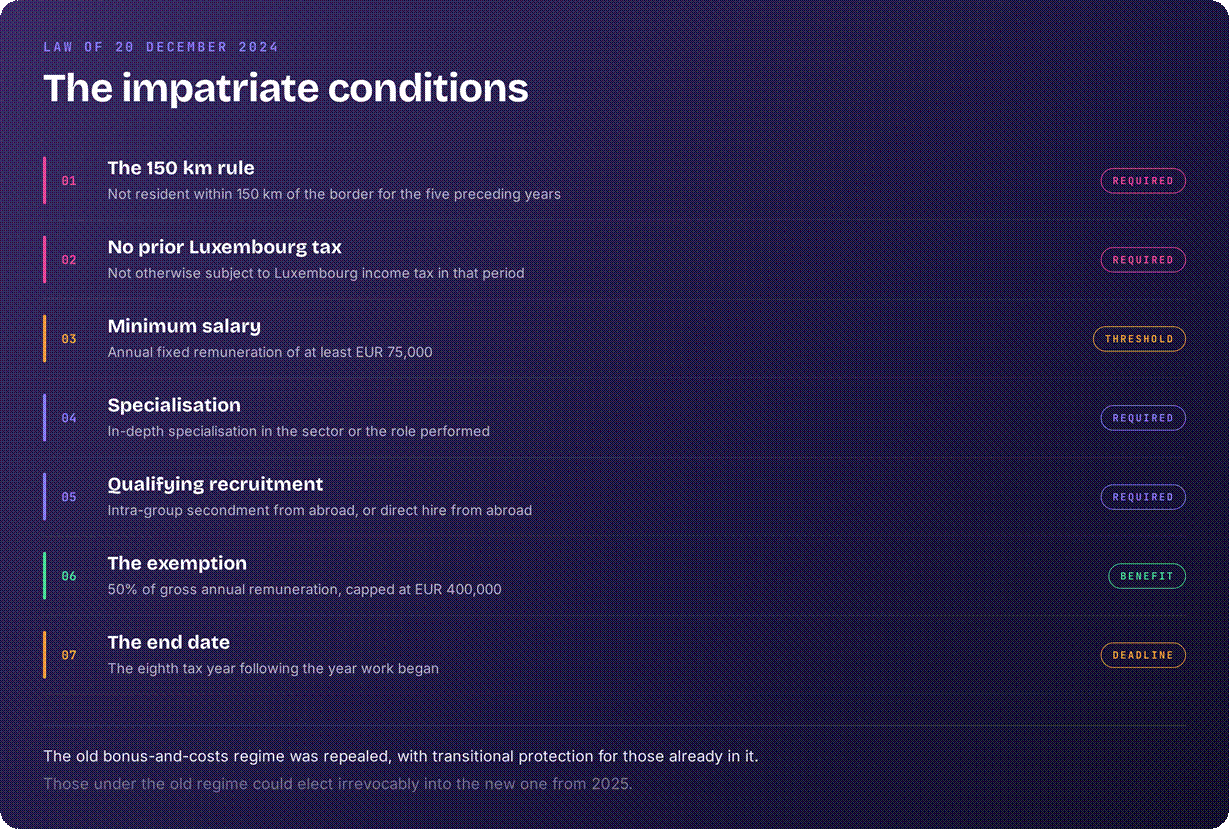
Every condition must hold together.
The profit-sharing bonus
Separately, the prime participative allows an employer to pay a bonus that benefits from a 50% exemption. From tax year 2025 the thresholds were raised: the maximum exempt bonus rose from 25% to 30% of the employee’s gross annual remuneration, and the total an employer may grant rose from 5% to 7.5% of the previous year’s profit.
This is not confined to impatriates. Any qualifying employee of a qualifying employer can receive it, and it stacks with the impatriate exemption rather than competing with it.
The young employee bonus
A third relief, introduced by the same law, gives a 75% exemption on a bonus paid to an employee under 30 who is on their first permanent employment contract, where total annual remuneration does not exceed EUR 100,000. It runs for a maximum of five years.
The condition that bites is the first-contract requirement: changing employer within the five-year period ends the exemption, because the contract is no longer a first contract. The bonus is discretionary on the employer’s part.
Case study: Sven had a choice worth making
Sven moved to Luxembourg in 2023 under the old regime, receiving a partially exempt impatriation premium and tax-free reimbursement of relocation costs. His premium was modest relative to his total package.
When the new regime arrived he could either continue under transitional protection or elect irrevocably into the new one from 2025. Under the new rules, 50% of his entire gross remuneration becomes exempt rather than a portion of a separately identified premium — a materially larger number on his facts.
The election is irrevocable, which is why it needed modelling rather than assuming the newer regime was automatically better. For someone whose old premium was unusually large, the answer could have gone the other way.
Filing and the compliance calendar
The Luxembourg tax year follows the calendar year. Employment income is subject to withholding through the payroll, and an annual return is required in defined circumstances, including where a taxpayer has multiple income sources or claims certain deductions.
Prepare in good time:
• Documentation supporting the 150 kilometre condition;
• Evidence of fixed annual remuneration against the EUR 75,000 minimum;
• Evidence of specialisation in the role or sector;
• The election, if you moved from the old regime to the new;
• Records of any profit-sharing or young employee bonus received; and
• The start date of your Luxembourg employment, which fixes the end date.
Timing matters more than the headline exemption
Model your position before accepting an offer, considering:
• Whether you meet the 150 kilometre condition on your pre-move address;
• Whether your fixed remuneration clears EUR 75,000;
• How much of your package sits above the EUR 400,000 ceiling;
• Whether a profit-sharing bonus could be structured alongside;
• Whether the young employee bonus applies, if you are under 30;
• When the eighth year following your start date falls; and
• Whether an election out of the old regime is worth making, if you are still in it.
Your Luxembourg checklist
1. Measure your pre-move address against the 150 kilometre condition;
2. Confirm fixed annual remuneration clears EUR 75,000;
3. Check your recruitment route fits one of the two qualifying forms;
4. Establish the start date, since the end date runs from it;
5. Model how much of your package sits above the EUR 400,000 ceiling;
6. If you are in the old regime, model the election before making it;
7. Ask whether a profit-sharing bonus can be structured alongside;
8. Check the young employee bonus if you are under 30;
9. Keep evidence of specialisation for the full period; and
10. Plan for the year after the exemption ends.
Frequently asked questions
What does the Luxembourg impatriate regime give?
A 50% exemption of gross annual remuneration, including benefits in kind, calculated on remuneration up to EUR 400,000 a year, running to the end of the eighth tax year following the year work began.
What replaced the old regime?
The law of 20 December 2024 repealed the partial exemption of the impatriation premium and the exemption of certain relocation costs, replacing both with the single 50% exemption from tax year 2025.
I was already under the old regime. What happens?
Transitional protection allowed continuation under the old rules while the conditions were met, with a right to elect irrevocably into the new regime from 2025. Because the election cannot be reversed, it was worth modelling rather than assuming.
What is the 150 kilometre rule?
You must not have been resident within 150 kilometres of the Luxembourg border, or otherwise subject to Luxembourg income tax, during the five preceding years. It excludes much of Belgium, the German border region and eastern France.
Is there a minimum salary?
Yes — annual fixed remuneration of at least EUR 75,000, alongside a requirement for in-depth specialisation in the sector or role.
What is the profit-sharing bonus?
The prime participative allows an employer to grant a bonus benefiting from a 50% exemption, up to 30% of the employee’s gross annual remuneration, within an employer limit of 7.5% of the previous year’s profit. It is not confined to impatriates.
What is the young employee bonus?
A 75% exemption on a discretionary bonus for employees under 30 on their first permanent employment contract, with total annual remuneration not exceeding EUR 100,000, for up to five years. Changing employer ends it.
Can the reliefs be combined?
The profit-sharing bonus operates independently of the impatriate regime, so an impatriate employee may receive both. The specific interaction should be confirmed for your package rather than assumed.
Official sources and further reading
• Administration des contributions directes
Important information
This article is general information and does not constitute tax, legal, immigration or financial advice, and does not create a client relationship. Tax outcomes depend on travel history, income sources, treaty status and the law applying to the relevant year. Rates, thresholds and regimes change, and some measures described may be proposed rather than enacted; this article reflects our understanding as at the date of publication. Obtain advice from a suitably qualified professional before acting or refraining from action.
