
Macao caps personal tax at 12% and then reduces it three separate ways — an exemption allowance, a general deduction, and a rebate the government sets in the budget each year.
Macao runs what its own investment promotion body calls a simple and minimal tax system, and the description holds. Professional tax on employment income runs at 7% to 12% after a personal allowance, with the top rate reached only at a relatively high level of income.
Three separate reductions apply before you reach the rate. There is an annual exempt amount below which no professional tax is due. There is a 25% general allowance deducted under the Professional Tax Ordinance. And there is an annual tax relief set in the government budget, which has repeatedly rebated a percentage of the tax otherwise payable.
For business income the complementary tax applies at progressive rates up to 12%, with the first MOP 600,000 exempt as a standing relief measure. On a profit of MOP 1,000,000 that produces an effective rate of 4.8%; even at MOP 20,000,000 it is 11.64%.

The Macao position at a glance.
Your residency status is the first step
Macao charges tax by reference to income arising from activity in Macao rather than by reference to a day count. Professional tax applies to employment income from services rendered in Macao, and complementary tax to income derived from commercial and industrial activity there.
The fiscal year runs from January to December and the system is administered by the Financial Services Bureau. Because the charge follows the activity rather than the person, the question to settle is where work is performed rather than how many days you spend in the territory.
Maintain accurate records of:
• Where employment duties are physically performed;
• Whether income is employment income or business income;
• Your age, since a higher exemption applies from 65;
• Any income arising in a Portuguese-speaking country, and tax paid there;
• Holdings of Macao-issued bonds; and
• The exemption allowance and rebate announced for the year in question.
The tax rates
Item | Position |
Professional tax on employment income | 7% to 12% after allowances |
Top professional tax rate | Applies above roughly MOP 424,000 |
General allowance deduction | 25% under the Professional Tax Ordinance |
Higher exemption | For those aged 65 or over, or with qualifying disability |
Annual rebate | A percentage of tax payable, set in the budget |
Complementary tax exemption | First MOP 600,000 of taxable income |
Complementary tax above that | 12% |
Macao bond interest and gains | Exempt |
The exemption allowance and the rebate are set annually, which means the effective rate moves year to year in the taxpayer’s favour rather than through legislation. Any figure taken from an older guide should be checked against the current budget.
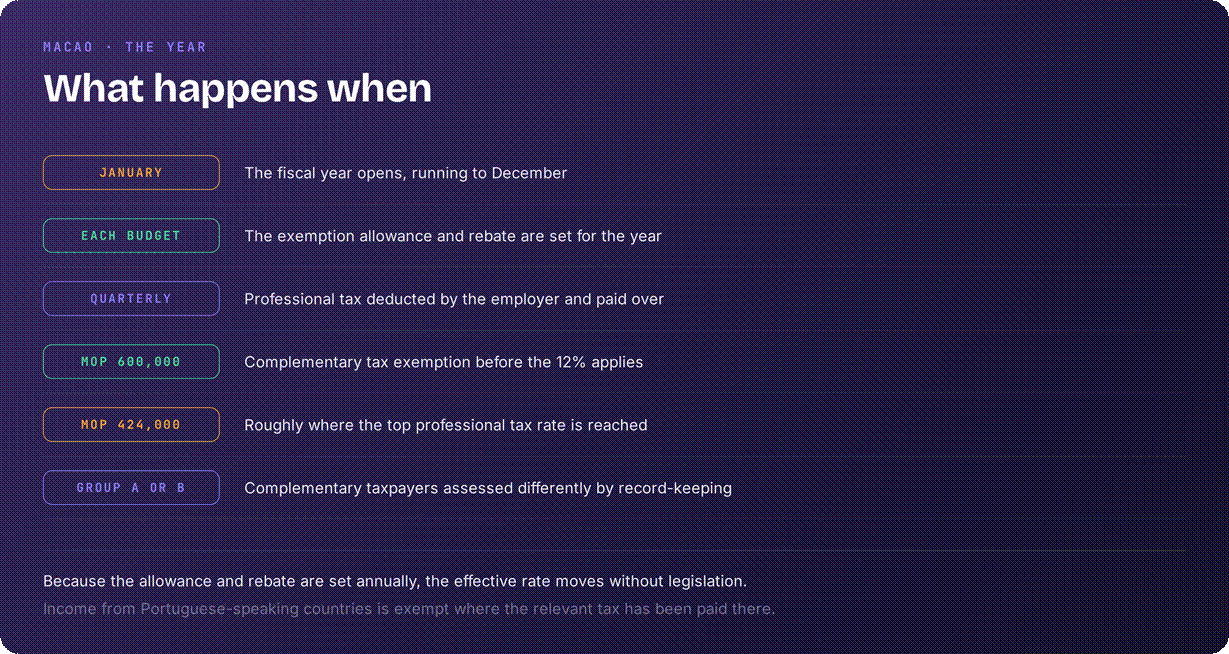
What the year brings, and when.
What makes Macao attractive
The combination is one of the lightest anywhere outside a zero-tax jurisdiction:
• A 12% ceiling on both personal and business income, reached only at higher levels;
• An annual exempt amount removing lower earners from professional tax entirely;
• A 25% general allowance deducted before the rate applies;
• An annual rebate of a percentage of tax payable, set in the government budget;
• MOP 600,000 of complementary tax exemption, giving effective rates under 5% at moderate profit levels;
• Exemption for income from Portuguese-speaking countries where tax has been paid there — a genuine oddity reflecting Macao’s history; and
• Exempt interest and gains on bonds issued in Macao, with social security a nominal fixed monthly amount rather than a percentage of pay.
The honest qualification is that Macao is expensive to live in and the economy is concentrated. The tax position is excellent; the cost of housing is not.
Case study: Helena and the effective rate
Helena runs a consultancy through a Macao entity with taxable profit of MOP 1,000,000. The first MOP 600,000 is exempt, so 12% applies to MOP 400,000 — MOP 48,000, an effective rate of 4.8%.
At MOP 5,000,000 the effective rate is 10.56%, and even at MOP 20,000,000 it is 11.64%. The exemption allowance does the heavy lifting at the small end and the flat 12% caps the top.
On the employment side, the 25% general allowance and the annual rebate work the same way — reducing what the headline rate suggests rather than changing the rate itself.
Filing and the compliance calendar
Professional tax is deducted at source by the employer and paid to the tax department quarterly. Complementary tax taxpayers are divided into Group A — companies above a capital or profit threshold, or those electing in with proper accounting records — and Group B, assessed by a committee where a full accounting system is not maintained.
Prepare in good time:
• Registration with the Financial Services Bureau;
• Payroll records and quarterly professional tax payments;
• Accounting records, if seeking Group A status;
• Evidence of tax paid in a Portuguese-speaking country, where claiming exemption;
• The current year’s exemption allowance and rebate; and
• Records of Macao bond holdings.
Check the budget, not last year’s guide
Consider:
• That the exemption allowance and rebate are set annually;
• That the ceiling is 12% for both personal and business income;
• Whether the 25% general allowance has been applied to your assessment;
• Whether any income arises in a Portuguese-speaking country;
• Whether Group A status would suit your business;
• That Macao bond interest and gains are exempt; and
• The cost of living alongside the rate.
Your Macao checklist
1. Establish where employment duties are physically performed;
2. Separate employment income from business income;
3. Check the exemption allowance announced for the current year;
4. Check whether a rebate has been set in the budget;
5. Confirm the 25% general allowance has been applied;
6. Identify any income from a Portuguese-speaking country;
7. Keep evidence of tax paid there, to claim the exemption;
8. Consider whether Group A status suits your business;
9. Note that Macao bond interest and gains are exempt; and
10. Budget for housing costs alongside the tax position.
Frequently asked questions
What is the Macao personal tax rate?
Professional tax runs at 7% to 12% on employment income after a personal allowance, with the top rate reached only above roughly MOP 424,000. A 25% general allowance is also deducted under the Professional Tax Ordinance.
What is the annual rebate?
A tax relief measure set in the government budget each year, which has repeatedly rebated a percentage of the professional tax otherwise payable. Because it is set annually rather than legislated, the effective rate moves year to year.
How is business income taxed?
Through complementary tax, with the first MOP 600,000 of taxable income exempt and 12% above. That produces an effective rate of 4.8% on MOP 1,000,000 of profit and 11.64% even at MOP 20,000,000.
What is the Portuguese-speaking countries exemption?
All income obtained or generated in Portuguese-speaking countries is exempt from complementary tax, provided the relevant tax has been paid in that country. It reflects Macao’s historical ties and is genuinely unusual.
Are bonds taxed?
No. Interest obtained from bonds issued in Macao, and profits from their purchase and sale, redemption or other disposal, are exempt from complementary tax.
Is there a higher exemption for older people?
Yes. Employees aged over 65, or with a qualifying level of permanent disability with proper proof, are eligible for a higher exemption amount before professional tax applies.
What about social security?
Employers make a nominal fixed monthly contribution per employee, at a slightly higher figure for non-resident employees. It is a fixed amount rather than a percentage of pay, which is unusual and keeps the total burden low.
How is professional tax collected?
It is deducted at source by the employer and paid to the tax department quarterly within the prescribed period, so most employees have nothing further to compute.
Official sources and further reading
• Financial Services Bureau, Macao SAR
Important information
This article is general information and does not constitute tax, legal, immigration or financial advice, and does not create a client relationship. Tax outcomes depend on travel history, income sources, treaty status and the law applying to the relevant year. Rates, thresholds and regimes change, and some measures described may be proposed rather than enacted; this article reflects our understanding as at the date of publication. Obtain advice from a suitably qualified professional before acting or refraining from action.
