
Madagascar caps salary income tax at 20%, the lowest in southern Africa by a distance. A finance bill proposes adding a 25% band above it, so the position may not hold.
Madagascar’s salary income tax — IRSA, the Impôt sur les Revenus Salariaux et Assimilés — tops out at 20%. Against Malawi’s 40%, Zambia’s 37% and Eswatini’s 33%, that is the lowest ceiling in the southern African group by a clear margin.
The scale is short and reaches the top quickly: nothing up to MGA 350,000, then 5%, 10% and 15% across narrow bands, with 20% applying above MGA 600,000.
Individuals are subject either to IRSA on salary, or to business income tax — IR, the Impôt sur les Revenus — depending on the nature of the revenue earned.

The scale now, and what is proposed.
Your residency status is the first step
For IRSA purposes, an individual resident in Madagascar — whether Malagasy or foreign — is liable on worldwide income. Foreign nationality does not narrow the charge.
For IR purposes, an individual who is not resident in Madagascar is liable only on income from Malagasy sources.
The split between the two taxes therefore matters as much as the residence question, because they carry different scopes as well as different computations.
Maintain accurate records of:
• Whether each receipt is salary income or business income;
• Your residence position in Madagascar;
• Worldwide income, if resident and within IRSA;
• Malagasy-source income separately;
• Income against each of the four IRSA thresholds; and
• Whether the minimum charge applies in any month.
The tax rates
Income range (MGA) | IRSA rate |
Up to 350,000 | 0% |
350,001 to 400,000 | 5% |
400,001 to 500,000 | 10% |
500,001 to 600,000 | 15% |
Above 600,000 | 20% |
Minimum payable | MGA 3,000 regardless of income |
Basis for residents | Worldwide income |
Basis for non-residents (IR) | Malagasy-source income only |
The minimum charge is the feature that surprises people. Whatever the income, and however far below the MGA 350,000 threshold it falls, MGA 3,000 of salary income tax is payable. The zero band is therefore not quite a zero band in practice.
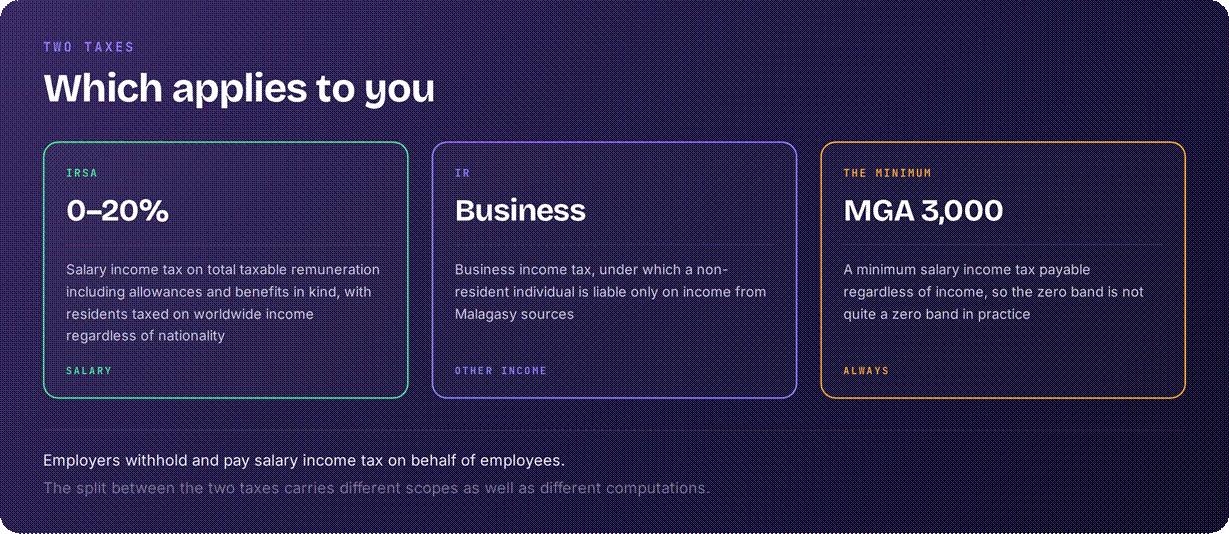
Two taxes, and which one applies.
The 2026 proposal
The Initial Finance Bill 2026 proposes changing the top of the scale in two ways. The 20% band would be extended to cover income from MGA 600,001 to MGA 4,000,000, and a new 25% bracket would apply above MGA 4,000,000.
For most earners the extension of the 20% band changes nothing, since they sit well below MGA 4,000,000. For higher earners it introduces a rate that does not currently exist.
The proposal is not enacted. It was introduced in the finance bill and the article should be read on that basis — the 20% ceiling holds until the measure passes. Anyone planning on the current position should confirm the status before relying on it.
What makes Madagascar attractive
The rate is the case, and it is a strong one:
• A 20% ceiling on salary income tax, the lowest in southern Africa;
• A zero band to MGA 350,000, subject to the minimum charge;
• A short scale reaching its top quickly, which makes the position simple to model;
• A clear split between salary tax and business income tax, each with its own rules;
• For non-residents within IR, a charge limited to Malagasy-source income; and
• A very low cost of living.
The honest qualifications are that residents are taxed on worldwide income for IRSA purposes regardless of nationality, that a minimum charge applies however low the income, and that a 25% band is proposed which would end the 20% ceiling for higher earners.
Case study: the ceiling and the proposal
Someone earning MGA 5,000,000 a year currently faces 20% on everything above MGA 600,000, with no higher band available. That is the position today.
Under the Initial Finance Bill 2026, the same income would face 20% to MGA 4,000,000 and 25% on the MGA 1,000,000 above it. The change is modest in absolute terms but it removes the feature that makes Madagascar distinctive — a genuine ceiling rather than a rate that keeps climbing.
For anyone considering a move on the strength of the 20% figure, the status of that bill is the thing to check before committing.
Filing and the compliance calendar
Employers are responsible for withholding and paying salary income tax on behalf of employees, covering salaries, allowances and benefits in kind. The scale is applied to total taxable remuneration.
Prepare in good time:
• Registration with the tax administration;
• A clear split between salary and business income;
• Records of benefits in kind, which are within taxable remuneration;
• Worldwide income records, if resident;
• Confirmation of whether the minimum charge applies; and
• The current status of the Initial Finance Bill 2026.
Check the bill before the rate
Consider:
• That the 20% ceiling is the lowest in the region;
• That a 25% band is proposed above MGA 4,000,000;
• That the proposal is not enacted;
• That residents are taxed on worldwide income for IRSA;
• That foreign nationality does not narrow that charge;
• That MGA 3,000 is payable however low your income; and
• Whether you fall within IRSA or IR.
Your Madagascar checklist
1. Establish whether you fall within IRSA or IR;
2. Note that residents pay IRSA on worldwide income;
3. Note that foreign nationality does not narrow that;
4. Include allowances and benefits in kind in remuneration;
5. Expect the MGA 3,000 minimum however low your income;
6. Model income against the four thresholds;
7. Check the status of the Initial Finance Bill 2026;
8. Do not rely on the 20% ceiling without checking that;
9. Confirm employer withholding is operating correctly; and
10. Keep Malagasy-source income recorded separately.
Frequently asked questions
What is the Madagascar top tax rate?
The IRSA salary scale tops out at 20% on income above MGA 600,000 — the lowest ceiling in southern Africa. A finance bill proposes adding a 25% band above MGA 4,000,000, but it is not enacted.
What are the bands?
0% up to MGA 350,000, 5% to MGA 400,000, 10% to MGA 500,000, 15% to MGA 600,000 and 20% above that.
Is there really a minimum charge?
Yes. A minimum salary income tax of MGA 3,000 is payable regardless of income, however low, so the zero band is not a complete exemption in practice.
Does Madagascar tax foreign income?
For IRSA purposes, yes. An individual resident in Madagascar, whether Malagasy or of foreign nationality, is liable on worldwide income. Foreign nationality does not narrow the charge.
What is the difference between IRSA and IR?
IRSA is salary income tax, applying to total taxable remuneration including allowances and benefits in kind. IR is business income tax, under which a non-resident individual is liable only on Malagasy-source income.
What does the 2026 finance bill propose?
Extending the 20% band to cover income from MGA 600,001 to MGA 4,000,000, and introducing a new 25% bracket above MGA 4,000,000. Neither change is enacted.
Should I plan around the 20% ceiling?
Only after confirming the status of the finance bill. The ceiling is the feature that makes Madagascar distinctive, and the proposal would remove it for higher earners.
Who accounts for the tax?
Employers are responsible for withholding and paying salary income tax on behalf of employees, calculated on total taxable remuneration.
Official sources and further reading
Important information
This article is general information and does not constitute tax, legal, immigration or financial advice, and does not create a client relationship. Tax outcomes depend on travel history, income sources, treaty status and the law applying to the relevant year. Rates, thresholds and regimes change, and some measures described may be proposed rather than enacted; this article reflects our understanding as at the date of publication. Obtain advice from a suitably qualified professional before acting or refraining from action.
