
The Maldives had no personal income tax at all until 2020. What arrived is generous: nothing on the first MVR 720,000, a top rate of 15%, and no tax on capital gains.
Personal income tax is new here. The Income Tax Act was ratified on 17 December 2019 and took effect on 1 January 2020, with tax on employment income commencing on 1 April 2020. Before that the Maldives had no personal income tax.
What it created is light. The first MVR 720,000 — roughly USD 46,700 — is taxed at 0%. Above that the bands run 5.5%, 8% and 12%, reaching the top rate of 15% only above MVR 2,400,000.
The Act also abolished three taxes that had fallen on foreigners in particular: a 3% remittance tax on money transferred out of the Maldives by foreigners employed there, a 15% land sales tax, and petroleum tax.
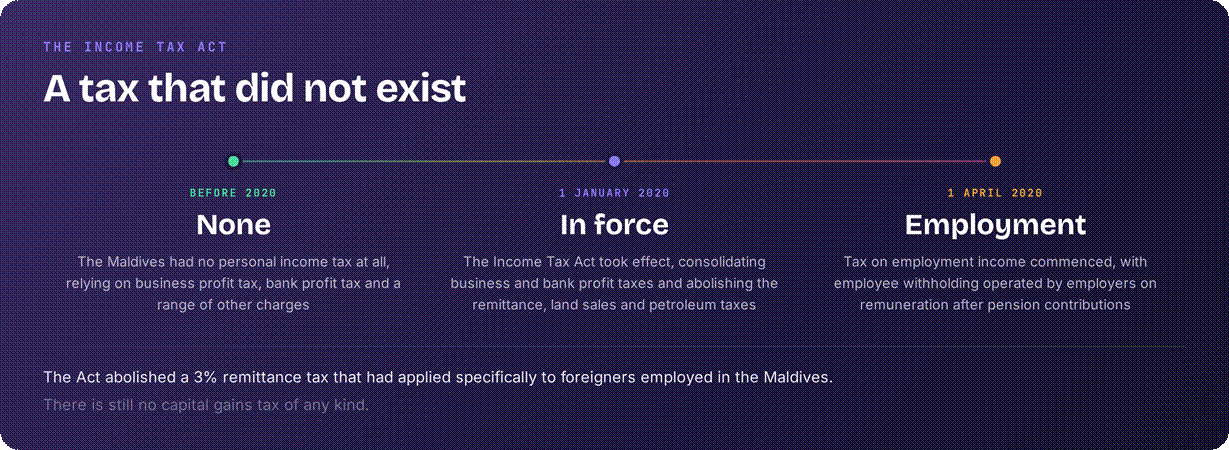
From no income tax at all to a five-band scale.
Your residency status is the first step
An individual is a Maldivian tax resident if their permanent home is in the Maldives, or if they are present in the country for 183 days or more in any twelve-month period.
Residents are taxed on worldwide income. Non-residents and temporary residents are taxed only on income from sources within the Maldives. The Act adopts a residence-based system explicitly, at sections 10(a) and 10(b).
Maintain accurate records of:
• Days present across rolling twelve-month periods;
• Whether your permanent home is in the Maldives;
• Income by source, Maldivian and foreign;
• Annual taxable income against the MVR 720,000 threshold;
• Pension contributions, which are deductible; and
• Any other country that may also treat you as resident.
The tax rates
Annual taxable income (MVR) | Rate |
Not exceeding 720,000 | 0% |
720,001 to 1,200,000 | 5.5% |
1,200,001 to 1,800,000 | 8% |
1,800,001 to 2,400,000 | 12% |
Above 2,400,000 | 15% |
Capital gains | Not taxed |
Corporate, up to MVR 500,000 | 0% |
Corporate, above MVR 500,000 | 15% |
The monthly withholding thresholds mirror the annual bands — nil to MVR 60,000 a month, then 5.5% to 100,000, 8% to 150,000, 12% to 200,000 and 15% above. Remuneration is measured after deducting the employee’s contribution to the Maldives Retirement Pension Scheme.
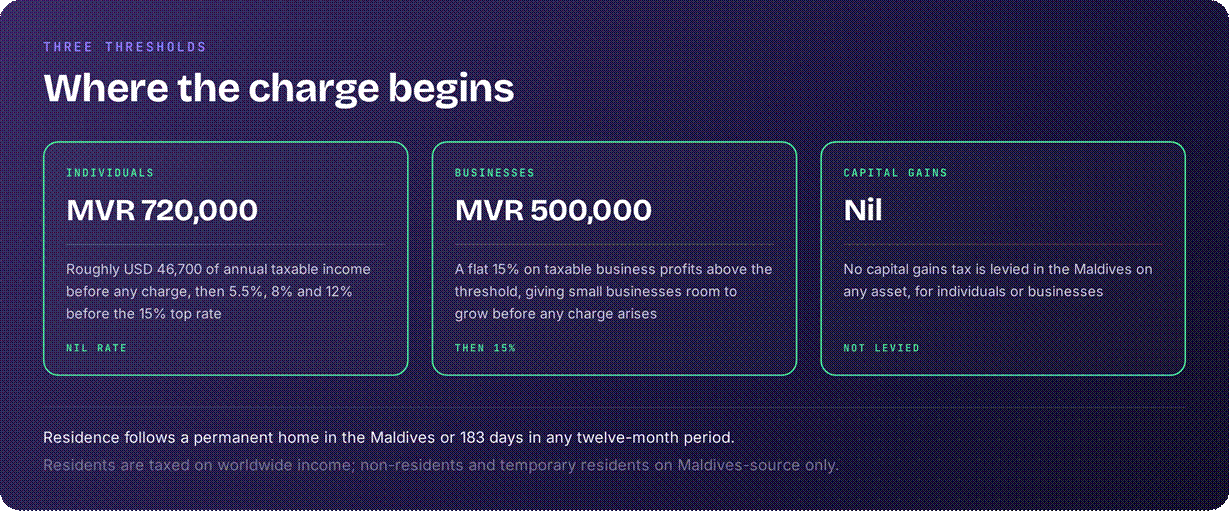
Every threshold that matters.
What the Maldives does not tax
The absences are the strongest part of the position:
• No capital gains tax is levied in the Maldives at all;
• No remittance tax — the 3% charge on money transferred out by foreign employees was abolished from 2020;
• No land sales tax — the 15% charge on the sale price of dwellings or land went at the same time; and
• Nothing on the first MVR 720,000 of annual taxable income, which removes most ordinary salaries from the charge entirely.
What makes the Maldives attractive
For an internationally mobile individual the numbers are unusually good:
• A nil-rate band of MVR 720,000, roughly USD 46,700, before any tax applies;
• A top rate of just 15%, reached only above MVR 2,400,000;
• No capital gains tax on any asset;
• The abolition of the remittance tax that used to catch foreign workers specifically;
• A MVR 500,000 exempt threshold for business income, then a flat 15%;
• Deductions for pension contributions, zakat al-mal and approved donations up to 5% of taxable income; and
• Residence on a permanent home or 183 days, with no investment or capital requirement.
The honest qualification is that residents are taxed on worldwide income, so there is no territorial shelter, and the cost of living in a resort economy is high relative to the region.
Case study: Farah crosses one band
Farah earns the equivalent of MVR 1,000,000 a year in Malé. The first MVR 720,000 is taxed at nothing, and the remaining MVR 280,000 at 5.5% — around MVR 15,400, an effective rate of about 1.5% on her total income.
She also sells a foreign investment at a substantial gain during the year. The Maldives levies no capital gains tax, so that produces nothing to pay.
Her position would look very different in most systems, where the gain would be the larger charge of the two. Here it is not charged at all.
Filing and the compliance calendar
Returns are filed with the Maldives Inland Revenue Authority no later than 30 June of the following tax year, with payments generally made in three instalments — a first interim payment on 31 July of the ongoing year, a second on 31 January following, and the final payment on 30 June. The interim payments are based on half the previous year’s liability, with any difference adjusted at the final payment.
Employee withholding tax is deducted by the employer from remuneration, and anyone registered with the authority as at 1 January 2020 was registered automatically under the new Act.
Model the bands, not the top rate
Consider:
• That the first MVR 720,000 is entirely untaxed;
• That the 15% top rate only engages above MVR 2,400,000;
• That there is no capital gains tax on any asset;
• That residents are taxed on worldwide income;
• Whether a permanent home would make you resident regardless of days;
• Pension contributions and approved donations as deductions; and
• The instalment cycle, which starts before the year ends.
Your Maldives checklist
1. Check annual taxable income against the MVR 720,000 nil band;
2. Note the 15% top rate only applies above MVR 2,400,000;
3. Remember there is no capital gains tax on any asset;
4. Count days across rolling twelve-month periods;
5. Consider whether a permanent home makes you resident;
6. Deduct pension contributions before applying the bands;
7. Claim approved donations up to 5% of taxable income;
8. Plan for the three-instalment payment cycle;
9. File with MIRA by 30 June following the tax year; and
10. Note that residents are taxed on worldwide income.
Frequently asked questions
Does the Maldives have income tax?
Yes, but only since 2020. The Income Tax Act was ratified in December 2019, took effect on 1 January 2020, and tax on employment income commenced on 1 April 2020. Before that there was no personal income tax at all.
What are the rates?
Nil on annual taxable income up to MVR 720,000, then 5.5% to MVR 1,200,000, 8% to MVR 1,800,000, 12% to MVR 2,400,000 and 15% above that.
Is there capital gains tax?
No. No capital gains tax is levied in the Maldives, on any asset, for individuals or businesses.
What did the Act abolish?
Three taxes from 1 January 2020 — a 3% remittance tax on money transferred out by foreigners employed in the Maldives, a 15% land sales tax on the sale price of dwellings or land, and petroleum tax. It also consolidated business and bank profit taxes.
How do I become tax resident?
By having your permanent home in the Maldives, or by being present for 183 days or more in any twelve-month period. Residents are taxed on worldwide income; non-residents and temporary residents on Maldives-source income only.
How is business income taxed?
At 0% up to MVR 500,000 of taxable profit and a flat 15% above. Banks are taxed at a higher rate, and non-resident withholding applies at 10%.
What deductions are available?
Contributions to the Maldives Retirement Pension Scheme, zakat al-mal paid to a relevant government institution, and donations to approved charitable organisations capped at 5% of taxable income before the donation.
When do I file?
By 30 June of the following tax year, with payment in three instalments — a first interim payment on 31 July of the ongoing year, a second on 31 January following, and the final payment on 30 June.
Official sources and further reading
Important information
This article is general information and does not constitute tax, legal, immigration or financial advice, and does not create a client relationship. Tax outcomes depend on travel history, income sources, treaty status and the law applying to the relevant year. Rates, thresholds and regimes change, and some measures described may be proposed rather than enacted; this article reflects our understanding as at the date of publication. Obtain advice from a suitably qualified professional before acting or refraining from action.
