
Montenegro is a small Adriatic country using the euro without being in the eurozone, and negotiating EU accession. Its personal tax rates are among the lowest in Europe and its zero band is the most generous on the continent. For anyone with foreign income, though, the more interesting feature is a specific provision in the income tax act.
The exemption is codified, not implied. Article 32d of the Law on Personal Income Tax exempts qualifying foreign-source income from personal income tax. That is a materially stronger position than the many jurisdictions where a favourable outcome depends on a general rule being read a particular way, or on administrative practice that could change without legislation.
The catch is timing. This guide covers the exemption and what it reaches, the ordinary rate structure underneath it, how residency is determined, and what happens when the relief ends.
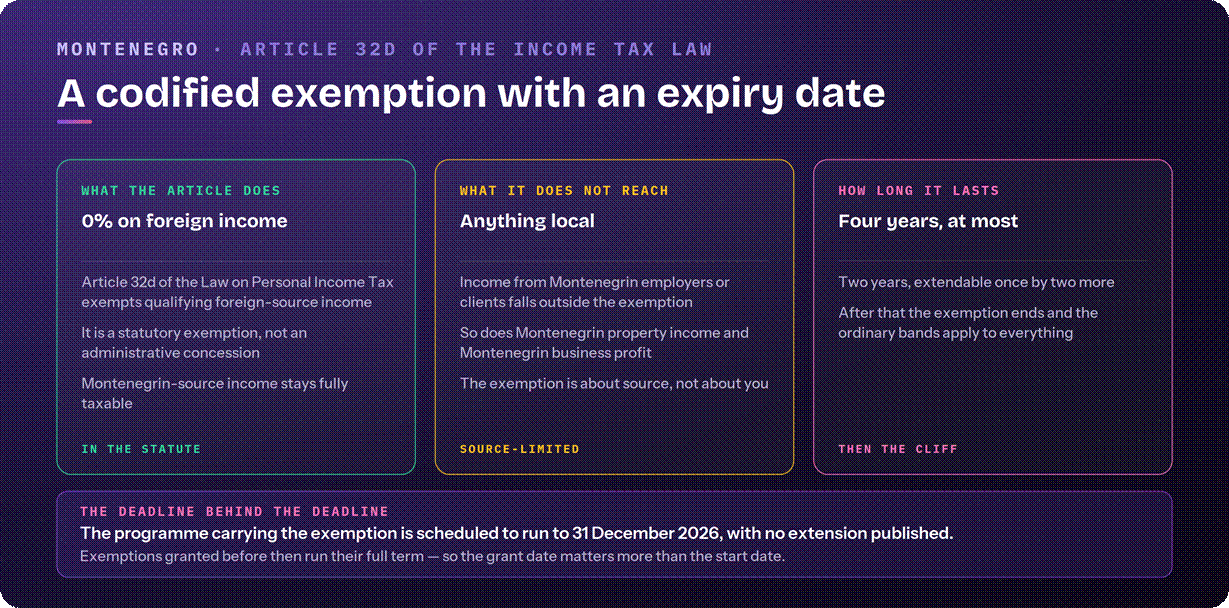
What the provision exempts, what it leaves taxable, and how long it lasts.
What Article 32d actually exempts
The exemption is defined by source. Income arising outside Montenegro — from an employer or clients not registered in Montenegro — falls outside the personal income tax charge while the provision applies to you.
Income arising in Montenegro does not. Employment with a Montenegrin entity, fees from Montenegrin clients, rent from Montenegrin property and profits from a Montenegrin business are all taxed at the ordinary bands regardless. The provision is about where the income comes from, not about who you are.
One Montenegrin engagement can undo the arithmetic. Because the relief is source-limited, taking on local work does not simply add a small taxable slice — it creates a Montenegrin-source stream that sits entirely outside it. If you are modelling Montenegro on the basis of this exemption, model it on the assumption that every euro stays foreign-source.
The relief runs for two years and can be extended once by a further two, giving four years at most. After that the ordinary rules apply to the whole of your income — and since Montenegro taxes residents on worldwide income, that is a meaningful step rather than a marginal one.
Watch the provision’s own end date, not just yours. The programme carrying the exemption sits inside the government’s economic package and is currently framed as running to 31 December 2026. At the time of writing no decision extending or abolishing it has been published. Grants made before the deadline run their full term — so the date the relief is granted matters more than the date you arrive. Confirm the current position before relying on it.
The tax rates underneath
If the exemption does not apply to you — because it has ended, because your income is Montenegrin-source, or because you never qualified — the ordinary structure is still among the friendliest in Europe.
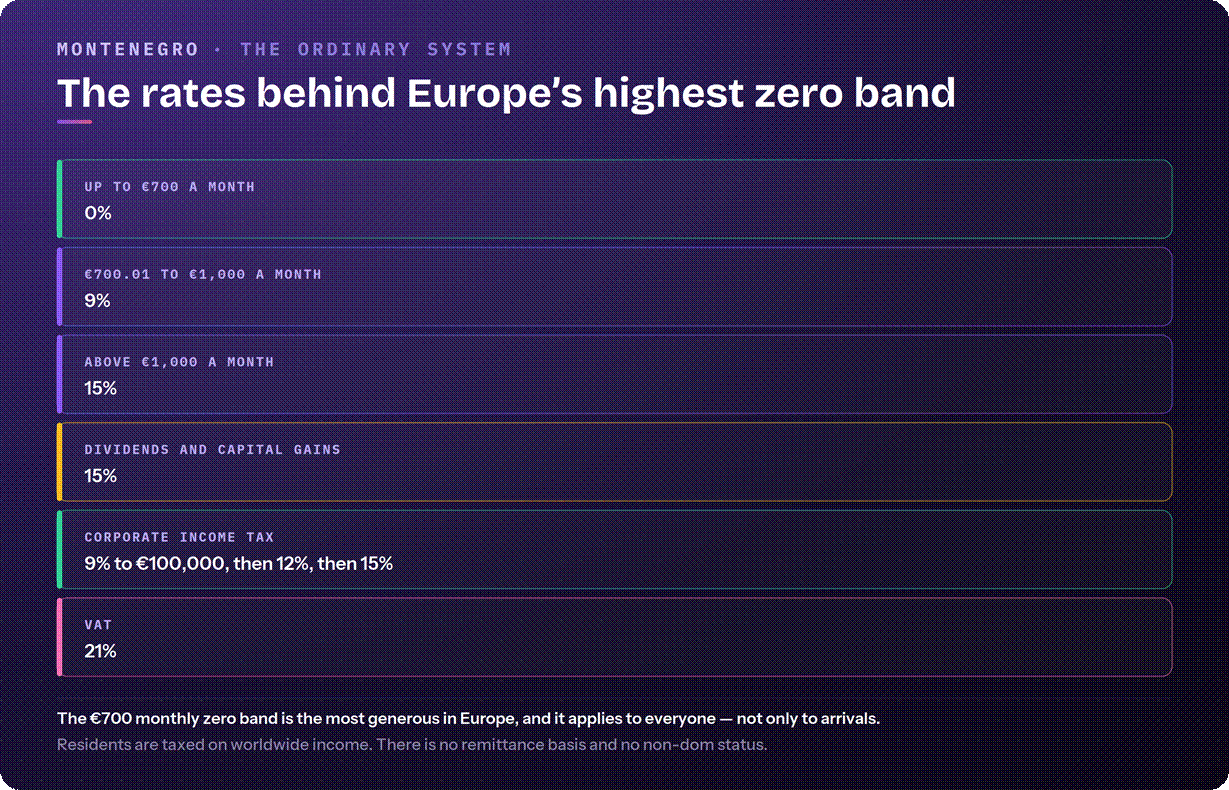
The general system, which applies to everyone rather than only to new arrivals.
The zero band on the first €700 of monthly gross income is the highest non-taxable threshold in Europe. Unlike an impatriate regime it is not time-limited and not restricted to arrivals — it is simply how the schedule begins. Above it, 9% applies to €1,000 a month and 15% beyond.
Corporate income tax runs at 9% on profits to €100,000, 12% to €1.5 million and 15% above. Dividends and capital gains are taxed at 15%. VAT is 21%. There is no wealth tax.
The company route is what makes larger incomes work here. A Montenegrin company taxed at 9% on its first €100,000, paying a salary within the zero band and distributing the remainder as dividends at 15%, produces a combined effective load in the high teens. That is a structure rather than a regime: it needs real substance, proper accounting and advice, and it turns Montenegrin-source profit into the base. But it explains why Montenegro appears in plans the personal rates alone would not justify.
How residency works
You are a Montenegrin tax resident if you spend at least 183 days in the tax year in Montenegro, if you have a domicile here, or if your centre of personal and economic activities is here. Individuals sent abroad to work on behalf of a Montenegrin resident are also treated as resident.
Residents are taxed on worldwide income. Outside Article 32d there is no remittance basis, no non-dom status and no impatriate regime — residence brings the whole of your income into the 9% to 15% structure.
The 183-day rule is hard and unmodified. There is no Cyprus-style 60-day alternative here, and no averaging provision. If your travel pattern spreads across several countries and you cannot anchor 183 days in Montenegro, you do not become Montenegrin tax resident — which means you stay resident wherever you were, and the 9% to 15% structure is irrelevant to you. Establishing residence here is a decision, not a side effect.
What happens when the exemption ends
This is the part worth planning for, because the transition is abrupt. On the day the relief lapses, foreign income that has been entirely outside the charge moves into it at up to 15%, with no tapering and no transitional relief.
Two consequences follow. Realising gains or taking distributions while the exemption holds is worth considering, since foreign capital gains fall within the exempt category on the same source logic as income. And the year in which the relief ends is the year to model carefully, because it may contain both exempt and taxable periods depending on how the provision is applied.
A four-year relief in an accession candidate carries legislative risk. EU alignment tends to bear on exactly this kind of preferential treatment. There is no grandfathering commitment beyond the term of an individual grant, so a plan that assumes the exemption will still exist in five years is a plan with a substantial assumption inside it.
Your checklist
• Confirm whether Article 32d has been extended beyond 31 December 2026;
• Work backwards from that date, since the grant date is what fixes your term;
• Sort your income into Montenegrin-source and foreign-source before anything else;
• Treat any Montenegrin engagement as falling entirely outside the exemption;
• Model the year the relief ends, when foreign income moves into charge at up to 15%;
• Consider realising foreign gains while the exemption still holds;
• If you will be taxed normally, model the €700 zero band and the 9% and 15% steps;
• Compare the personal position against a Montenegrin company at 9% with dividends at 15%;
• Remember residence brings worldwide income into charge outside the exemption; and
• Factor in accession-driven legislative risk over a four-year horizon.
Frequently asked questions
Does Montenegro really exempt foreign income?
For those the provision applies to, yes, and it is written into statute. Article 32d of the Law on Personal Income Tax exempts qualifying foreign-source income from personal income tax.
When does the exemption end?
The programme carrying it is currently scheduled to run to 31 December 2026, with no published decision extending or abolishing it beyond that. Grants made before the deadline run their full term.
How long does it last for an individual?
Two years, extendable once by a further two, so four years at most. After that the ordinary rules apply to the whole of your income.
Does it cover Montenegrin income too?
No. The exemption is defined by source. Income from Montenegrin employers, clients, property or businesses is taxed at the ordinary bands throughout.
What are the ordinary income tax rates?
0% on the first €700 of monthly gross income — the highest zero band in Europe — then 9% to €1,000 a month and 15% above. Dividends and capital gains are 15%.
Am I tax resident if I stay here?
You are resident on 183 days in the tax year, on having a domicile here, or on your centre of personal and economic interests being here. Residents are taxed on worldwide income, which is precisely why Article 32d matters.
Is there a non-dom or remittance basis?
No. Outside Article 32d there is no remittance basis, no non-dom status and no impatriate regime. Residence brings everything into the 9% to 15% structure.
What about a Montenegrin company?
Corporate income tax is 9% on the first €100,000 of profit, then 12% and 15%. With a salary inside the zero band and the remainder distributed as dividends at 15%, the combined load lands in the high teens. It requires genuine substance and local advice.
Official sources and further reading
• Montenegro — legal status and the Article 32d tax provision
Important information
This article is general information and does not constitute tax, legal, immigration or financial advice, and does not create a client relationship. Tax outcomes depend on travel history, income sources, treaty status and the law applying to the relevant year. Rates, thresholds and regimes change, and some measures described may be proposed rather than enacted; this article reflects our understanding as at the date of publication. Obtain advice from a suitably qualified professional before acting or refraining from action.
