
Mozambique charges income tax from the first metical earned. It also taxes non-residents at a flat 20% which at higher incomes is better than the resident position.
Unlike most of the region, Mozambique has no zero-rate band. IRPS — the Imposto sobre o Rendimento das Pessoas Singulares — applies from the first metical of earnings.
Five bands run from 10% on income to MZN 42,000, through 15%, 20% and 25%, reaching 32% above MZN 1,512,000.
Two mechanisms soften that considerably. A personal deduction of MZN 1,800 a year reduces taxable income, and each bracket above the first carries a built-in deduction that converts the marginal rates into a single formula: IRPS equals taxable income multiplied by the band rate, less the built-in deduction. Effective rates are therefore substantially below the headline figures, particularly at lower incomes.
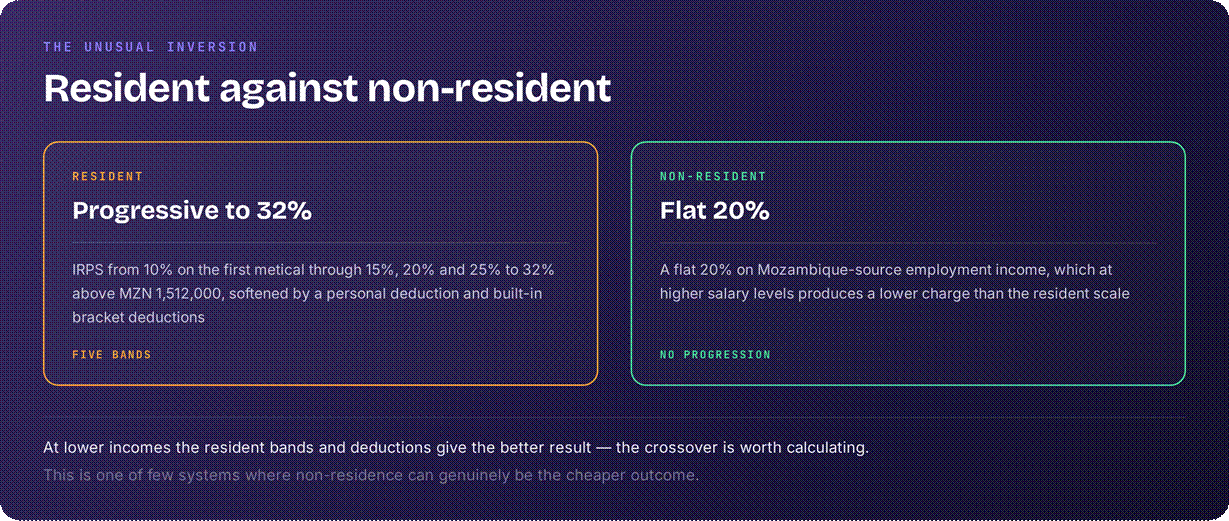
Two statuses, and which one costs less.
Your residency status is the first step
Residents are taxed on the progressive IRPS scale. Non-residents pay a flat 20% on Mozambique-source employment income.
Because the resident scale reaches 25% at MZN 504,000 and 32% above MZN 1,512,000, a non-resident on a substantial salary can face a lower effective charge than a resident on the same figure. That is unusual and worth modelling rather than assuming.
Maintain accurate records of:
• Your residence status and how it was determined;
• Annual income against each of the five band thresholds;
• The personal deduction applied;
• The built-in deduction for your band;
• INSS contributions, which are deductible from gross; and
• Whether any income is Mozambique-source, for non-resident purposes.
The tax rates
Annual taxable income (MZN) | Rate |
0 to 42,000 | 10% |
42,001 to 168,000 | 15% |
168,001 to 504,000 | 20% |
504,001 to 1,512,000 | 25% |
Above 1,512,000 | 32% |
Non-residents | 20% flat on Mozambique-source employment income |
Personal deduction | MZN 1,800 a year |
INSS, employee | 3% of gross, no cap |
Each bracket above the first carries a built-in deduction, which is how the marginal structure is turned into a single calculation. The practical effect is that the amount actually payable is meaningfully below what applying the band rate to the whole of income would suggest.
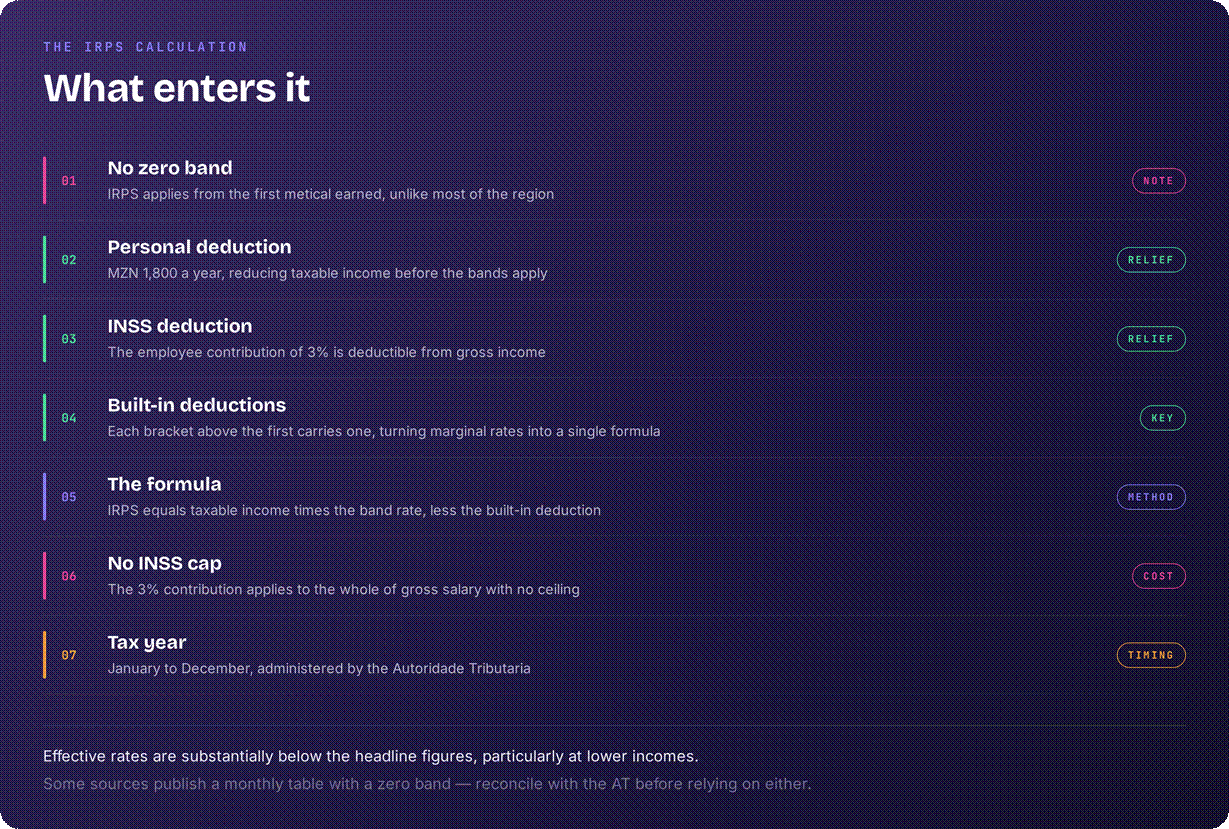
Everything that enters the calculation.
What makes Mozambique workable
The position is better than the absence of a zero band implies:
• A 10% entry rate, which is low even though it starts at the first metical;
• Built-in bracket deductions that pull effective rates well below the headline figures;
• A personal deduction reducing taxable income before the bands apply;
• A flat 20% for non-residents, which beats the resident position at higher incomes;
• A 32% top rate that only engages above MZN 1,512,000; and
• A calendar tax year, aligning with most of the world.
The honest qualifications are that INSS applies at 3% with no earnings cap, that there is no tax-free threshold at all, and that published sources differ — some show a monthly table with a zero band up to around MZN 20,249, which should be reconciled with the Autoridade Tributária before relying on either.
Case study: when non-residence is better
A resident earning MZN 2,000,000 a year moves through every band, reaching 32% on the portion above MZN 1,512,000, with the built-in deductions softening but not removing the effect.
A non-resident on the same MZN 2,000,000 of Mozambique-source employment income pays a flat 20% on the whole amount, with no bands and no progression.
The comparison runs the opposite way at lower incomes, where the resident bands and deductions produce a better result. The crossover point is worth calculating rather than assuming, and it is one of the few systems where being a non-resident can genuinely be the cheaper outcome.
Filing and the compliance calendar
IRPS is withheld monthly as retenção na fonte sobre rendimentos do trabalho and administered by the Autoridade Tributária de Moçambique. The tax year runs January to December.
Employees also contribute 3% of gross salary to INSS, the Instituto Nacional de Seguridade Social, with no earnings cap, and the employer contributes a further amount. The employee contribution is deductible from gross income in computing IRPS.
Prepare in good time:
• Registration with the Autoridade Tributária;
• Payroll records showing the personal and built-in deductions;
• Confirmation of your residence status;
• INSS records, noting the absence of a cap;
• Reconciliation of the annual and monthly tables; and
• Records of Mozambique-source income if non-resident.
Model both statuses
Consider:
• That there is no zero band — 10% starts immediately;
• That built-in deductions pull the effective rate well below the headline;
• That non-residents pay a flat 20% with no progression;
• That this can be cheaper than the resident position at higher incomes;
• That INSS at 3% has no earnings cap;
• That published monthly and annual tables differ; and
• That the tax year runs January to December.
Your Mozambique checklist
1. Note there is no zero band at all;
2. Apply the MZN 1,800 personal deduction first;
3. Deduct the 3% INSS contribution from gross;
4. Use the built-in deduction for your band;
5. Model the flat 20% non-resident position as a comparison;
6. Calculate the crossover point between the two;
7. Note INSS has no earnings cap;
8. Reconcile the annual and monthly tables with the AT;
9. Work to the January-to-December year; and
10. Confirm your residence status formally.
Frequently asked questions
Does Mozambique have a tax-free band?
No. IRPS applies from the first metical earned, which is unusual in the region. A personal deduction of MZN 1,800 a year and built-in bracket deductions reduce the effect but there is no zero band.
What are the rates?
Five bands — 10% on income to MZN 42,000, 15% to MZN 168,000, 20% to MZN 504,000, 25% to MZN 1,512,000 and 32% above that.
What is a built-in deduction?
Each bracket above the first carries a deduction that converts the marginal rates into a single formula: IRPS equals taxable income multiplied by the band rate, less the built-in deduction. It makes effective rates substantially lower than the headline rates suggest.
How are non-residents taxed?
At a flat 20% on Mozambique-source employment income, with no bands and no progression.
Can non-residence be cheaper?
At higher incomes, yes. Because the resident scale reaches 25% at MZN 504,000 and 32% above MZN 1,512,000, a non-resident paying a flat 20% can face a lower charge. At lower incomes the resident position is better.
What about social security?
Employees contribute 3% of gross salary to INSS with no earnings cap, and employers contribute a further amount. The employee contribution is deductible in computing IRPS.
Why do sources disagree on the bands?
Some publish an annual table with no zero band while others show a monthly table with a zero band to around MZN 20,249. The two should be reconciled with the Autoridade Tributária before relying on either.
When does the tax year run?
January to December. IRPS is withheld monthly at source and administered by the Autoridade Tributária de Moçambique.
Official sources and further reading
• Autoridade Tributária de Moçambique
Important information
This article is general information and does not constitute tax, legal, immigration or financial advice, and does not create a client relationship. Tax outcomes depend on travel history, income sources, treaty status and the law applying to the relevant year. Rates, thresholds and regimes change, and some measures described may be proposed rather than enacted; this article reflects our understanding as at the date of publication. Obtain advice from a suitably qualified professional before acting or refraining from action.
