
Most countries start with residence and then ask what a resident is taxed on. Namibia does not. It asks one question: is this income from a Namibian source, or deemed to be? If yes, it is taxed. If no, it is not — and it makes no difference whether you arrived last week or have lived in Windhoek for twenty years.
That is a genuinely unusual position, and a genuinely useful one. There is no 183-day rule to manage, no centre-of-vital-interests test to argue about, and no need for a special expatriate regime — because on a source basis there is nothing for one to relieve. Foreign dividends, foreign interest, foreign consulting fees, foreign pensions and foreign portfolio gains sit outside Namibian tax by default.
The complication is on the other side of the line. Namibia’s deeming provisions are broad, and one of them is aimed squarely at people doing work while physically present.
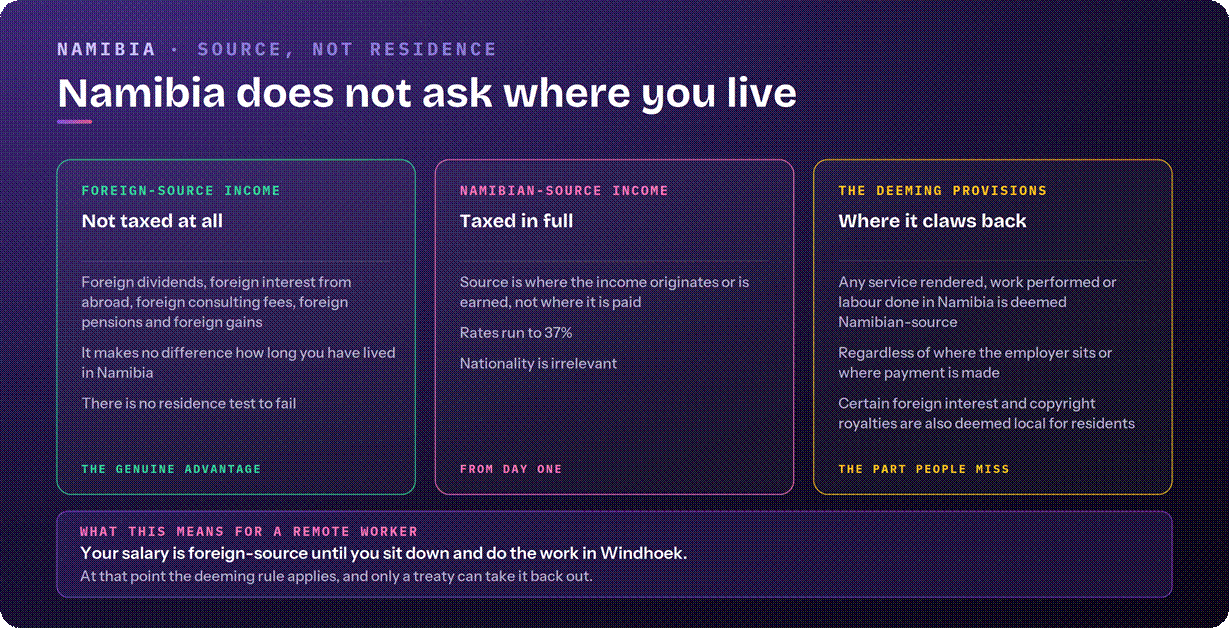
Source is the only question, and the deeming rules decide the hard cases.
How source is determined
Source is the place where income originates or is earned — not the place of payment. The legislation then adds deeming provisions that treat certain income as Namibian-source even where a plain reading might not.
The provision that matters most to an expatriate deems Namibian-source any service rendered, work performed or labour done in Namibia. It applies regardless of where the employment contract was concluded, where the employer is established, or where the remuneration is paid — including where it is paid entirely offshore.
Paying yourself offshore does not solve it. This is the single most common misunderstanding about Namibia. A foreign employer paying a foreign salary into a foreign bank account does not put the income outside the Namibian net if the work itself was performed in Namibia. The place of payment is not decisive; the place of performance is.
A second set of deeming rules works in the other direction: certain income arising outside Namibia — notably some interest and certain copyright royalties — may be deemed to arise in Namibia in the hands of a Namibian resident. So the pure source description has edges, and those edges are worth checking against your own income mix.
Where the deeming rule stops
There is no domestic relief from the deeming rule. Namibia has no expatriate regime, no short-stay exemption in its own legislation and no de minimis threshold of days below which the charge does not arise. On a strict reading, income from services rendered while physically in Namibia is Namibian-source, which brings with it an obligation to register for tax and file a return.
The treaty is what usually rescues the position. Namibia has agreements with Botswana, France, Germany, India, Malaysia, Mauritius, Romania, Russia, South Africa, Sweden and the United Kingdom. Most contain a short-stay employment article that relieves the charge for someone resident in the treaty country, paid by a non-Namibian employer, whose cost is not borne by a Namibian permanent establishment. If your country is not on that list, there is no relief — only the domestic charge.
Namibian domestic law does not itself recognise the concept of a permanent establishment. It only arises where a treaty applies. That cuts both ways: it removes a protection for foreign employers who have no treaty to rely on, and it means a foreign employer whose staff work from Namibia can face exposure sooner than they expect.
Example: Rachel
Rachel is UK tax resident and spends four months working from Swakopmund for a London employer that has no Namibian presence and bears none of her cost locally.
Under Namibian domestic law her remuneration for those four months is deemed Namibian-source, because the services were performed in Namibia. Under the UK–Namibia agreement, the short-stay employment article is likely to relieve the charge on the facts described. The analysis depends entirely on the treaty — and it would come out differently for someone resident in a country Namibia has no agreement with.
The tax rates and what does not exist
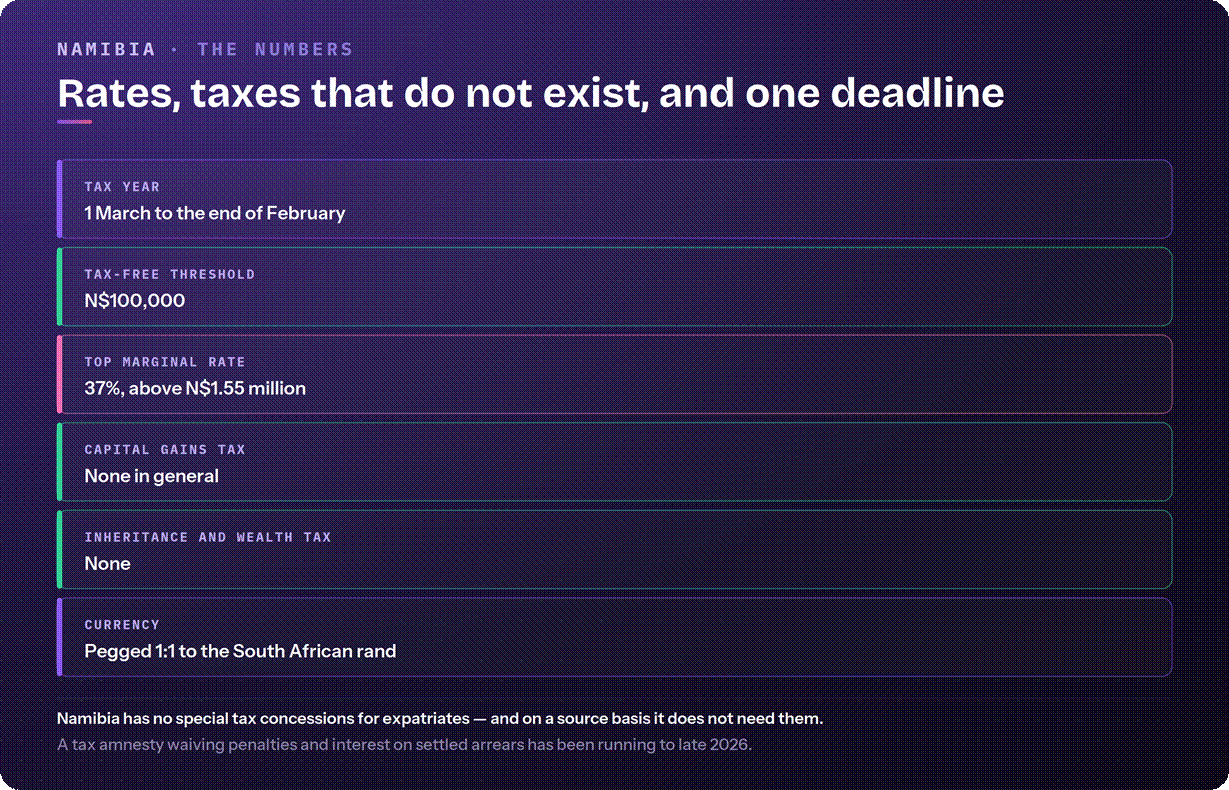
Rates on Namibian-source income, and a short list of taxes Namibia does not charge.
The tax year runs from 1 March to the end of February, which matters if you are coordinating with a calendar-year or an April-to-April system elsewhere. Rates are progressive from a tax-free threshold of N$100,000 up to a top marginal rate of 37%.
There is no general capital gains tax, no inheritance tax and no wealth tax. Withholding taxes apply on dividends and royalties paid to non-residents, and on certain services rendered by non-residents; interest paid by a registered Namibian banking institution or unit trust scheme to a person other than a Namibian company carries 10% withholding. VAT is 15%. The Namibian dollar is pegged one-to-one with the South African rand, so rand income carries no exchange risk and other currencies do.
A tax amnesty waiving penalties and interest on arrears settled by the deadline has been running into late 2026. If you have an unresolved Namibian filing history, that is worth checking before the window closes.
Who Namibia suits
It suits someone whose income genuinely arises outside Namibia and who wants a real base rather than a paper one: a retiree with a foreign pension, an investor with a foreign portfolio, a business owner whose operations are elsewhere. For all of them, Namibia taxes nothing and asks no residence questions.
It suits someone doing the work on the ground less cleanly, because the deeming rule points the other way and the answer then depends on whether a treaty covers you. And it suits nobody who wants a paper residence while actually living elsewhere — substance matters for your departing country’s exit rules regardless of what Namibia thinks.
Your checklist
• Sort your income into Namibian-source and foreign-source before anything else;
• Assume work physically performed in Namibia is Namibian-source, whoever pays it;
• Check whether Namibia has an agreement with your country of residence;
• If it does, read the short-stay employment article carefully against your facts;
• If it does not, budget for a domestic charge and a filing obligation;
• Flag the permanent establishment question to your employer, since Namibia recognises it only under treaty;
• Check whether any foreign interest or copyright royalties are caught by the reverse deeming rules;
• Work to a 1 March to end-February tax year;
• Note that there is no capital gains, inheritance or wealth tax; and
• If you have historic Namibian exposure, look at the amnesty window before it closes.
Frequently asked questions
Does Namibia tax my foreign income?
No. Namibia taxes source, not residence, so foreign-source income falls outside the charge however long you live there. Narrow exceptions deem certain foreign interest and copyright royalties to arise in Namibia for residents.
Is there a 183-day rule?
Not for the basis of charge. Namibia does not tax on residence at all, so there is no day count that brings foreign income into the net. Residence concepts only become relevant under a treaty, where another country is also claiming you.
I work remotely from Namibia for a foreign employer. Am I taxed?
On a strict reading, yes. Any service rendered, work performed or labour done in Namibia is deemed Namibian-source regardless of where the employer sits or where you are paid. Whether a charge actually arises usually turns on whether a treaty relieves it.
Is there a minimum number of days before the charge arises?
Not in Namibian domestic law. There is no de minimis threshold and no short-stay exemption, so the deeming rule applies from the first day of work performed in Namibia. Any relief has to come from a treaty.
Which countries does Namibia have treaties with?
Botswana, France, Germany, India, Malaysia, Mauritius, Romania, Russia, South Africa, Sweden and the United Kingdom. If your country is not on the list, there is no treaty relief available.
What are the income tax rates?
Progressive, with a tax-free threshold of N$100,000 and a top marginal rate of 37% above N$1.55 million. The tax year runs 1 March to the end of February.
Is there capital gains or inheritance tax?
No general capital gains tax, no inheritance tax and no wealth tax. Withholding taxes do apply to certain payments to non-residents.
Are there special regimes for expatriates?
No, and on a source basis there is nothing for one to relieve. The absence of expatriate concessions is a feature of the system rather than a gap in it.
Official sources and further reading
• Namibia Revenue Agency (NamRA)
Important information
This article is general information and does not constitute tax, legal, immigration or financial advice, and does not create a client relationship. Tax outcomes depend on travel history, income sources, treaty status and the law applying to the relevant year. Rates, thresholds and regimes change, and some measures described may be proposed rather than enacted; this article reflects our understanding as at the date of publication. Obtain advice from a suitably qualified professional before acting or refraining from action.
