
Oman will be the first Gulf state to tax personal income. The law is already passed, the rate is 5%, and nothing at all happens until 1 January 2028.
For anyone weighing a Gulf base, Oman is now a different proposition from its neighbours. Not because anything has changed yet, but because something definitely will.
Royal Decree No. 56/2025 was issued on 22 June 2025 and published in the Official Gazette on 30 June 2025. It promulgates Oman’s Personal Income Tax Law: seventy-six articles across sixteen chapters, imposing a 5% charge on annual income above OMR 42,000 — roughly USD 109,000 — with effect from 1 January 2028.
It is the first personal income tax in the Gulf Cooperation Council, and the Tax Authority has said the threshold was set so that approximately 99% of the population falls below it. Between now and the end of 2027, the position is unchanged: Oman charges no personal income tax at all.

Nothing happens until 2028 and then it happens all at once.
Your residency status is the first step
The law distinguishes residents from non-residents, and the distinction decides scope. A resident individual will be taxed on global income; a non-resident on Omani-sourced income. For this purpose, a tax resident is broadly a person present in Oman for 183 days or more during a calendar year.
That matters more for Oman than it does for a zero-tax jurisdiction, because from 2028 residence will carry a worldwide charge rather than being a purely administrative status. Anyone structuring a Gulf base now should assume the residence question becomes live in 2028 even if it is academic today.
Maintain accurate records of:
• Arrival and departure dates by calendar year;
• Days present in Oman, tracked from now rather than from 2028;
• Where your employment or business activity is carried on;
• Worldwide income by category, in anticipation of the global charge;
• Any deductions and exemptions you expect to claim; and
• Any other country that may also treat you as resident.
What the law says so far
The mechanics published to date are straightforward. Gross income includes receipts in cash and in kind. Net income is calculated by deducting the OMR 42,000 threshold, and taxable income is net income less allowable deductions, exemptions and losses. The 5% applies to the excess rather than to the whole.
The law also carries a set of socially oriented deductions and exemptions, covering education, healthcare, inheritance, zakat, donations and primary housing. The precise scope of each will be set by the executive regulations.
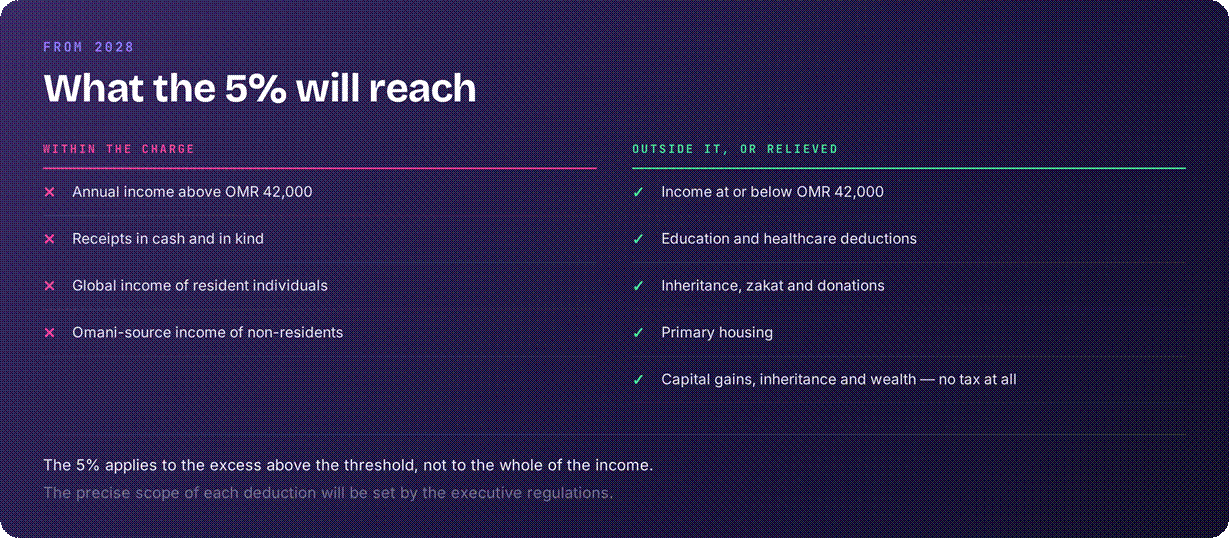
What the law reaches, and what stays outside it.
What is not changing
Oman’s wider tax position is unaffected. Corporate income tax remains at 15%, with a reduced 3% rate for qualifying small enterprises, and VAT at 5% applies to most goods and services. Free zone regimes continue on their own terms.
The rial remains pegged to the dollar, and there is no capital gains tax on individuals, no inheritance tax and no wealth tax. Even from 2028, a 5% rate on income above roughly USD 109,000 leaves Oman the lightest personal tax jurisdiction in the region by a wide margin.
Case study: Marcus plans three years out
Marcus is weighing Muscat against Dubai for a regional role paying the equivalent of OMR 70,000. Through 2026 and 2027 the two are identical on personal tax: nothing in either.
From 2028 the arithmetic diverges. In Oman, OMR 28,000 of his income sits above the threshold, and 5% of that is around OMR 1,400 a year before deductions. In the UAE, his salary remains untaxed, though he would face the AED 1 million turnover test if he worked through a business rather than as an employee.
The sum involved is small. What is not small is the precedent: Oman has legislated the principle, and anyone planning a decade in the Gulf should assume the question will be revisited elsewhere.
The compliance calendar that does not exist yet
There is no Omani personal tax return for 2026 or 2027, and none is due under the decree. The first taxable year is 2028. Returns are expected within six months of the year end, which points to a first filing deadline in mid-2029 unless the executive regulations set a different administrative rule.
The Tax Authority has been building an electronic compliance system integrated with government databases, and has signalled that training, infrastructure and educational guidance are being put in place ahead of the start date. Confirm the published position closer to the time rather than relying on this article’s reading of a law that has not yet operated.
Timing matters more here than anywhere
Oman is the rare case where the planning window is measured in years and is entirely visible. Consider:
• Whether your income would exceed OMR 42,000 from 2028;
• Whether you would be resident under the 183-day test in that year;
• How the global charge on residents would reach your foreign income;
• Which of the announced deductions and exemptions might apply to you;
• Whether the executive regulations have been published yet;
• How Oman compares with neighbouring states once the charge begins; and
• Whether your home country would still tax you regardless.
Your Oman checklist
1. Confirm whether your income would exceed OMR 42,000 from 2028;
2. Start tracking days now against the 183-day residence test;
3. Inventory your worldwide income, since residents face a global charge;
4. Identify which announced deductions might apply to you;
5. Check whether the executive regulations have been published;
6. Do not file or plan for an Omani personal return before 2029;
7. Reassess Oman against neighbouring states on a post-2028 basis;
8. Remember corporate tax at 15% and VAT at 5% are unaffected;
9. Confirm whether your home country taxes you regardless; and
10. Revisit the position once the Tax Authority publishes guidance.
Frequently asked questions
Does Oman tax personal income now?
No. Oman charges no personal income tax through 2026 and 2027. The 5% charge introduced by Royal Decree 56/2025 takes effect on 1 January 2028.
What is the rate and threshold?
5% on annual income above OMR 42,000, roughly USD 109,000. The charge applies to the excess above the threshold rather than to the whole of the income.
Who will be affected?
The Tax Authority has indicated that approximately 99% of the population falls below the threshold. The law applies to Omani nationals and expatriates alike, with residents taxed on global income and non-residents on Omani-source income.
When is the first return due?
The first taxable year is 2028. Returns are expected within six months of the year end, pointing to a first deadline in mid-2029, unless the executive regulations set a different rule.
What deductions will be available?
The law provides for socially oriented deductions and exemptions covering education, healthcare, inheritance, zakat, donations and primary housing. The precise scope of each is for the executive regulations to set.
Is this the first personal income tax in the Gulf?
Yes. Oman is the first GCC state to legislate a tax on personal income, which is why the decree attracted attention well beyond its modest revenue effect.
Does anything else change?
No. Corporate income tax stays at 15%, with 3% for qualifying small enterprises, and VAT remains at 5%. There is no capital gains tax on individuals, no inheritance tax and no wealth tax.
Should I change my plans now?
There is nothing to comply with before 2028, but there is time to plan, which is unusual. The useful step now is to establish whether you would be resident and above the threshold in 2028, and to revisit once the executive regulations are published.
Official sources and further reading
Important information
This article is general information and does not constitute tax, legal, immigration or financial advice, and does not create a client relationship. Tax outcomes depend on travel history, income sources, treaty status and the law applying to the relevant year. Rates, thresholds and regimes change, and some measures described may be proposed rather than enacted; this article reflects our understanding as at the date of publication. Obtain advice from a suitably qualified professional before acting or refraining from action.
