
Paraguay does not tax foreign income and asks remarkably little of you to become resident. That combination is the whole attraction — and it is also the weakness.
Paraguay is consistently marketed as the easiest tax residency in the world, and the claim is not unfair. Law 6380/2019 built a territorial system with low rates, and the practical requirements for becoming and staying a registered taxpayer are lighter than almost anywhere else.
Personal income tax — IRP — applies exclusively to Paraguayan-source income. Foreign dividends, interest, capital gains, pensions and income from services performed abroad are simply not taxed. There is no remittance test and no time limit, because there is no charge to begin with.
The rates on what is taxable are correspondingly modest: personal services at 8%, 9% or 10% depending on net income, and Paraguayan-source capital income at 8%, charged on the actual gain or a presumed one — 30% of the price on sales of real estate and shares — whichever produces the lower result, giving an effective rate as low as 2.4%.
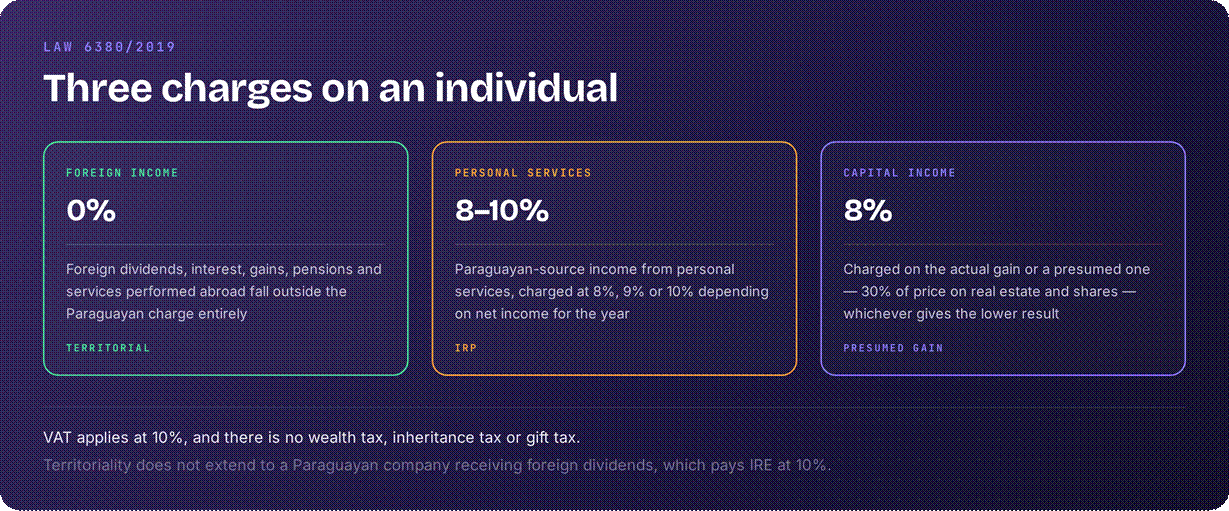
Three charges, and the one that matters most is nil.
Your residency status is the first step, and the weak point
In practice, Paraguayan tax residency follows registration. Once you hold residence and a RUC tax number issued by the tax authority, you are treated as a taxpayer, and a fiscal residence certificate can be obtained under the procedure set out in Resolución General 65/2020 for treaty purposes.
What the system does not impose is a substantial physical presence requirement. For a genuine relocation that is convenient. For someone who has moved nowhere, it is a trap, because a certificate does not answer the question another country will actually ask.
Where two countries both claim you, a treaty tie-breaker runs through permanent home, centre of vital interests, habitual abode and nationality. A Paraguayan RUC sits outside that sequence entirely. If your home, your family and your working life remain in the country you left, that country is likely to win the tie-break regardless of what your certificate says.
Maintain accurate records of:
• Days actually spent in Paraguay, even though no minimum is imposed;
• Where your permanent home is, and whether one remains available elsewhere;
• Where your family lives and where your economic interests sit;
• Registration and RUC dates, and any certificate obtained;
• Where services were physically performed, and for whom; and
• Any other country that may also treat you as resident.
What Paraguay taxes
The charge follows the source of the income, and the structure is unusually clean:
Income | Paraguayan treatment |
Foreign dividends, interest and gains | Not taxed |
Foreign pensions | Not taxed |
Services performed abroad for a foreign client | Not taxed |
Personal services performed in Paraguay | IRP at 8%, 9% or 10% |
Paraguayan-source capital income | IRP at 8%, on actual or presumed gain |
Business profits of a Paraguayan entity | IRE at 10% |
Dividends from a Paraguayan company | IDU at 8% for residents, 15% for non-residents |
Services performed abroad for an IRE or IRP taxpayer | Deemed Paraguayan-source |
Income of non-residents | INR at 15% on a presumed net margin |
Territoriality does not carry to the corporate level in the way people expect. A Paraguayan company receiving dividends or yields from foreign entities pays IRE at 10%, because Law 6380 extends the source rule to that income. The relief that benefits individuals does not follow the structure.
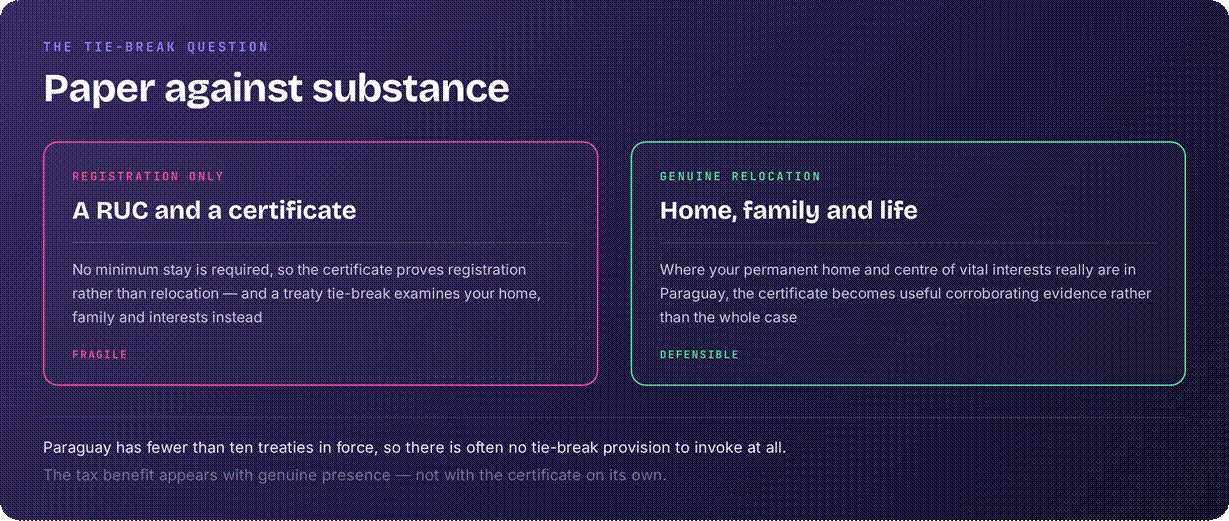
A certificate is evidence of registration, not evidence of relocation.
Tthe wider position
The treaty network is very narrow — fewer than ten agreements in force — so domestic withholding applies to most outbound payments and treaty relief cannot be assumed.
That narrow network is a second reason the paper-residency strategy is fragile. A tie-break argument needs a treaty to run through, and for most nationalities there is no Paraguay treaty to invoke.
Case study: Lena has a certificate and a problem
Lena registered in Asunción, obtained a RUC and a fiscal residence certificate, and files a Paraguayan return each year. She spends about two weeks a year in the country. Her apartment, her partner and her clients are all in Germany, where she lives for most of the year.
Paraguay is content. Germany is the issue. On a tie-break, her permanent home and centre of vital interests point firmly to Germany, and her certificate does not change any of the facts the test actually examines.
The certificate is not worthless — it is evidence, and for someone who has genuinely moved it is useful evidence. It is simply not a substitute for having moved.
Filing and the compliance calendar
The Paraguayan tax year follows the calendar year, and the authority is the Dirección Nacional de Ingresos Tributarios. IRP returns are filed annually after the year end, with the due date set by a perpetual calendar keyed to the last digit of your RUC, so two taxpayers have different deadlines in the same year.
Registration is the gateway to everything else, and a certificate of fiscal residence is generally available only once returns have been filed. Prepare in good time:
• Registration and an active RUC;
• Records of Paraguayan-source income by category;
• Documentation of where services were performed and for whom;
• Evidence supporting any presumed-gain calculation on a disposal;
• Your filing date under the perpetual calendar; and
• Evidence of genuine presence, if you intend to rely on residence abroad.
Substance matters more than structure
Model your position honestly before you rely on it, considering:
• Whether you are genuinely relocating or only registering;
• Where your permanent home and centre of vital interests will actually be;
• Whether a treaty exists between Paraguay and your other country at all;
• Whether services you perform abroad are deemed Paraguayan-source;
• Whether a Paraguayan company would lose the territorial benefit;
• What your former country requires before it releases you; and
• Whether you could evidence your position if it were challenged.
Your Paraguay checklist
1. Decide whether you are relocating or only registering, and be honest about it;
2. Establish where your permanent home and centre of vital interests will sit;
3. Check whether a treaty exists between Paraguay and your other country;
4. Track days in Paraguay even though no minimum is imposed;
5. Identify services performed abroad for IRE or IRP taxpayers, which are deemed local;
6. Separate personal services income from capital income for rate purposes;
7. Check whether the presumed-gain basis produces a lower charge on a disposal;
8. Register for a RUC and keep it active;
9. Find your filing date under the perpetual calendar keyed to your RUC; and
10. Keep evidence you could produce if your residence position were challenged.
Frequently asked questions
Does Paraguay tax foreign income?
No. IRP applies exclusively to Paraguayan-source income, so foreign dividends, interest, capital gains, pensions and income from services performed abroad are outside the charge. There is no remittance test and no time limit.
Is there a minimum stay to keep Paraguayan tax residency?
No substantial physical presence requirement is imposed, which is the basis of Paraguay’s reputation as the easiest tax residency to obtain. That absence is also what makes the position weak if another country challenges it.
Will a Paraguayan residence certificate stop my home country taxing me?
Not by itself. A treaty tie-break runs through permanent home, centre of vital interests, habitual abode and nationality. A certificate evidences registration, not relocation, and none of those tests asks whether you hold one.
What are the personal income tax rates?
8%, 9% or 10% on income from personal services depending on net income, and 8% on Paraguayan-source capital income — charged on the actual gain or a presumed one, whichever is lower.
What is the presumed gain basis?
For sales of real estate and shares, the gain may be presumed at 30% of the price. The tax is charged on the lower of the actual and presumed gain, which gives an effective rate as low as 2.4% on such disposals.
Are services I perform outside Paraguay always foreign income?
No. Law 6380 treats personal services performed outside Paraguay as Paraguayan-source where the recipient of the services is itself an IRE or IRP taxpayer. This is an easy provision to miss.
Does a Paraguayan company get the same territorial benefit?
No. A Paraguayan company receiving dividends or yields from foreign entities pays IRE at 10%, because the law extends the source rule to that income. The relief that benefits individuals does not carry over to the corporate level.
When do I file?
The tax year follows the calendar year, and IRP returns are due on a date set by a perpetual calendar keyed to the last digit of your RUC. Two taxpayers therefore have different deadlines in the same year, so check yours rather than assuming a common date.
Official sources and further reading
• Dirección Nacional de Ingresos Tributarios (DNIT)
Important information
This article is general information and does not constitute tax, legal, immigration or financial advice, and does not create a client relationship. Tax outcomes depend on travel history, income sources, treaty status and the law applying to the relevant year. Rates, thresholds and regimes change, and some measures described may be proposed rather than enacted; this article reflects our understanding as at the date of publication. Obtain advice from a suitably qualified professional before acting or refraining from action.
