
Poland built three separate incentives for people moving in, and they suit completely different incomes. One is for the wealthy, one for returning workers, and one for anyone earning from intellectual property.
Poland is not an obvious entry on a list of favourable tax jurisdictions, and that is largely a reputational lag. Since 2022 it has operated a lump-sum regime on foreign income that sits alongside regimes in Greece and Italy, and it has two further reliefs that are considerably more accessible.
Poland taxes residents on worldwide income. The general scale is 12% and 32%, with the higher rate applying above PLN 120,000 and a tax-free amount of PLN 30,000. Entrepreneurs can elect a flat 19% or a revenue-based lump sum, and capital income — dividends, interest and securities gains — is taxed separately at a flat 19%.
A solidarity levy of 4% applies to most categories of income above PLN 1 million a year, which is the figure high earners tend to overlook when comparing headline rates.
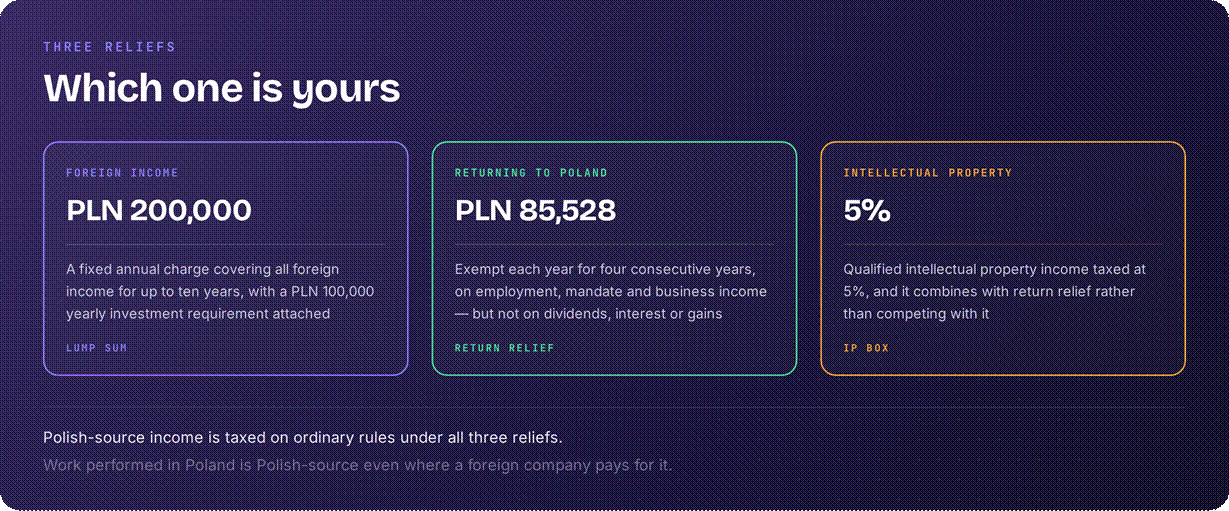
Three reliefs, three entry tests, three different targets.
Your residency status is the first step
You are Polish tax resident if you have your centre of personal or economic interests in Poland, or if you stay in Poland for more than 183 days in a tax year. Either is enough, and the first does not depend on the second.
The centre-of-interests limb is the one that catches people. Someone whose family moves to Warsaw while they continue working elsewhere can be Polish resident on a modest day count, and the reliefs below all require Polish residence, so establishing it is the gateway rather than the risk.
Maintain accurate records of:
• Days spent in Poland in each tax year;
• Where your family lives and where your economic interests sit;
• The years you were tax resident elsewhere, and in which countries;
• The date you transferred residence to Poland;
• Foreign entities you control, for the CFC rules; and
• Any other country that may also treat you as resident.
The three reliefs side by side
Relief | What it does |
Lump sum on foreign income | PLN 200,000 a year covers all foreign income |
Lump sum entry test | Not Polish resident in 5 of the 6 preceding years |
Lump sum election | By the end of January following relocation |
Lump sum investment | At least PLN 100,000 a year in qualifying activity |
Return relief | Up to PLN 85,528 exempt a year, for four years |
Return relief entry test | Residence moved to Poland after 31 December 2021 |
IP Box | 5% on qualified intellectual property income |
Polish-source income | Taxed on ordinary rules under all three |
Polish-source income includes work performed in Poland even where a foreign company pays for it. That matters for the lump-sum regime in particular: it covers income derived outside Poland, and a remote worker sitting in Warsaw is not deriving income outside Poland merely because the client is abroad.

Every condition must hold — the lump sum is the narrowest of the three.
The lump sum on foreign income
A fixed PLN 200,000 a year — roughly USD 50,000 — discharges Polish tax on all foreign income, whatever its size, and the individual does not declare the underlying foreign income at all. The regime runs for up to ten consecutive tax years.
Entry requires that you were not Polish tax resident in at least five of the six years immediately preceding the year of relocation, and the election must be filed by the end of January of the year following the one in which you became resident. On top of the tax, you must invest at least PLN 100,000 a year in socially significant activity from the year after relocation.
The arithmetic is straightforward: the regime works above roughly PLN 1 million of foreign income and not below it. Someone with moderate foreign income is better off on ordinary rules.
Return relief
Far more accessible, and far more widely useful. Return relief exempts income up to PLN 85,528 a year for four consecutive years for someone who moved their residence to Poland after 31 December 2021 and had been tax resident elsewhere for at least three years beforehand.
It covers employment income, contracts of mandate, maternity benefit, and business income taxed under the scale, the flat 19%, the 5% IP Box or the registered lump sum. It does not cover management contracts or board remuneration, interest, dividends or capital gains, task contracts, or royalties outside an employment relationship.
You choose whether the four years start in the year you move or the following year, which is worth thinking about if you arrive late in a year.
The IP Box
Income from qualified intellectual property rights can be taxed at 5%. For software developers, designers and others whose income derives from IP they have created, this is frequently the most valuable of the three, and it combines with return relief rather than competing with it.
Case study: Marek and Kasia arrive the same month
Marek returns from London after six years to take a development role in Kraków, earning the equivalent of PLN 180,000. Return relief exempts the first PLN 85,528 for four years, and the balance is taxed on the scale. If he structures his work around qualified IP he may reach the 5% IP Box on part of it as well.
Kasia returns the same month with a portfolio generating PLN 2.5 million a year in foreign dividends. Return relief is worth little to her — her income is capital income, which it does not cover. The lump sum does: PLN 200,000 a year discharges the lot.
Two returning Poles, the same month, needing entirely different advice. The reliefs are not ranked; they are aimed at different incomes.
Filing, and the way out
The Polish tax year follows the calendar year and the annual PIT return is due by 30 April of the following year. A PESEL or NIP number is needed first.
Departure has its own charge. Poland applies an exit tax on unrealised gains where the taxpayer was Polish resident for at least five of the ten preceding years, so a long stay changes the arithmetic of leaving. Prepare in good time:
• Evidence of prior non-residence for the relief you are claiming;
• The election filing, where the lump sum applies;
• Documentation of the PLN 100,000 annual investment;
• Records separating Polish-source from foreign-source income;
• Qualified IP documentation, if claiming the IP Box; and
• A review of foreign entities against the CFC rules.
Choosing between them
Model your position before you move, considering:
• Whether your income is employment income, business income or capital income;
• Whether it exceeds roughly PLN 1 million, where the lump sum starts to work;
• How many of the last six years you were resident elsewhere;
• Whether the end-of-January election deadline is achievable;
• Whether any of your work will be performed physically in Poland;
• Whether qualified IP income could reach the 5% rate; and
• What the exit tax would cost if you later leave.
Your Poland checklist
1. Establish which relief your income type actually fits;
2. Count the preceding years of non-residence against the right test;
3. Model the lump sum against ordinary rules at your actual income;
4. Diarise the end-of-January election deadline if using the lump sum;
5. Budget for the PLN 100,000 annual investment requirement;
6. Check whether return relief covers your income category;
7. Decide whether return relief starts in the year of arrival or the next;
8. Assess whether qualified IP income could reach the 5% rate;
9. Review foreign entities against the CFC rules before arriving; and
10. Price the exit tax before committing to a long stay.
Frequently asked questions
What does the PLN 200,000 lump sum cover?
All foreign income, whatever its size, for up to ten consecutive tax years. The underlying foreign income does not have to be declared. Polish-source income is taxed on ordinary rules alongside it.
Who can elect the lump sum?
Someone who was not Polish tax resident in at least five of the six years preceding relocation, who elects by the end of January of the year following, and who invests at least PLN 100,000 a year in socially significant activity.
At what income does the lump sum make sense?
Broadly above PLN 1 million of foreign income. Below that, ordinary rules — or return relief, if your income qualifies — usually produce a lower liability.
What is return relief?
An exemption of up to PLN 85,528 a year for four consecutive years, for someone who moved their residence to Poland after 31 December 2021 having been resident elsewhere for at least three years. It covers employment, mandate and business income, including under the IP Box.
Does return relief cover investment income?
No. Interest, dividends and capital gains are outside it, as are management contracts, board remuneration, task contracts and royalties earned outside an employment relationship.
Can I use return relief and the IP Box together?
Yes. Business income taxed under the 5% IP Box is among the categories return relief covers, so the two work alongside each other rather than in competition.
Am I resident if I spend under 183 days in Poland?
Possibly. Having your centre of personal or economic interests in Poland makes you resident independently of the day count, so someone whose family has moved while they work elsewhere can be caught.
What happens if I leave Poland later?
An exit tax applies to unrealised gains where you were Polish resident for at least five of the ten preceding years. A long stay therefore changes the cost of departure, and it should be modelled before rather than at the point of leaving.
Official sources and further reading
• Krajowa Administracja Skarbowa — podatki.gov.pl
• Powroty.gov.pl — official guidance for returning residents
Important information
This article is general information and does not constitute tax, legal, immigration or financial advice, and does not create a client relationship. Tax outcomes depend on travel history, income sources, treaty status and the law applying to the relevant year. Rates, thresholds and regimes change, and some measures described may be proposed rather than enacted; this article reflects our understanding as at the date of publication. Obtain advice from a suitably qualified professional before acting or refraining from action.
