
If you are considering a low-tax European base, Romania deserves careful attention. Its generally applicable 10% personal income tax rate is among the lowest in the European Union, and the country has an extensive network of 86 double taxation agreements.
However, the headline rate is only one part of the decision. Where will you pay tax? Will Romania treat you as a tax resident? Will your worldwide income become taxable, or will Romania tax only your Romanian-source income? What must you file, and when?
These questions should be answered before you relocate, not after your tax position has already been established.
This guide explains the main points from the TaxPilot Global Tax Index, focusing on personal taxation, residency, rates, treaty protection and compliance.
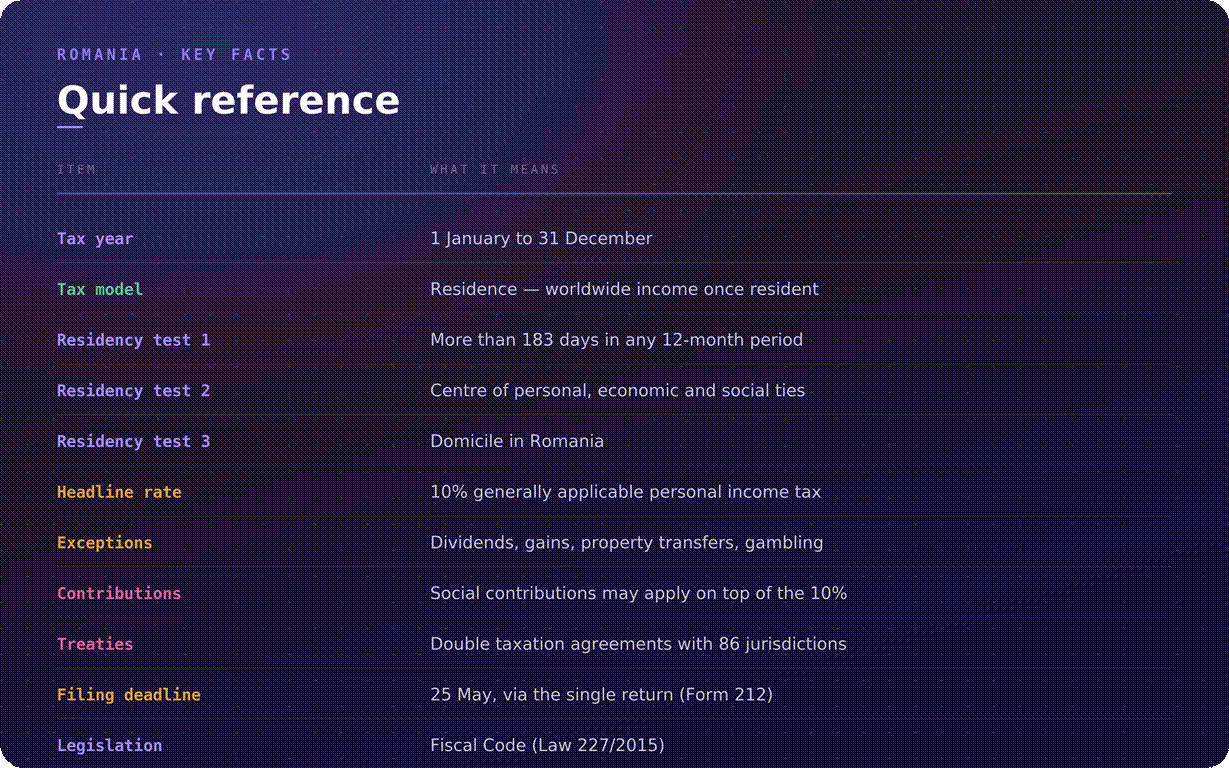
The Romanian position at a glance.
Your Romanian tax residency status is the first thing to establish
Romania follows a residence taxation model. Romanian tax residents are generally taxed on their worldwide income, while non-residents are generally taxed only on income sourced in Romania.
You may be treated as a Romanian tax resident if any of the following applies:
• You are present in Romania for more than 183 days during any 12-month period;
• Your personal, economic and social ties are located in Romania during the tax year; or
• You are domiciled in Romania, unless you relocate to a country that has a treaty with Romania and can establish treaty residence there.
The 183-day threshold is important, but it is not the only test. A common mistake is to assume that staying under 183 days automatically prevents Romanian tax residence. That conclusion may be wrong if your home, family, work, business or economic interests are principally located in Romania.
What do the Romanian authorities assess?
Your position is typically assessed by looking at several connected factors rather than any one of them in isolation:
Factor | What is assessed |
Physical presence | Days spent in Romania during the relevant 12-month period |
Accommodation | Whether a home or other accommodation is available for your use |
Personal ties | Where your spouse, children and close relationships are located |
Economic ties | Where you work, trade, hold investments or generate income |
Domicile | Whether Romania remains your legal or permanent home |
Treaty residence | Whether another country can claim you under the applicable treaty |
The broader question is often where your life is genuinely centred.
Worth knowing. Romania operates a residency questionnaire for arrivals and departures. Non-residents are generally expected to submit it to the competent tax office within 30 days of meeting the 183-day threshold, and the authority then notifies whether you have a full Romanian tax obligation or will be taxed only on Romanian-source income.
Case study: Mark relocates to Bucharest
Mark is a freelance software developer who moves from the United Kingdom to Bucharest. During the year he spends 200 days in Romania, rents an apartment and performs his work from there.
Mark is likely to satisfy the physical-presence test, and his accommodation and work pattern support the conclusion that Romania is his tax residence. He should expect Romania to examine his worldwide income position, subject to any applicable treaty provisions and to how each income source is classified.
Mark should keep records of his travel, accommodation, contracts, invoices and income received both before and after the move. These records may be decisive if his residency position is reviewed.
Residents and non-residents are taxed very differently
Your exposure depends substantially on which side of that line you fall.

Residency decides the scope of the charge, not just the rate.
If you are a Romanian tax resident
You will generally be taxable in Romania on your worldwide income. Depending on your circumstances, this may include:
• Employment income;
• Freelance and self-employment income;
• Business income;
• Rental income;
• Dividends and interest;
• Capital gains; and
• Other foreign or domestic personal income.
The rules differ by category of income, so the 10% headline rate should not be applied mechanically to every payment you receive.
If you are a Romanian non-resident
You are generally taxed only on Romanian-source income. This may include income connected with Romanian employment, Romanian property, local business activities or other Romanian sources.
If you work remotely from outside Romania and do not become Romanian tax resident, your foreign income may fall outside Romanian worldwide taxation. Romanian-source income can still create reporting or payment obligations.
The point most people miss. You may also have obligations in the country where you are resident, the country where you physically perform the work, and the country from which income is sourced. For remote work, the location of the activity usually matters more than the location of your client, employer or bank account.
The 10% flat tax is attractive, but it is not the whole bill
Romania generally applies a 10% personal income tax rate, making it a notable low-tax option in Europe. That can be particularly relevant if you are a freelancer, remote worker or entrepreneur whose income would otherwise face higher progressive rates elsewhere.
However, the 10% rate is generally applicable rather than universal. Different treatment can apply to particular categories, including some forms of:
• Dividend income;
• Capital gains;
• Transfers of immovable property; and
• Gambling income.
Social contributions and other obligations may also apply depending on your income type and circumstances. You should therefore distinguish between the personal income tax rate and your total effective tax burden.
Case study: Felicity compares two tax bases
Felicity is a location-independent consultant earning income from clients in several countries. She is considering Romania because the 10% rate is lower than the rate in her current country.
Felicity should not compare rates alone. She must first determine whether Romania would treat her as resident, whether her consulting income is taxable in Romania, whether social contributions apply, and whether her current country continues to regard her as resident.
If both countries treat her as resident, the relevant treaty may provide tie-breaker rules and relief from double taxation. She should take advice based on the specific treaty, her workdays, her accommodation and her personal ties.
Romania's 86 treaties can help manage double taxation
Romania has 86 double taxation agreements, which is a significant practical advantage for internationally mobile individuals.
A treaty allocates taxing rights between two countries and provides mechanisms intended to prevent the same income being taxed twice. The applicable agreement may address:
• Which country can treat you as a treaty resident;
• Which country can tax employment income;
• How business or self-employment income is allocated;
• How dividends, interest and pensions are treated; and
• Whether foreign tax credits or exemptions are available.
If you are domestically resident in both Romania and another country, the treaty may apply a tie-breaker test examining your permanent home, centre of vital interests, habitual abode and nationality.
Establish your treaty position in good time. A treaty does not automatically eliminate every obligation, and it may not prevent source-country taxation in all circumstances.
You should also obtain and retain relevant evidence, such as:
• A foreign tax residence certificate;
• Romanian residency documentation;
• Travel and day-count records;
• Lease agreements;
• Employment or client contracts;
• Evidence of where work was physically performed; and
• Records of foreign tax paid.
The Romanian compliance calendar runs January to December
Romania uses the calendar year as its tax year.
The principal individual filing deadline is 25 May, generally for reporting and settling relevant income from the preceding calendar year. Income earned in one calendar year is generally reported by 25 May of the following year, subject to the applicable filing rules.
You may be required to submit a personal tax declaration where you receive non-salary income, including freelance, rental or investment income. This is filed through the single return, known in Romania as the Declarație unică, Form 212. Advance payments may also apply depending on your income and circumstances.
You should therefore:
1. Track your Romanian presence throughout each 12-month period;
2. Identify when your Romanian tax residence begins;
3. Categorise each income source correctly;
4. Review whether foreign income must be included;
5. Check whether advance payments apply;
6. Prepare your filing before 25 May; and
7. Retain supporting documents for your residency and income position.
Late filing or late payment may result in penalties and interest. Take the relevant steps well before the deadline, particularly if you have income from several countries.
Is Romania right for your international lifestyle?
Romania may suit you if you are seeking:
• A generally applicable 10% personal income tax rate;
• A European tax residence;
• Access to a broad treaty network;
• A calendar-year tax system; and
• A potentially efficient base for freelance or remote work.
It may be less suitable if you want to avoid worldwide taxation after becoming resident, if your personal ties remain strongly connected to another country, or if your income falls within categories subject to different rates or contributions.
Romania's opportunity lies in the combination of a low headline rate, its residence rules and an 86-treaty network. The right outcome depends on how those features interact with your individual circumstances.
Frequently asked questions
Does staying under 183 days keep me out of Romanian tax residence?
Not necessarily. The day count is one test among several. Romania can also treat you as resident based on where your personal, economic and social ties sit, or on domicile, so a short stay does not settle the question by itself.
If I become Romanian tax resident, does Romania tax my foreign income?
Generally yes. Romania operates a residence model, so residents are taxed on worldwide income. A treaty may restrict what Romania can tax or provide credit for foreign tax paid, depending on the income type and the agreement in question.
Is the 10% rate really what I will pay?
Not always. The 10% rate is generally applicable rather than universal, and different treatment applies to some dividends, capital gains, property transfers and gambling income. Social contributions may also apply on top, so your effective burden can be higher than the headline rate.
I am a freelancer. Do I pay social contributions as well as income tax?
Possibly. Social contributions can apply depending on your income type and level, and they sit alongside income tax rather than within it. This is the single most common reason a Romanian calculation comes out higher than expected.
When is the Romanian filing deadline?
The main individual deadline is 25 May, covering income from the previous calendar year. Non-salary income such as freelance, rental or investment income is reported on the single return, Form 212.
What happens if both Romania and my home country treat me as resident?
The applicable treaty usually contains a tie-breaker that runs through permanent home, centre of vital interests, habitual abode and finally nationality. You will need evidence — leases, day counts, contracts and a foreign residence certificate — to support your position.
Do I need to tell the Romanian authorities when I arrive or leave?
Generally yes. Romania operates a residency questionnaire for arrival and departure, and non-residents are typically expected to submit it within 30 days of meeting the 183-day threshold. The tax office then confirms the extent of your Romanian obligation.
Can I keep my foreign company and just live in Romania?
It is not that simple. Where a company is managed from can affect where it is treated as resident, and your own residency can change how distributions are taxed. Structures that ignore the management question often create more exposure than they remove.
Official sources and further reading
• Romanian Fiscal Code (Law 227/2015)
• ANAF guidance on the fiscal residence of individuals (English)
• ANAF list of double taxation conventions
• ANAF guidance on the single return (Form 212)
Important information
This article is general information and does not constitute tax, legal, immigration or financial advice, and does not create a client relationship. Tax outcomes depend on travel history, income sources, treaty status and the law applying to the relevant year. Rates, thresholds and regimes change, and some measures described may be proposed rather than enacted; this article reflects our understanding as at the date of publication. Obtain advice from a suitably qualified professional before acting or refraining from action.
