
Saint Lucia splits taxpayers three ways rather than two. Land in the middle category and foreign income is taxed only to the extent you bring it in — and there is no capital gains tax at all.
Most systems divide people into residents and non-residents. Saint Lucia uses three categories, and the middle one is where the value sits.
An individual who is resident or ordinarily resident is taxed on income from all sources, whether in or outside Saint Lucia. An individual who is resident but not ordinarily resident is taxed on all Saint Lucian sources, plus foreign income only to the extent that it is remitted to Saint Lucia. A non-resident is taxed on income arising in Saint Lucia, plus foreign income to the extent it is received there.
That middle category is a genuine remittance basis, and it is the one an arriving expatriate typically occupies before ordinary residence is established.
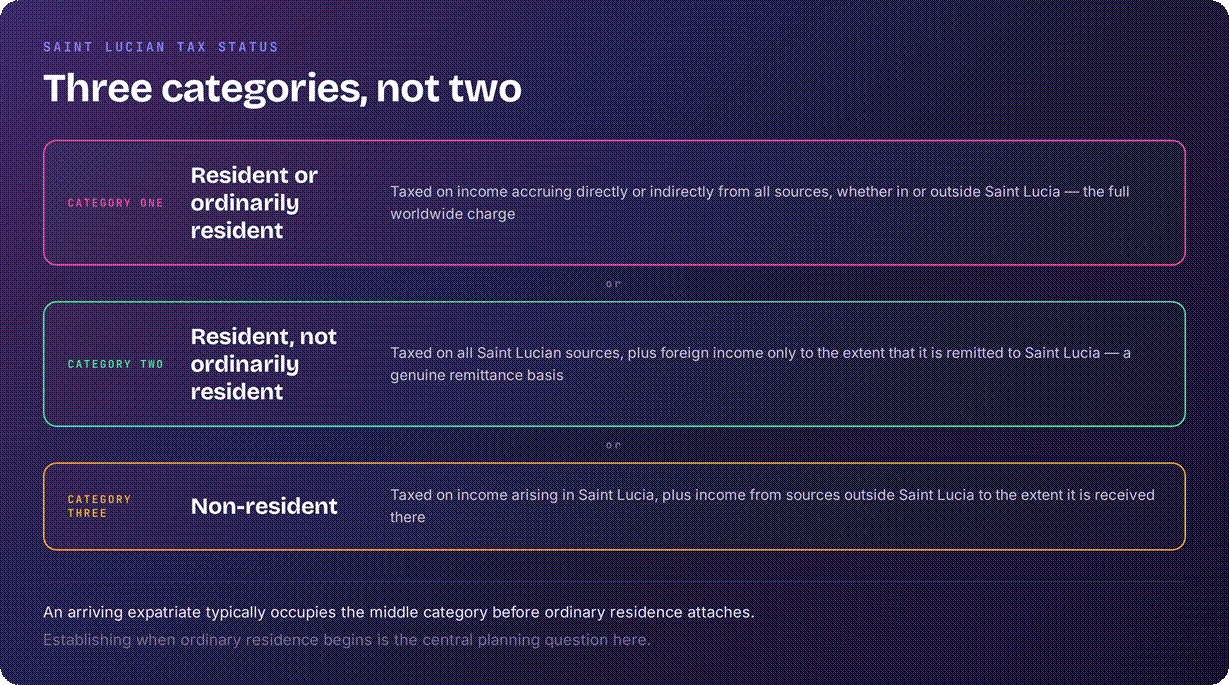
Three categories, three different charges.
Your residency status is the first step
The distinction between resident and ordinarily resident does the heavy lifting here. Residence follows presence, generally more than 183 days in a tax year. Ordinary residence is a further concept reflecting settled, habitual residence rather than mere presence.
Someone who is resident without yet being ordinarily resident falls into the remittance category. Someone who becomes ordinarily resident moves into the worldwide charge. Establishing which category applies to you, and when it changes, is the whole exercise.
Maintain accurate records of:
• Days present in each tax year;
• Whether your residence has become settled and habitual;
• Foreign income kept separate from income remitted;
• Every remittance into Saint Lucia, with dates and amounts;
• Pension income and whether it arises outside Saint Lucia; and
• Your residence position immediately before retiring, for the pension exemption.
The tax rates
Item | Position |
Personal allowance | A tax-free threshold, revised periodically |
First taxable band | 15% |
Middle band | 20% |
Top band | 30% |
Capital gains tax | None |
Inheritance tax | None |
Non-resident withholding on Saint Lucian income | 25% |
Currency | XCD, pegged to the US dollar at 2.70 |
Published figures for the personal allowance differ between sources, so it should be confirmed with the Inland Revenue Department for the year in question. The band structure of 15%, 20% and 30% is consistent across sources.
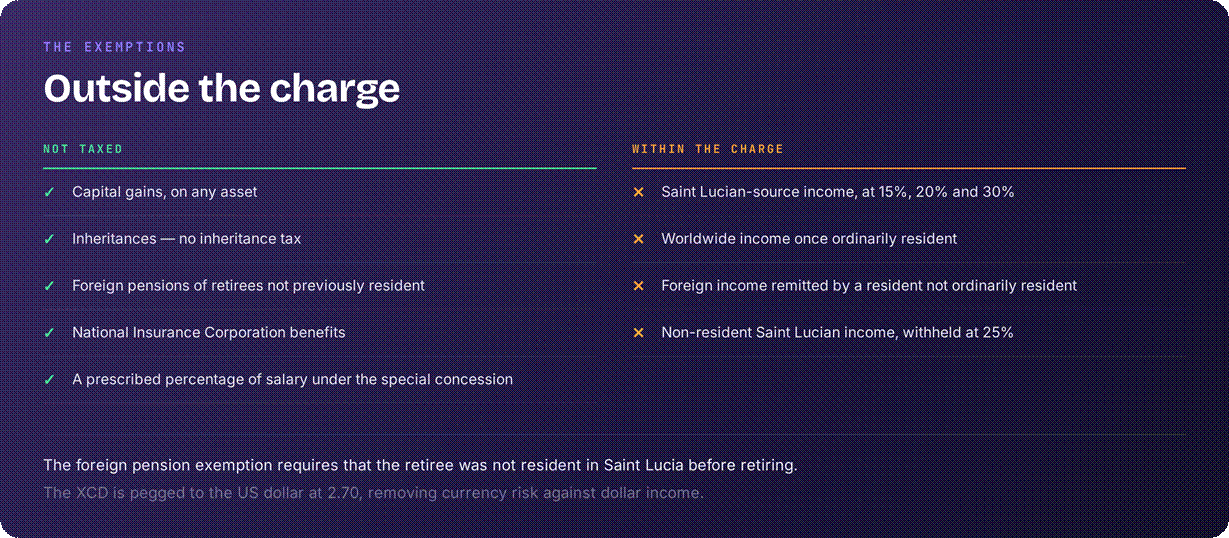
What Saint Lucia leaves alone.
The exemptions worth knowing
Several statutory exemptions matter to an inbound individual:
• Any pension accruing from a source outside Saint Lucia to a retired person who, prior to retirement, was not resident in Saint Lucia — a complete exemption for the incoming retiree;
• The first XCD 6,850 or XCD 6,000 of Saint Lucian pension income for past services, payable by the Government or an approved pension fund, subject to conditions;
• The same relief on earned income other than a pension for a resident individual who is a citizen of Saint Lucia and has reached 60;
• Benefits payable under the National Insurance Corporation Act; and
• A special tax concession allowing a prescribed percentage of an employee’s or contractor’s salary or fees to be exempt from income tax, for qualifying persons.
The foreign pension exemption is the standout. Someone who spends their working life elsewhere and retires to Saint Lucia takes their foreign pension entirely outside the charge, provided they were not resident before retiring.
What makes Saint Lucia attractive
The combination is strong for the right profile:
• A remittance basis for individuals resident but not ordinarily resident;
• No capital gains tax, on any asset;
• No inheritance tax;
• A complete exemption for foreign pensions of incoming retirees not previously resident;
• A personal allowance before the 15% band begins;
• The XCD pegged to the US dollar at 2.70, removing currency risk against dollar income; and
• A special concession exempting a prescribed percentage of salary or fees for qualifying persons.
The honest qualifications are that ordinary residence eventually brings worldwide income into charge, that the 30% top band arrives at a modest level, and that published allowance figures differ — so the position needs confirming rather than assuming.
Case study: Margaret retires to Soufrière
Margaret spends her career in Canada and retires to Saint Lucia at 63, drawing a Canadian pension. She has never been resident in Saint Lucia before.
Her Canadian pension accrues from a source outside Saint Lucia to a retired person who was not resident prior to retirement, and is therefore exempt — not taxed on a remittance basis, not taxed at a reduced rate, but exempt outright.
If she later takes local employment or Saint Lucian-source income, that falls into the ordinary charge at 15%, 20% and 30%. The exemption attaches to the foreign pension specifically, not to her generally.
Filing and the compliance calendar
The Inland Revenue Department imposes personal income tax on income after allowances and deductions, for residents and non-residents earning income in Saint Lucia. Returns are due by 31 March each year, and late submission carries a penalty of 5% on chargeable income.
Where income accrues to a non-resident company from a source other than a business carried on through a permanent establishment, the gross amount is liable to withholding tax at 25%. International Business Companies have been subject to income tax at 30% since 1 July 2021.
Prepare in good time:
• Registration with the Inland Revenue Department;
• Day-count records for each tax year;
• Evidence of your residence and ordinary residence position;
• A log of remittances into Saint Lucia;
• Pension documentation, including your pre-retirement residence position; and
• The allowance figure confirmed for the year in question.
Establish which of the three you are
Consider:
• Whether you are resident, ordinarily resident, or neither;
• That the middle category carries a remittance basis;
• When ordinary residence is likely to attach, since that ends it;
• How and when you remit foreign income;
• Whether the foreign pension exemption applies to you;
• That there is no capital gains tax or inheritance tax; and
• That the allowance figure needs confirming with the IRD.
Your St Lucia checklist
1. Establish which of the three categories applies to you;
2. Work out when ordinary residence is likely to attach;
3. Keep foreign income separate from income remitted;
4. Log every remittance into Saint Lucia;
5. Check whether the foreign pension exemption applies;
6. Document your residence position before retirement;
7. Note there is no capital gains tax or inheritance tax;
8. Confirm the personal allowance figure with the IRD;
9. File by 31 March to avoid the 5% penalty; and
10. Check whether the special salary concession is available to you.
Frequently asked questions
Does Saint Lucia have a remittance basis?
Yes, for individuals who are resident but not ordinarily resident. They are taxed on all Saint Lucian sources plus foreign income only to the extent that it is remitted to Saint Lucia.
What is the difference between resident and ordinarily resident?
Residence follows presence, generally more than 183 days. Ordinary residence is a further concept reflecting settled, habitual residence. Someone resident without being ordinarily resident gets the remittance basis; once ordinarily resident, the worldwide charge applies.
Is there capital gains tax?
No. Saint Lucia levies no capital gains tax on any asset, and no inheritance tax either.
How are foreign pensions treated?
Any pension accruing from a source outside Saint Lucia to a retired person who, prior to retirement, was not resident in Saint Lucia is exempt. That is a complete exemption rather than a reduced rate or a remittance test.
What are the rates?
A personal allowance, then bands at 15%, 20% and 30%. Published figures for the allowance differ between sources, so it should be confirmed with the Inland Revenue Department for the year in question.
How are non-residents taxed?
On income arising in Saint Lucia, plus income from sources outside Saint Lucia to the extent received there. Income accruing to a non-resident company outside a permanent establishment is liable to withholding tax at 25% on the gross amount.
Does the currency carry risk?
Little against the US dollar. The Eastern Caribbean dollar has been pegged at XCD 2.70 to the US dollar since 1976, which gives stability for anyone earning or holding in dollars.
When do I file?
By 31 March each year. Late submission carries a penalty of 5% on chargeable income, so the deadline is worth diarising.
Official sources and further reading
Important information
This article is general information and does not constitute tax, legal, immigration or financial advice, and does not create a client relationship. Tax outcomes depend on travel history, income sources, treaty status and the law applying to the relevant year. Rates, thresholds and regimes change, and some measures described may be proposed rather than enacted; this article reflects our understanding as at the date of publication. Obtain advice from a suitably qualified professional before acting or refraining from action.
