
Senegal divides your income by family parts before applying the bands, then multiplies the tax back. Two people on the same salary can face very different bills.
Senegal’s IRPP is a progressive tax, but the bands are not applied to your income directly. They are applied to your income divided by the number of family parts — the quotient familial — and the resulting tax is then multiplied back by that number of parts.
The effect is substantial. A single person has one part. A married person with children has more, up to a maximum of five parts. Because dividing income by parts pushes it into lower bands before the tax is computed, a household with several parts pays materially less on the same gross income than a single person does.
The bands themselves run 0% up to XOF 630,000 a year — XOF 52,500 a month — then 20% to XOF 1,500,000, 30% to XOF 4,000,000, 35% to XOF 8,000,000 and 37% to XOF 13,500,000, with a top band above that.
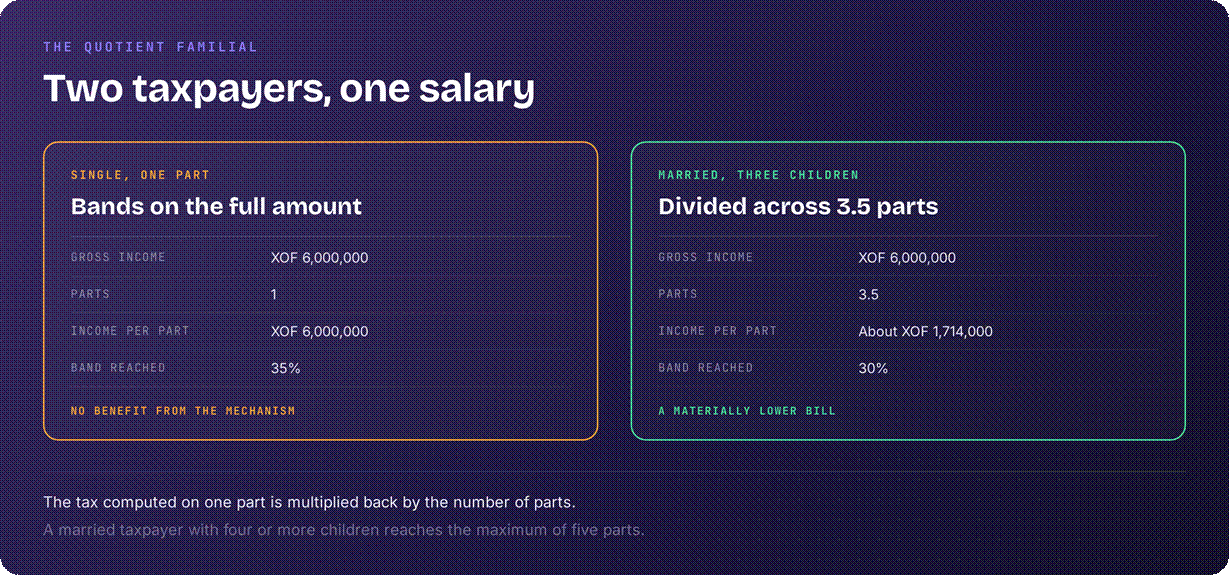
Same income, different households.
Your residency status is the first step
Under Article 48, income tax is due by any individual domiciled in Senegal or holding income of Senegalese source. Either brings you within the charge.
That second limb means a non-resident with Senegalese-source income is within the system, not outside it. The question is not only where you live but where the income arises.
Maintain accurate records of:
• Your domicile position in Senegal;
• The source of each item of income;
• Your family circumstances, for the number of parts;
• Marital status and number of dependent children;
• Gross income and mandatory social contributions deducted; and
• The band figures applying to the year in question.
The tax rates
Annual income per part (XOF) | Rate |
0 to 630,000 | 0% |
630,001 to 1,500,000 | 20% |
1,500,001 to 4,000,000 | 30% |
4,000,001 to 8,000,000 | 35% |
8,000,001 to 13,500,000 | 37% |
Above 13,500,000 | Top band — sources differ |
Maximum family parts | 5 |
IPRES pension, employee | 5.6% general, 7.4% for cadres |
The bands apply to income per part, not to total income. That is the point to hold onto — a figure of XOF 4,000,000 means four million per part, so a household with three parts reaches it only at XOF 12,000,000 of total income.
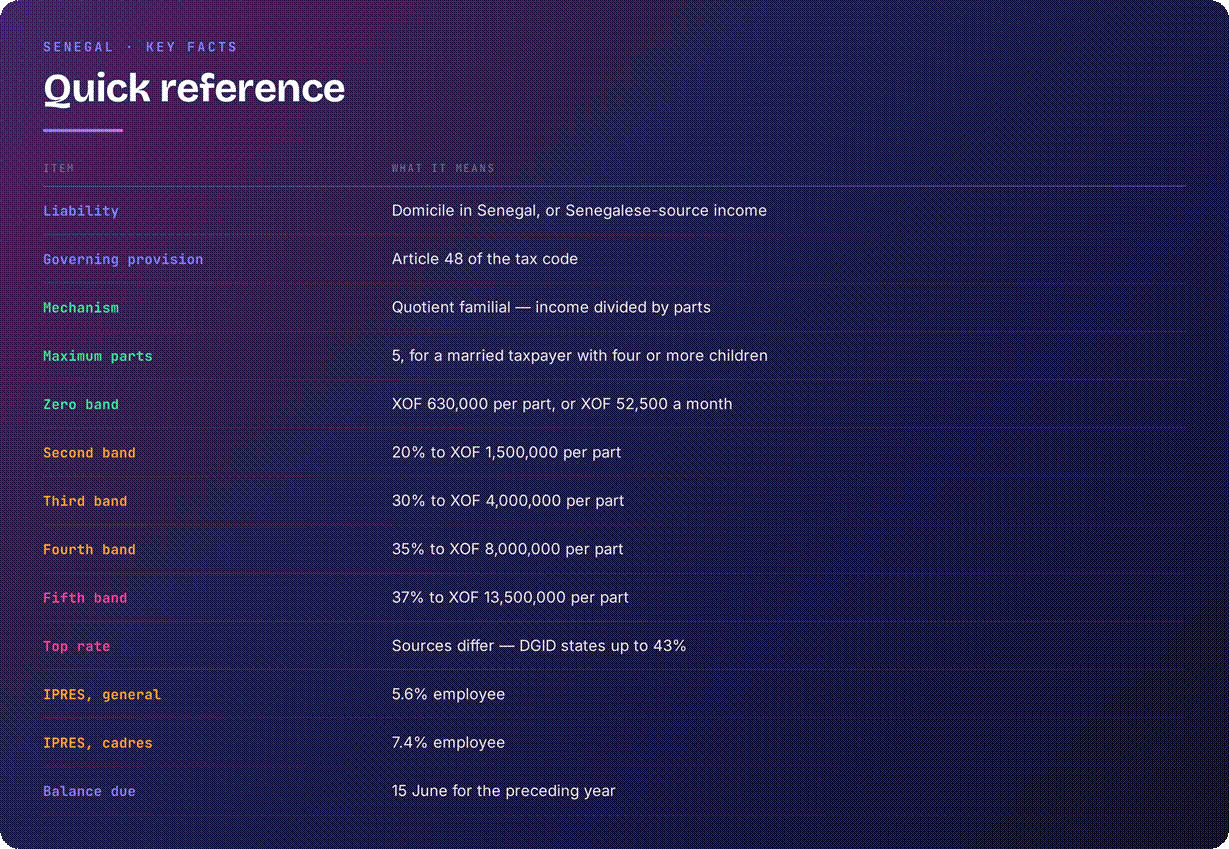
The Senegalese position at a glance.
What makes Senegal workable
The quotient familial is the main feature, and for the right household it is generous:
• The quotient familial, dividing income by family parts before the bands apply;
• Up to five parts for a married taxpayer with four or more children;
• A zero band of XOF 630,000 per part, applied after the division;
• IRPP withheld at source monthly by the employer, so most employees have little to administer;
• Tax computed on net taxable income, after mandatory social contributions; and
• A predictable annual cycle, with the balance of income tax due by 15 June.
The honest qualifications are that a single person with one part gets none of the benefit and faces the bands on their full income, that the top rate is disputed between sources, and that the marginal rates climb steeply — 30% arrives at XOF 1,500,000 per part.
Case study: same salary, different households
Two people each earn XOF 6,000,000 a year. The first is single, with one part. The bands are applied to the full XOF 6,000,000, reaching the 35% band.
The second is married with three children — 3.5 parts. Their income per part is roughly XOF 1,714,000, which sits in the 30% band rather than the 35% one, and a larger proportion falls into the 20% and zero bands beneath it. The tax computed on one part is then multiplied by 3.5.
The result is a materially lower bill on identical gross income. The system is designed to favour households, and for anyone moving to Senegal with a family that is worth understanding before modelling a net figure.
Filing and the compliance calendar
IRPP is administered by the Direction Générale des Impôts et des Domaines, under the Ministry of Finance and Budget. For employees it is withheld monthly at source by the employer as the retenue à la source sur les traitements et salaires.
The tax applies to net taxable income — gross salary after deduction of mandatory social contributions. IPRES pension contributions are 5.6% for general employees and 7.4% for cadres. The balance of income tax for the preceding year is due by 15 June.
Prepare in good time:
• Registration with the DGID;
• Documentation of marital status and dependants, for the parts calculation;
• Records of mandatory contributions deducted;
• Evidence of the source of any income;
• Confirmation of the current band figures; and
• A reminder for the 15 June balancing payment.
Count your parts first
Consider:
• That the bands apply to income per part, not total income;
• How many parts your household qualifies for, up to five;
• That a single person gets no benefit from the mechanism;
• That domicile or Senegalese-source income brings you into charge;
• That contributions are deducted before the bands apply;
• That the top rate is disputed and needs confirming with the DGID; and
• That the balance of income tax falls due on 15 June.
Your Senegal checklist
1. Establish how many family parts you qualify for;
2. Divide income by parts before applying the bands;
3. Multiply the resulting tax back by the number of parts;
4. Note the maximum is five parts;
5. Note that a single person gets no benefit;
6. Deduct mandatory contributions before the calculation;
7. Check whether domicile or source brings you into charge;
8. Confirm the top rate with the DGID before relying on it;
9. Record IPRES at the correct rate for your category; and
10. Diarise the 15 June balancing payment.
Frequently asked questions
What is the quotient familial?
A mechanism that divides your income by the number of family parts, applies the bands to the result, and then multiplies the tax back by the number of parts. It means a household with several parts pays materially less than a single person on the same gross income.
How many parts can I have?
Up to five. A single person has one part, and the number rises with marital status and dependent children, reaching the maximum of five for a married taxpayer with four or more children.
What are the bands?
0% up to XOF 630,000 per part, then 20% to XOF 1,500,000, 30% to XOF 4,000,000, 35% to XOF 8,000,000 and 37% to XOF 13,500,000, with a top band above that.
What is the top rate?
Sources disagree. The DGID states the scale runs from 0 to 43%, while published guides show 37% or 40% at the top. The bands below are consistent, but the top figure should be confirmed with the DGID.
Who is liable?
Under Article 48, any individual domiciled in Senegal or holding income of Senegalese source. The second limb means a non-resident with Senegalese income is within the system.
Do the bands apply to my total income?
No — to your income per part. A threshold of XOF 4,000,000 means four million per part, so a household with three parts reaches it only at XOF 12,000,000 of total income.
What contributions apply?
IPRES pension contributions at 5.6% for general employees and 7.4% for cadres. Tax is computed on net taxable income after mandatory social contributions are deducted.
When is the tax due?
IRPP is withheld monthly at source by the employer. The balance of income tax for the preceding year falls due by 15 June.
Official sources and further reading
• Direction Générale des Impôts et des Domaines
Important information
This article is general information and does not constitute tax, legal, immigration or financial advice, and does not create a client relationship. Tax outcomes depend on travel history, income sources, treaty status and the law applying to the relevant year. Rates, thresholds and regimes change, and some measures described may be proposed rather than enacted; this article reflects our understanding as at the date of publication. Obtain advice from a suitably qualified professional before acting or refraining from action.
