
Slovakia added 30% and 35% bands to its two-band scale on 1 January 2026. The 15% rate for the self-employed survived untouched, which makes the gap between the two routes wider than it has ever been.
Slovakia spent years as a broadly flat system, then a two-band one at 19% and 25%. The third consolidation package, approved in October 2025 and effective from 1 January 2026, doubled the number of bands and pushed the top rate to 35%.
What did not change is the reduced rate for entrepreneurial income. A natural person earning self-employed income of up to EUR 100,000 a year is taxed at 15% — a rate now less than half the new top band.
That gap is the story. Slovakia has become considerably more progressive for employees while leaving the self-employed route where it was, which widens a difference that was already significant.
Two details most guides miss. The personal allowance now phases out faster, reaching zero at the point the 25% band begins, so the effective burden on middle incomes rises by more than the headline bands suggest. And dividend treatment depends on when the profits were generated, not when they were paid.
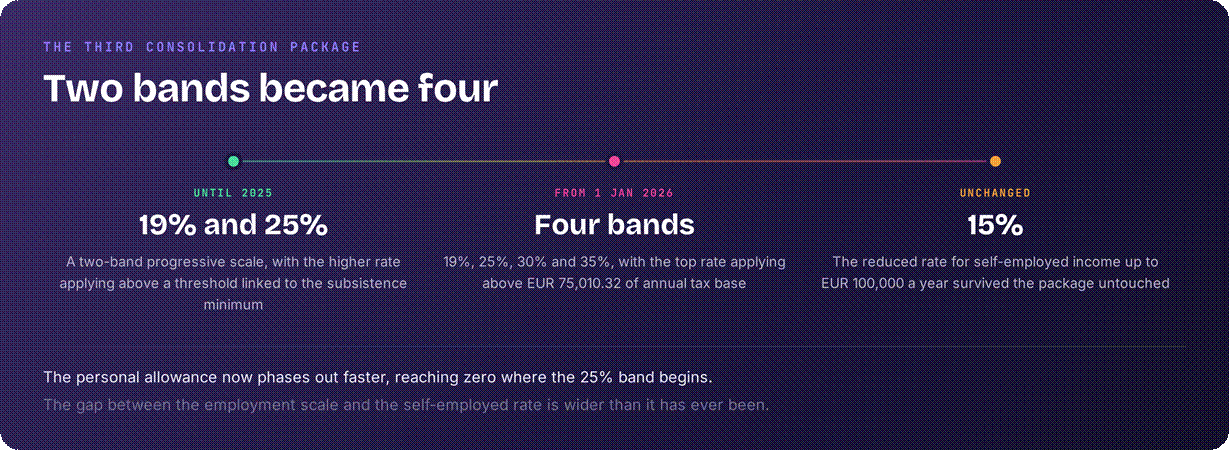
How the scale changed on 1 January 2026.
The 2026 tax rates
From 1 January 2026, the progressive rates apply to the annual tax base as follows:
Annual tax base | Rate |
Up to EUR 43,983.32 | 19% |
EUR 43,983.32 to EUR 60,349.21 | 25% |
EUR 60,349.21 to EUR 75,010.32 | 30% |
Above EUR 75,010.32 | 35% |
Self-employed income up to EUR 100,000 | 15% |
Capital income such as interest | 19% |
Dividends from profits generated from 2025 | 7% |
Dividends from non-cooperative jurisdictions | 35% |
The personal allowance for 2026 is EUR 5,966.73 a year, tied to the subsistence minimum. It rose in absolute terms but now reduces more rapidly as income climbs, reaching zero once the annual tax base hits EUR 43,983.32 — the same point at which the 25% band begins.
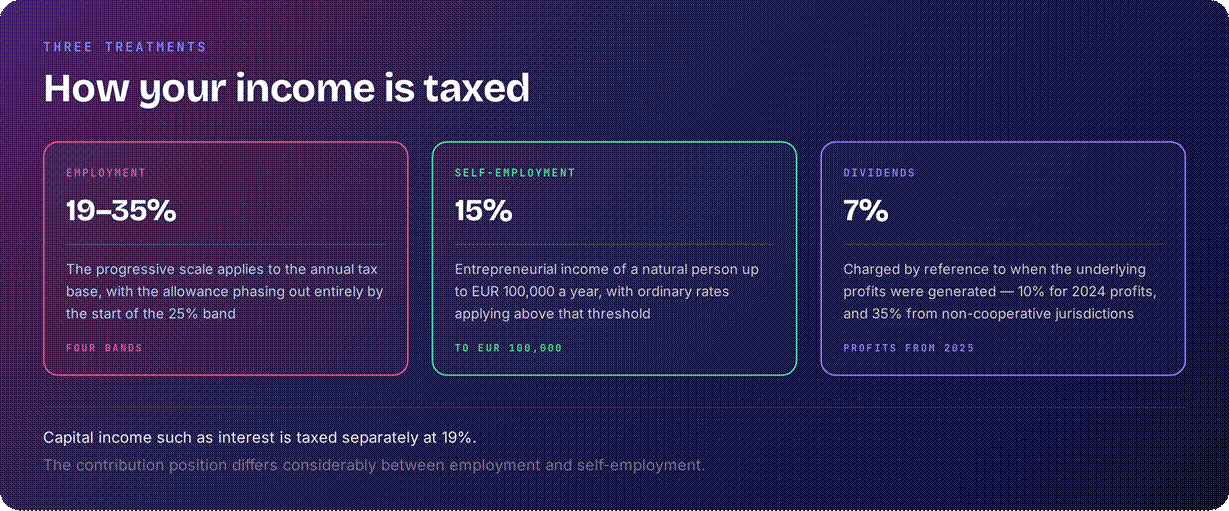
Three routes, three very different rates.
The self-employed route
Entrepreneurial income of a natural person not exceeding EUR 100,000 in the year is taxed at 15%. Above that threshold the ordinary progressive rates apply to the excess.
For a consultant, developer or other independent worker earning between roughly EUR 60,000 and EUR 100,000, the difference against the employment scale is now substantial — 15% against bands running at 25% and 30%. That is before considering the flat expense deduction available to some self-employed taxpayers, which reduces the base before the rate is applied.
The comparison is not purely a tax one, and the contribution position differs considerably between employment and self-employment. That side follows its own rules and is outside the scope of this article, but it should form part of any real decision.
Dividends, and the year that matters
Dividend treatment turns on when the underlying profits were generated, not when the dividend was declared or paid:
• Profits generated from 1 January 2025 onwards: 7%;
• Profits generated in 2024: 10%; and
• Dividends received from non-cooperative jurisdictions: 35%.
For an owner-manager distributing accumulated reserves, that means the vintage of the profits being distributed affects the rate, and distributions may need to be traced to the year they arose rather than treated as a single pool.
Case study: Martin compares two routes
Martin is offered a role in Bratislava at EUR 85,000, and alternatively could do the same work as an independent contractor for the same company at a similar figure.
As an employee, his tax base runs through the 19%, 25% and 30% bands, with no personal allowance because his income is well past the phase-out point. As a self-employed person earning below EUR 100,000, the whole amount is taxed at 15%.
The tax difference is considerable. What it does not capture is the contribution position, employment protections, and whether the arrangement would survive scrutiny as genuine self-employment rather than disguised employment — the same question Serbia answers with a formal test.
Your residency status
You are Slovak tax resident by having a permanent residence in Slovakia, or by being habitually present there — broadly 183 days or more in the calendar year, counting any part day as a whole day. Residents are taxed on worldwide income; non-residents on Slovak-source income.
Maintain accurate records of:
• Days present in Slovakia, counting part days;
• Whether any Slovak accommodation constitutes a permanent residence;
• Income classified as employment or entrepreneurial;
• Annual self-employed income against the EUR 100,000 threshold;
• The year in which distributed profits were generated; and
• Any other country that may also treat you as resident.
Filing and the compliance calendar
The Slovak tax year follows the calendar year. The annual return is generally due by 31 March of the following year, with extensions available on notification — commonly to the end of June, and longer where foreign income is involved.
Model both routes before deciding
Consider:
• Where your income sits against the four new bands;
• Whether self-employment at 15% is realistic and defensible for your work;
• How much the faster allowance phase-out costs you;
• Whether your self-employed income would stay below EUR 100,000;
• Whether the flat expense deduction applies to your activity;
• Which year any dividends you receive were generated in; and
• How the contribution position compares between the two routes.
Your Slovakia checklist
1. Re-model your position against the four new bands, not the old two;
2. Check where your income sits relative to EUR 75,010.32;
3. Account for the allowance phasing out by EUR 43,983.32;
4. Compare employment against self-employment at 15%;
5. Test whether self-employed income would stay below EUR 100,000;
6. Check whether the flat expense deduction applies to your activity;
7. Trace distributed profits to the year they were generated;
8. Count days present, treating part days as whole days;
9. Diarise 31 March, and note the extension routes; and
10. Take separate advice on the contribution position.
Frequently asked questions
What changed in Slovakia for 2026?
The third consolidation package added 30% and 35% bands to the existing 19% and 25% scale, with effect from 1 January 2026. The personal allowance also now phases out faster, reaching zero where the 25% band begins.
What are the new thresholds?
19% up to EUR 43,983.32 of annual tax base, 25% to EUR 60,349.21, 30% to EUR 75,010.32, and 35% above that.
Did the self-employed rate change?
No. Entrepreneurial income of a natural person up to EUR 100,000 a year remains taxed at 15%, which is now less than half the top employment band.
How are dividends taxed?
By reference to when the underlying profits were generated rather than when the dividend was paid: 7% for profits generated from 1 January 2025, 10% for 2024 profits, and 35% for dividends from non-cooperative jurisdictions.
Should I work as a contractor instead of an employee?
The tax difference is now substantial, but it is not the whole comparison. The contribution position differs considerably, and the arrangement needs to be genuine self-employment rather than disguised employment. Both sides need advice before restructuring.
When am I Slovak tax resident?
By having a permanent residence in Slovakia or being habitually present there, broadly 183 days or more in the calendar year, with part days counted as whole days. Residents are taxed on worldwide income.
What is the personal allowance?
EUR 5,966.73 for 2026, tied to the subsistence minimum. It rose in absolute terms but reduces more rapidly than before, reaching zero once the annual tax base reaches EUR 43,983.32.
When is the return due?
Generally 31 March following the calendar tax year, with extensions available on notification — commonly to the end of June, and longer where foreign income is involved.
Official sources and further reading
• Finančná správa — Slovak Financial Administration
Important information
This article is general information and does not constitute tax, legal, immigration or financial advice, and does not create a client relationship. Tax outcomes depend on travel history, income sources, treaty status and the law applying to the relevant year. Rates, thresholds and regimes change, and some measures described may be proposed rather than enacted; this article reflects our understanding as at the date of publication. Obtain advice from a suitably qualified professional before acting or refraining from action.
