
Slovenia taxes employment income through five bands topping out at 50%, and capital income on an entirely separate schedule. The gap between the two is what shapes almost every decision here.
Slovenian personal income tax — dohodnina — runs through five progressive bands, from 16% at the bottom to 50% at the top. The top rate is among the highest in the OECD, and combined with employee contributions the marginal burden on high earners is heavier still.
The OECD has observed that the combined employee contribution and top personal rate in Slovenia is around 61%, the highest in its membership, and has recommended abolishing the top band. That recommendation has not been adopted, and the 50% rate remains.
What sits alongside it is an entirely different treatment for capital. Slovenia applies schedular taxation to capital income — dividends, interest, rental income and capital gains are taxed under their own rules and rates rather than being added to the progressive base.
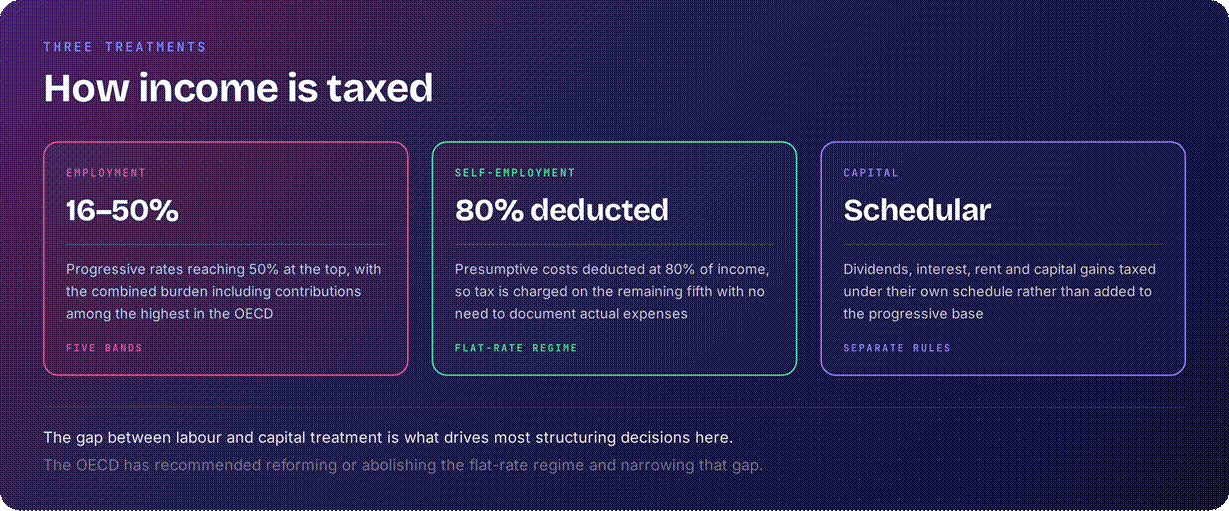
Three treatments, and the gap between them is the point.
Your residency status is the first step
You are Slovenian tax resident if you have a registered permanent residence in Slovenia, or your habitual abode or centre of personal and economic interests is there, or you are present for more than 183 days in a tax year. Residents are taxed on worldwide income; non-residents on Slovenian-source income.
Maintain accurate records of:
• Whether a permanent residence is registered in Slovenia;
• Days present in each tax year;
• Where your personal and economic interests are centred;
• Each income stream, and whether it is progressive or schedular;
• Self-employment revenue, for the flat-rate regime; and
• Any other country that may also treat you as resident.
The 2026 tax rate bands
The published brackets for 2026 are:
Annual taxable income (EUR) | Rate |
Up to 9,721.43 | 16% |
9,721.43 to 28,592.44 | 26% |
28,592.44 to 57,184.88 | 33% |
57,184.88 to 82,346.23 | 39% |
Above 82,346.23 | 50% |
General relief for 2026 | EUR 5,551.93 |
Capital income | Schedular, outside the progressive base |
Corporate income tax | 22% |
The bands are set by regulation each year. Secondary sources frequently quote the rates from an earlier year, so the middle-band figures in particular are worth confirming against the tax administration for the year you are modelling.
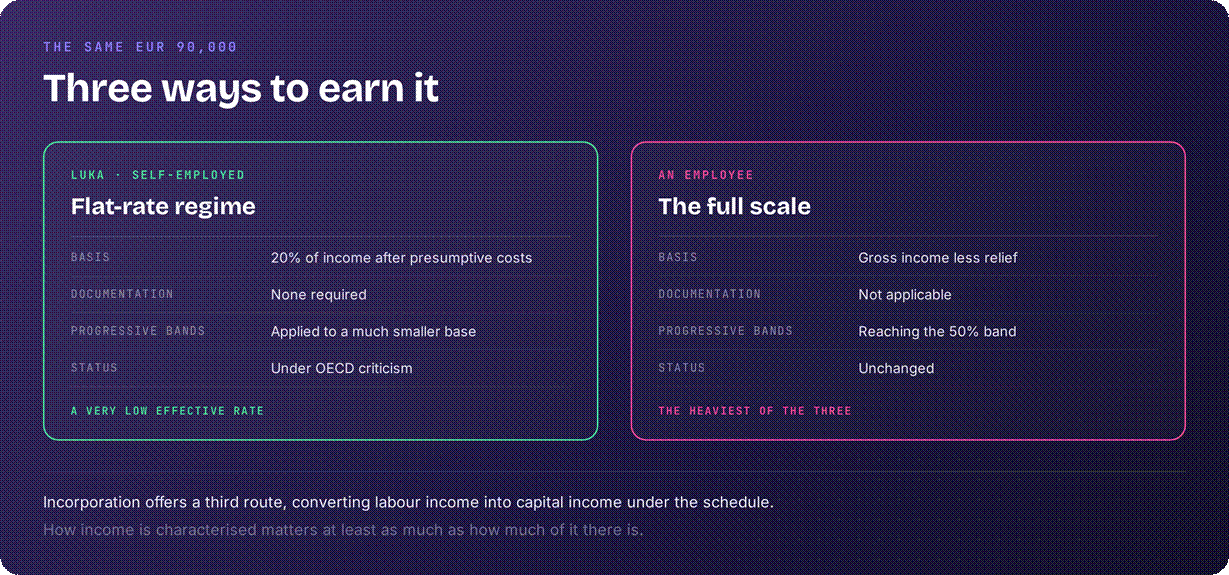
Same income, three different outcomes.
The schedular treatment of capital
Capital income is removed from the progressive base and taxed under its own schedule. Dividends, interest and rental income each have their own treatment, and capital gains are taxed with a rate that reduces the longer an asset has been held.
The effect is a substantial gap between the treatment of labour income and capital income. The OECD has noted that this gives self-employed people who do not use the flat-rate regime an incentive to incorporate, converting highly taxed labour income into lightly taxed capital income, and has recommended that the two be brought closer together.
For an individual, the practical consequence is that how income is characterised matters at least as much as how much of it there is.
The flat-rate regime
A self-employed person can elect a flat-rate regime under which presumptive costs are deducted at 80% of income, so tax is charged on the remaining 20% without any need to document actual expenses.
For a business with genuinely low costs — most service businesses — that produces a very low effective rate. The OECD has criticised the design on exactly that basis, arguing that it induces concealment of income and discourages businesses from growing past the point where the regime applies, and has recommended reform or abolition.
No change has been enacted. Anyone building a position around it should treat it as a regime under scrutiny rather than a settled feature.
Case study: Maja incorporates, Luka does not
Maja and Luka each earn around EUR 90,000 a year from consultancy. Luka operates as a self-employed person under the flat-rate regime, deducting 80% presumptive costs and paying tax on the remaining fifth.
Maja works through a company, paying corporate tax at 22% and then extracting profits as capital income under the schedular rules rather than as salary taxed through the progressive bands.
Both are considerably better off than an employee on the same figure, who would reach the 50% band. That gap between employment, self-employment and incorporation is the defining feature of the Slovenian system, and it is precisely what the OECD has recommended narrowing.
Filing and the compliance calendar
The Slovenian tax year follows the calendar year and the tax administration is FURS. The authority prepares an informative calculation for many taxpayers, which becomes the assessment if not objected to, with objections and returns due within published deadlines in the spring.
Characterisation matters more than amount
Consider:
• Where your income sits against the 39% and 50% bands;
• Whether income is employment income, self-employment income or capital income;
• Whether the flat-rate regime is available and appropriate to your activity;
• How long assets have been held, for capital gains purposes;
• That the flat-rate regime is under active OECD criticism;
• That the brackets are republished annually; and
• Whether a registered permanent residence would trigger residency.
Your Slovenia checklist
1. Confirm the current year’s brackets against the published regulation;
2. Establish where your income falls against the 39% and 50% bands;
3. Characterise each stream as employment, self-employment or capital;
4. Check whether the flat-rate regime is available to your activity;
5. Treat the flat-rate regime as under review rather than settled;
6. Track asset holding periods for capital gains purposes;
7. Review the informative calculation rather than accepting it automatically;
8. Consider whether a registered residence would trigger residency;
9. Factor 22% VAT into cost-of-living comparisons; and
10. Take separate advice on the contribution position.
Frequently asked questions
What are the Slovenian income tax rates?
Five progressive bands for 2026: 16% up to EUR 9,721.43, then 26%, 33% and 39%, reaching 50% above EUR 82,346.23. The brackets are republished by regulation each year.
Is the top rate really 50%?
Yes, and the OECD has observed that the combined employee contribution and top personal rate is around 61% — the highest in its membership. It has recommended abolishing the top band, but that has not been enacted.
How is capital income taxed?
Separately from the progressive base, under a schedular system. Dividends, interest and rental income have their own treatment, and capital gains are taxed at a rate that reduces with the length of holding.
What is the flat-rate regime?
An election for the self-employed under which presumptive costs are deducted at 80% of income, so tax is charged on the remaining fifth without documenting actual expenses. It produces a very low effective rate for service businesses.
Is the flat-rate regime at risk?
It is under scrutiny. The OECD has described the 80% deduction as significantly higher than the costs most businesses incur, argued that it induces concealment and discourages growth, and recommended reform or abolition. No change has been enacted.
Why does income characterisation matter so much?
Because the gap between the progressive treatment of labour income and the schedular treatment of capital income is wide. The OECD has noted this gives self-employed people an incentive to incorporate and convert labour income into capital income.
When am I Slovenian tax resident?
With a registered permanent residence in Slovenia, a habitual abode or centre of personal and economic interests there, or presence for more than 183 days in a tax year.
How does filing work?
FURS prepares an informative calculation for many taxpayers, which becomes the assessment if no objection is made within the published period. Deadlines fall in the spring following the calendar tax year.
Official sources and further reading
• Financial Administration of the Republic of Slovenia (FURS)
Important information
This article is general information and does not constitute tax, legal, immigration or financial advice, and does not create a client relationship. Tax outcomes depend on travel history, income sources, treaty status and the law applying to the relevant year. Rates, thresholds and regimes change, and some measures described may be proposed rather than enacted; this article reflects our understanding as at the date of publication. Obtain advice from a suitably qualified professional before acting or refraining from action.
