
Spain’s inbound regime is often described as a territorial carve-out. It is not. Employment income is caught wherever in the world it is earned, and that catches remote workers who assumed otherwise.
If you are moving to Spain for work, or planning to keep working remotely for a foreign employer while living there, the special regime for inbound workers is the first thing to assess. It can cut a top marginal rate to a flat 24%. It can also tax a foreign salary you assumed Spain would never see.
The regime sits in Article 93 of the Spanish personal income tax law and is universally known as the Beckham regime, after the footballer whose 2005 move made it famous. It allows a qualifying newcomer to be taxed broadly as a non-resident while actually living in Spain.
Spain otherwise follows a residence model, taxing residents on worldwide income at progressive rates that vary by autonomous community and reach the high forties. Non-residents are taxed on Spanish-source income. The regime is a third path between the two.
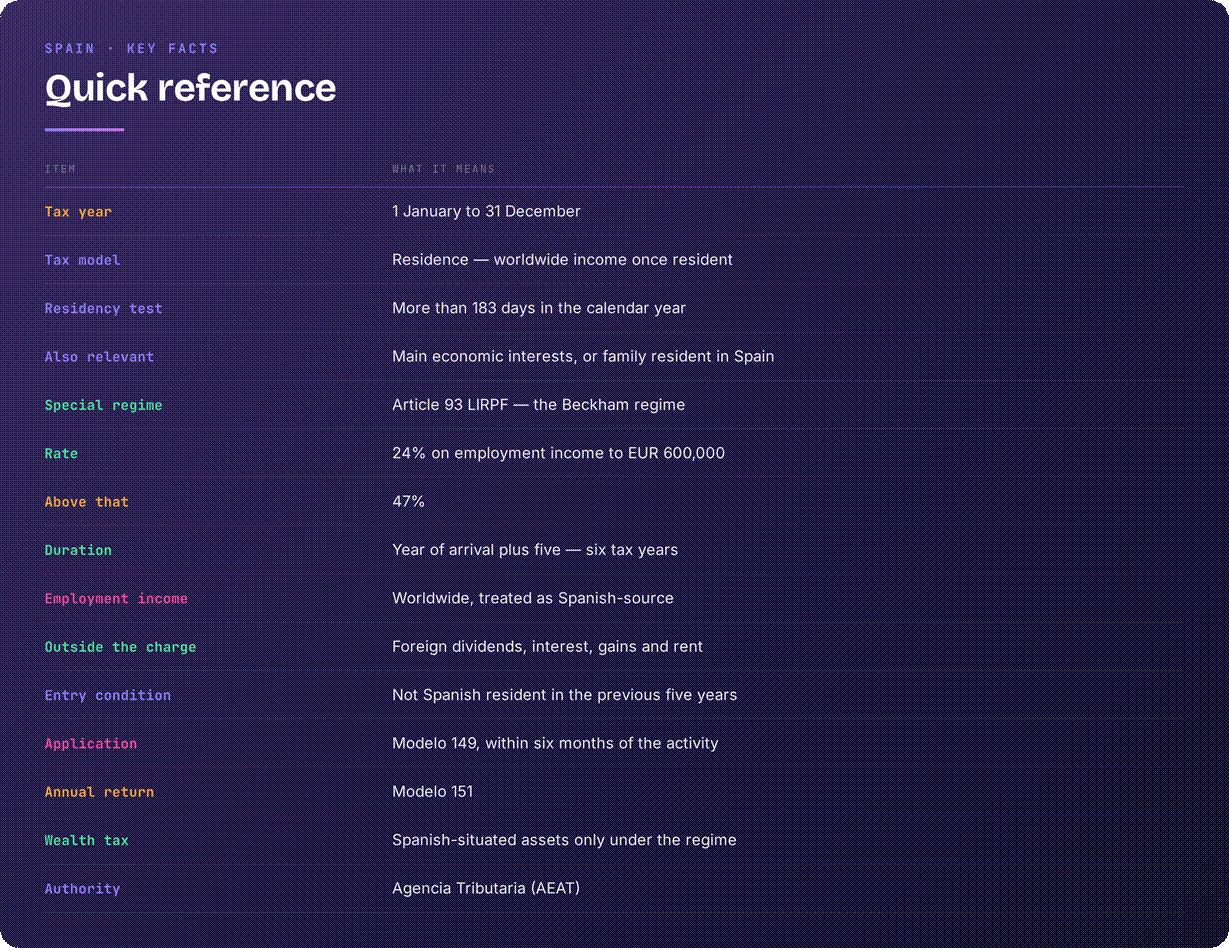
The Spanish position at a glance.
Your residency status is the first step
You become Spanish tax resident if you spend more than 183 days in Spain in the calendar year, or if the main base of your activities or economic interests is in Spain. There is also a presumption of residence where your spouse and dependent minor children habitually reside in Spain.
Sporadic absences count toward the 183 days unless you can prove tax residence elsewhere, which means occasional travel does not reduce the count in the way people expect. Spain uses the calendar year, so there is no split-year treatment of the kind some other countries apply.
Maintain accurate records of:
• Arrival and departure dates within each calendar year;
• Days physically spent in Spain, including partial days;
• Where your spouse and dependent children habitually reside;
• The location of your main economic interests and business activity;
• Accommodation arrangements in Spain and elsewhere; and
• Evidence of tax residence in another country, if you claim it.
What the regime does
Under the regime, you remain Spanish tax resident but are taxed broadly under the non-resident income tax rules. Employment income is charged at:
• 24% on the first EUR 600,000; and
• 47% on anything above that.
The ordinary Spanish scale reaches comparable top rates but arrives at them far sooner, and regional variation can push effective rates higher still. For a salary comfortably below EUR 600,000, the regime is a significant saving.
The part that catches remote workers
The regime does not exempt your foreign salary. Under Article 93, all employment income obtained during the period of application is treated as obtained in Spain and taxed accordingly.
So someone who moves to Valencia and continues working remotely for a German employer is taxed in Spain on that German salary at 24%. The regime is not a territorial shelter for employment income. It is a flat rate applied to worldwide employment income, which is a different proposition entirely.
Income | Treatment under the regime |
Spanish employment income | 24% to EUR 600,000, then 47% |
Foreign employment income | Treated as Spanish-source and taxed the same way |
Foreign dividends and interest | Outside the Spanish charge |
Foreign capital gains | Outside the Spanish charge |
Foreign rental income | Outside the Spanish charge |
Spanish savings income | Taxed at the savings scale |
Spanish property income | Taxed as Spanish-source |
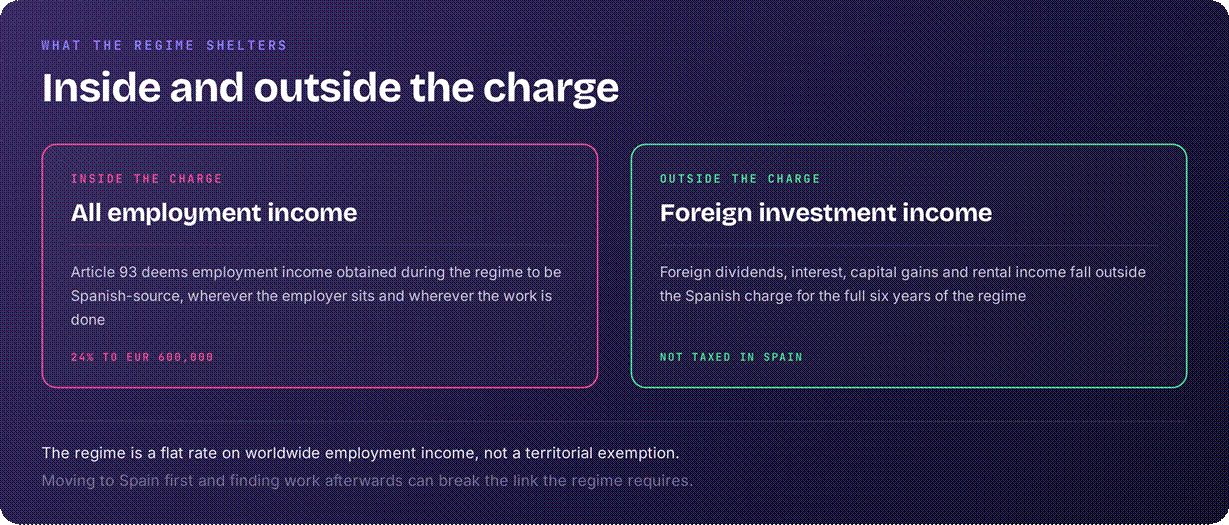
Employment income is inside the charge wherever it is earned.
How long it runs
The regime applies for the tax year in which residence is acquired plus the five following years — six tax years in total. Because Spain uses the calendar year and offers no split-year treatment, someone arriving in November gets a very short first year out of their six.
Arrival timing is therefore worth modelling before the move rather than after. Shifting a start date by a few weeks across a year end can add most of a year to the effective benefit.
Who can apply after the Startups Law
Law 28/2022 widened entry considerably. The prior non-residence requirement was reduced from ten years to five tax years, and the qualifying routes were extended beyond traditional posted employees to include:
• Employees moving under an employment contract, including those working remotely for a foreign employer on a suitable authorisation;
• Directors of Spanish companies, subject to shareholding limits where the company is an asset-holding entity;
• Entrepreneurs carrying on an activity classified as entrepreneurial; and
• Highly qualified professionals providing services to startups, or carrying out training, research or development activity.
The move to Spain must be connected to one of those circumstances. Moving first and finding work afterwards can break the link, because the regime requires the displacement and the activity to be related.
Case study: Lukas and the German salary
Lukas moves from Berlin to Valencia in February and continues working remotely for his German employer on EUR 95,000. He assumes that because the employer, the contract and the payment are all German, Spain will not tax the salary.
Under the regime, that salary is treated as Spanish-source and charged at 24%. What the regime does protect is his German share portfolio — foreign dividends and gains sit outside the Spanish charge for the six years.
His overall position is still likely better than the ordinary Spanish scale would give him. But it is not the exemption he expected, and the German side of the arrangement needs checking too.
Wealth tax, and the charge at the other end
Because someone under the regime is taxed on a non-resident basis, wealth tax generally applies only to assets situated in Spain rather than to worldwide assets. For an individual with substantial holdings abroad, this is frequently worth more than the income tax saving.
Rates and allowances vary considerably between autonomous communities, and the separate solidarity tax on large fortunes interacts with wealth tax. Both need checking against the specific region you are moving to rather than against a national figure.
There is also a charge on the way out. Spain applies a deemed disposal to individuals holding large shareholdings — broadly where holdings exceed EUR 4 million, or EUR 1 million with a stake above 25% — who cease to be resident after having been resident for at least ten of the previous fifteen years. Six years under the regime does not reach that threshold, but a longer stay afterwards can.
Filing and the compliance calendar
The Spanish tax year follows the calendar year. Election into the regime is made on Modelo 149, within six months of the start of the activity as recorded in Spanish registration. This is a strict deadline with no general late route.
Once inside, annual returns are filed on Modelo 151 rather than the ordinary Modelo 100. The annual filing window generally runs from April to the end of June for the preceding year, with dates confirmed each year by the tax agency.
Separate reporting may still apply. Spanish residents with assets abroad above certain thresholds have their own declaration obligations, and these are assessed independently of the income tax regime you are in.
Timing matters more than the headline rate
Model your position before you move, considering:
• Whether your displacement is properly linked to a qualifying activity;
• Whether arriving before or after a year end improves the six-year benefit;
• How much of your income is employment income rather than investment income;
• Whether your salary approaches the EUR 600,000 step;
• What the wealth tax position looks like in your specific region;
• Whether you intend to stay in Spain beyond the regime; and
• Whether a long stay could eventually bring you within the exit charge.
Case study: Ana runs past the six years
Ana enters the regime on arrival and benefits for six tax years. She then stays in Spain and moves onto the ordinary rules: worldwide income at progressive rates, worldwide assets within wealth tax, and her foreign investment income now inside the Spanish charge.
Nine years later she plans to leave. Having been resident for more than ten of the previous fifteen years, and holding shares worth over EUR 4 million, she falls within the exit charge on unrealised gains.
The regime was worth having. The decision that mattered more was what she did in year seven, and she made it without advice.
Your Spain checklist
1. Confirm you were not Spanish tax resident in the previous five tax years;
2. Check that your move is properly linked to a qualifying activity;
3. Model whether arriving before or after a year end improves the six years;
4. Separate employment income from investment income before assuming relief;
5. Assume foreign salary is inside the Spanish charge, not outside it;
6. Diarise the six-month Modelo 149 deadline from the start of the activity;
7. Check the wealth tax position in your specific autonomous community;
8. File on Modelo 151 rather than Modelo 100 while in the regime;
9. Review any separate reporting obligations for assets held abroad; and
10. Take advice in year six about what happens in year seven.
Frequently asked questions
Does the Beckham regime exempt my foreign salary?
No. Employment income obtained while the regime applies is treated as Spanish-source and taxed at 24% up to EUR 600,000, regardless of where the employer is or where the work is performed. Only other categories of foreign income sit outside the charge.
How many years does the regime last?
The year you become Spanish tax resident plus the following five, so six tax years. Spain uses the calendar year with no split-year treatment, so arriving late in the year shortens the benefit of that first year without extending the period.
How long must I have been non-resident beforehand?
Five tax years. The Startups Law reduced this from the previous ten-year requirement, which opened the regime to a considerably wider group.
What happens if I miss the application deadline?
The election must be made on Modelo 149 within six months of starting the qualifying activity. There is no general late-election route, so a missed deadline usually means being taxed under the ordinary progressive rules for the whole period.
Can I use the regime as a remote worker for a foreign employer?
Potentially yes, where you hold a suitable authorisation and the move is linked to the activity. But be clear about what you are getting: your foreign salary is taxed in Spain at 24%, not exempted.
Does wealth tax apply under the regime?
Generally only to assets situated in Spain, because you are taxed on a non-resident basis. Rates and allowances vary considerably between autonomous communities, and the solidarity tax on large fortunes needs checking alongside it.
Is my foreign investment income really untaxed in Spain?
Foreign dividends, interest, gains and rent fall outside the Spanish charge while the regime applies. That does not mean they are untaxed everywhere — the source country may still tax them, and the treaty position matters.
What happens when the six years end?
You move onto the ordinary rules: worldwide income at progressive rates, worldwide assets within wealth tax, and foreign investment income inside the Spanish charge. This transition is worth planning for a year ahead, not discovering in the seventh January.
Official sources and further reading
Important information
This article is general information and does not constitute tax, legal, immigration or financial advice, and does not create a client relationship. Tax outcomes depend on travel history, income sources, treaty status and the law applying to the relevant year. Rates, thresholds and regimes change, and some measures described may be proposed rather than enacted; this article reflects our understanding as at the date of publication. Obtain advice from a suitably qualified professional before acting or refraining from action.
