
Sri Lanka caps tax on foreign income at 15%, but only if it arrives in foreign currency through a Sri Lankan bank. Route it any other way and the rate runs to 36%.
Most countries with a remittance rule reward you for keeping money out. Sri Lanka does the opposite. Since April 2025 it has taxed foreign income and service exports at a maximum of 15% but the concession is conditional on the money being received in foreign currency and remitted through a bank in Sri Lanka.
Miss that condition and the same income is taxed on the ordinary progressive scale, which reaches 36%. The difference is not a rounding error, and it turns on banking arrangements rather than on anything about the work itself.
The change came through the Inland Revenue (Amendment) Act No. 2 of 2025, certified on 20 March 2025 and effective from 1 April 2025 — the start of the 2025/2026 year of assessment. Before it, income from services rendered to a foreign client was fully exempt if remitted to Sri Lanka. That exemption is gone.
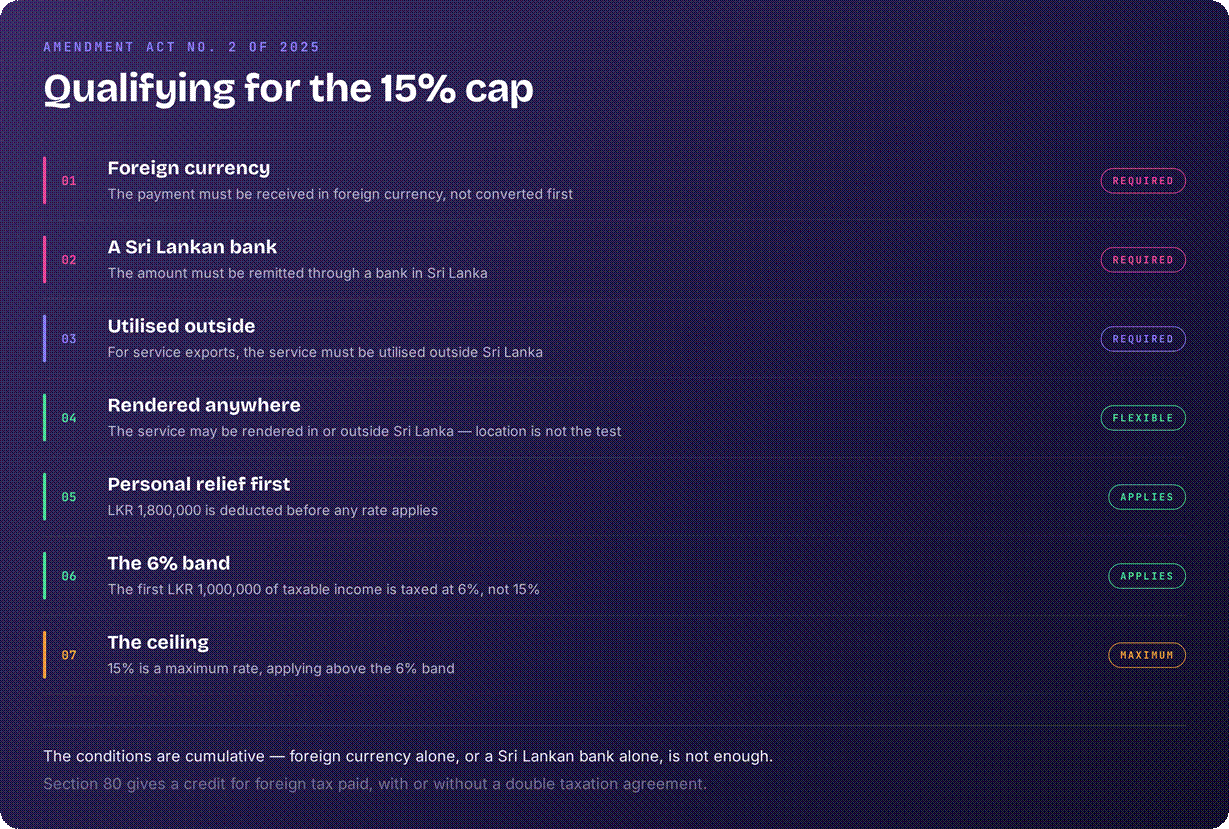
Both conditions must hold, or the concession is lost.
Your residency status is the first step
You are Sri Lankan tax resident broadly by spending 183 days or more in the country during the year of assessment. The tax year runs 1 April to 31 March, which misaligns with the calendar year and with most of the countries Sri Lankan residents deal with.
Residents are taxed on worldwide income. Non-residents who are citizens of Sri Lanka receive the same personal relief as residents, which is an unusual feature worth knowing.
Maintain accurate records of:
• Arrival and departure dates by year of assessment, April to March;
• The currency in which each payment was received;
• The bank through which each payment entered Sri Lanka;
• Whether services were utilised inside or outside Sri Lanka;
• Evidence of foreign tax paid, for the section 80 credit; and
• Any other country that may also treat you as resident.
The tax rates, and how the cap fits
Personal relief is LKR 1,800,000, raised from LKR 1,200,000. Above it, the ordinary progressive scale runs:
Taxable income | Rate |
First LKR 1,000,000 | 6% |
Next LKR 500,000 | 18% |
Next LKR 500,000 | 24% |
Next LKR 500,000 | 30% |
Balance | 36% |
Qualifying service exports | 15% maximum |
Qualifying foreign-source income | 15% maximum |
Betting, gaming, liquor and tobacco | 45% flat |
The 12% band that existed previously was removed in the same reform, so the scale now steps from 6% straight to 18%.
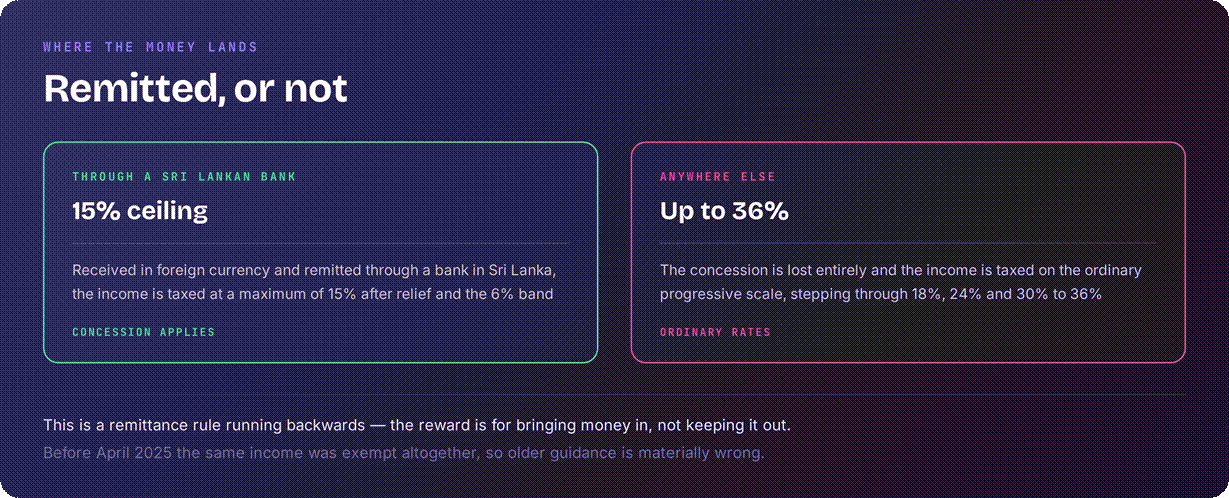
The same income, routed two different ways.
A worked example
Take a freelancer earning USD 1,000 a month from a UK client, remitted in dollars through a Sri Lankan bank. At an exchange rate of LKR 300, that is LKR 3,600,000 a year.
Personal relief of LKR 1,800,000 comes off first, leaving LKR 1,800,000 taxable. The first LKR 1,000,000 is taxed at 6%, giving LKR 60,000. The remaining LKR 800,000 is taxed at the 15% ceiling rather than the 18% band, giving LKR 120,000. Total tax: LKR 180,000 on LKR 3,600,000 of income.
Take the same income received into a foreign account instead. The concession is lost, the ordinary bands apply, and the effective rate climbs materially — with the top of the income potentially reaching 36% at higher earnings.
What qualifies
The 15% ceiling applies to two categories. The first is service exports: gains from any service rendered in or outside Sri Lanka to a person, to be utilised outside Sri Lanka, where payment is received in foreign currency and remitted through a bank to Sri Lanka. The second is foreign-source income generally, where it is earned in foreign currency and remitted through a bank to Sri Lanka.
Both conditions are cumulative. Foreign currency alone is not enough, and a Sri Lankan bank alone is not enough. The Inland Revenue Department has confirmed the treatment applies to individuals providing services to overseas clients through digital platforms as well as by other means.
Relief for foreign tax
Section 80 allows a resident person to claim a credit for foreign income tax paid on their assessable foreign income. Critically, this operates whether or not a double taxation agreement is in place, which is a meaningful protection given how few treaties Sri Lanka has relative to larger economies.
Filing and the compliance calendar
The year of assessment ends 31 March. Employment income is collected through the Advance Personal Income Tax withholding system, with tables issued by the Inland Revenue Department, and advance withholding on interest income was raised from 5% to 10% in the same reform.
Prepare in good time:
• A Taxpayer Identification Number and access to the online system;
• Bank statements evidencing the route and currency of each remittance;
• Contracts showing where services were utilised;
• Foreign tax receipts for section 80 credit claims;
• APIT records from any Sri Lankan employer; and
• Day counts on the April-to-March year.
Banking arrangements are the planning
Unusually, the decision that matters most here is operational rather than structural. Consider:
• Whether every payment arrives in foreign currency, not converted first;
• Whether every payment routes through a bank in Sri Lanka;
• Whether your platform or client can pay in the required form;
• How much income would sit above the 15% ceiling without the concession;
• Whether foreign tax already paid generates a useful credit;
• How the April-to-March year lines up with your other countries; and
• Whether the concession is worth restructuring your banking to secure.
Your Sri Lanka checklist
1. Confirm every payment is received in foreign currency;
2. Route every payment through a bank in Sri Lanka;
3. Keep bank statements evidencing the route and the currency;
4. Check whether your client or platform can pay in the required form;
5. Establish that services are utilised outside Sri Lanka;
6. Apply the personal relief and the 6% band before the 15% ceiling;
7. Collect foreign tax receipts for section 80 credits;
8. Count days on the April-to-March year of assessment;
9. Discard guidance describing foreign service income as exempt; and
10. Re-check the published bands each year of assessment.
Frequently asked questions
Is foreign service income still exempt in Sri Lanka?
No. It was exempt before 1 April 2025, but the Inland Revenue (Amendment) Act No. 2 of 2025 made it taxable. It is now capped at 15% where the qualifying conditions are met, and taxed at up to 36% where they are not.
What are the conditions for the 15% rate?
The payment must be received in foreign currency and remitted through a bank in Sri Lanka. For service exports, the service must also be for use outside Sri Lanka. The conditions are cumulative.
Does it matter where I perform the work?
No, and this is unusual. The statute covers services rendered in or outside Sri Lanka, provided they are to be utilised outside Sri Lanka. Where you physically sit is not the test — where the money arrives is.
Is 15% a flat rate?
No, it is a maximum. Personal relief of LKR 1,800,000 is deducted first, the next LKR 1,000,000 of taxable income is taxed at 6%, and the 15% ceiling applies above that.
What happens if I keep the money offshore?
The concession is lost and the income falls on the ordinary progressive scale, stepping through 18%, 24% and 30% to 36%. There is no partial relief for partial remittance of a payment.
Can I claim credit for tax paid abroad?
Yes. Section 80 allows a resident to credit foreign income tax paid on assessable foreign income, and it operates whether or not a double taxation agreement exists — which matters given Sri Lanka’s modest treaty network.
When does the Sri Lankan tax year run?
1 April to 31 March. The misalignment with the calendar year affects both day counting and the matching of foreign income to a year of assessment.
What is the personal relief?
LKR 1,800,000 for a year of assessment, raised from LKR 1,200,000 by the 2025 amendment. It is available to residents and to non-residents who are citizens of Sri Lanka.
Official sources and further reading
• Inland Revenue Department of Sri Lanka
• Ministry of Finance, Sri Lanka
• Department of Government Printing — Sri Lankan legislation
Important information
This article is general information and does not constitute tax, legal, immigration or financial advice, and does not create a client relationship. Tax outcomes depend on travel history, income sources, treaty status and the law applying to the relevant year. Rates, thresholds and regimes change, and some measures described may be proposed rather than enacted; this article reflects our understanding as at the date of publication. Obtain advice from a suitably qualified professional before acting or refraining from action.
