
Taiwan taxes residents mainly on Taiwan-source income and reaches foreign income only through a separate alternative charge. For most arrivals that alternative charge never applies at all.
Taiwan is one of the few developed economies that taxes residents on a largely territorial basis. A resident is charged at progressive rates on Taiwan-source income, and foreign-source income is not brought into the regular income tax computation.
Foreign income is reached instead through the Income Basic Tax — an alternative minimum charge often called the AMT. It applies at a flat 20% to basic income, and only bites where foreign-source income exceeds NT$1,000,000 and basic income exceeds NT$7,500,000, with the first NT$7,500,000 deducted before the rate is applied.
The practical effect is that a great many expatriates in Taiwan never encounter it. Someone earning a normal professional salary in Taipei with modest foreign investment income falls well below both thresholds, and their foreign income is simply outside the Taiwanese system.
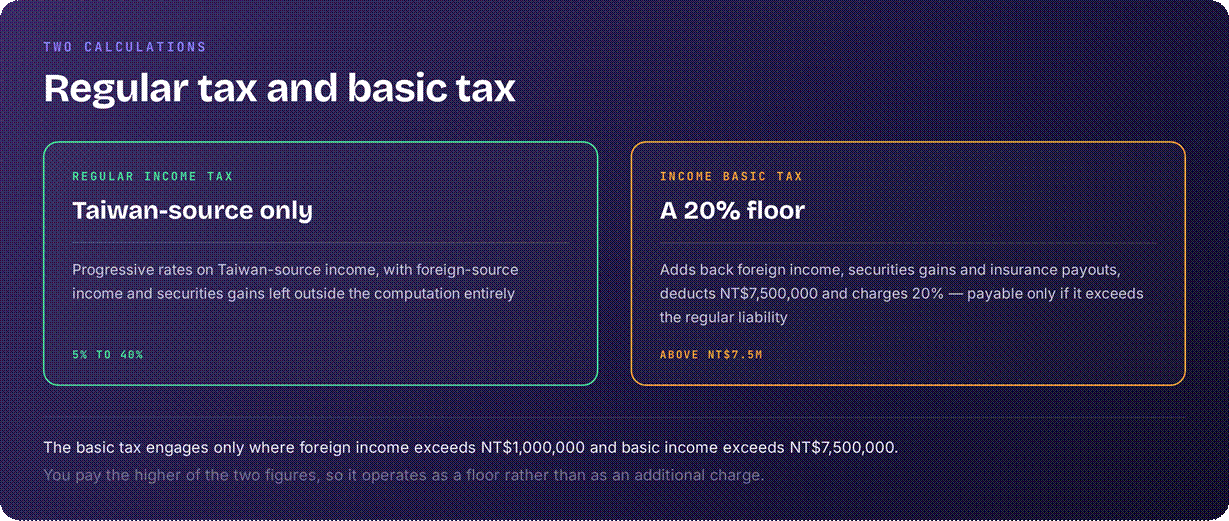
Two computations, and you pay the higher of them.
Your residency status is the first step
Under Article 7 of the Income Tax Act, you are a resident if you are domiciled in and reside within Taiwan, or if you have no domicile but reside in Taiwan for 183 days or more in the taxable year.
For non-residents the position splits again by day count:
• 90 days or fewer — 18% withholding on Taiwan-source income, with foreign-source income exempt;
• More than 90 but fewer than 183 days — 18% withholding on income, with remuneration paid by an offshore employer for work performed in Taiwan brought into charge; and
• 183 days or more — resident, taxed at progressive rates from 5% to 40% on Taiwan-source income.
Both non-resident categories must report their income and settle their liability on a non-resident return before leaving the country, which is an administrative point that catches people planning a departure.
Maintain accurate records of:
• Days present in Taiwan in each taxable year;
• Whether you have a domicile in Taiwan, separately from the day count;
• Income by source, Taiwan and foreign;
• Foreign-source income against the NT$1,000,000 threshold;
• Basic income against the NT$7,500,000 threshold; and
• Any other country that may also treat you as resident.
The tax rates
Item | Position |
Resident, Taiwan-source income | Progressive, 5% to 40% |
Resident, foreign-source income | Outside the regular income tax |
Income Basic Tax | 20% on basic income above NT$7,500,000 |
Foreign income threshold for the IBT | NT$1,000,000 |
Securities capital gains | Outside the regular income tax |
Non-resident, 90 days or fewer | 18% on Taiwan-source income only |
Non-resident, 90 to 183 days | 18%, with a wider reach |
Standard deduction | NT$131,000 single, NT$262,000 joint |
You pay the higher of the two computations, not both. If the basic income tax liability exceeds the liability under the regular progressive rates, you pay the basic income tax; if it is lower, you pay the regular amount. It is a floor rather than an additional charge.
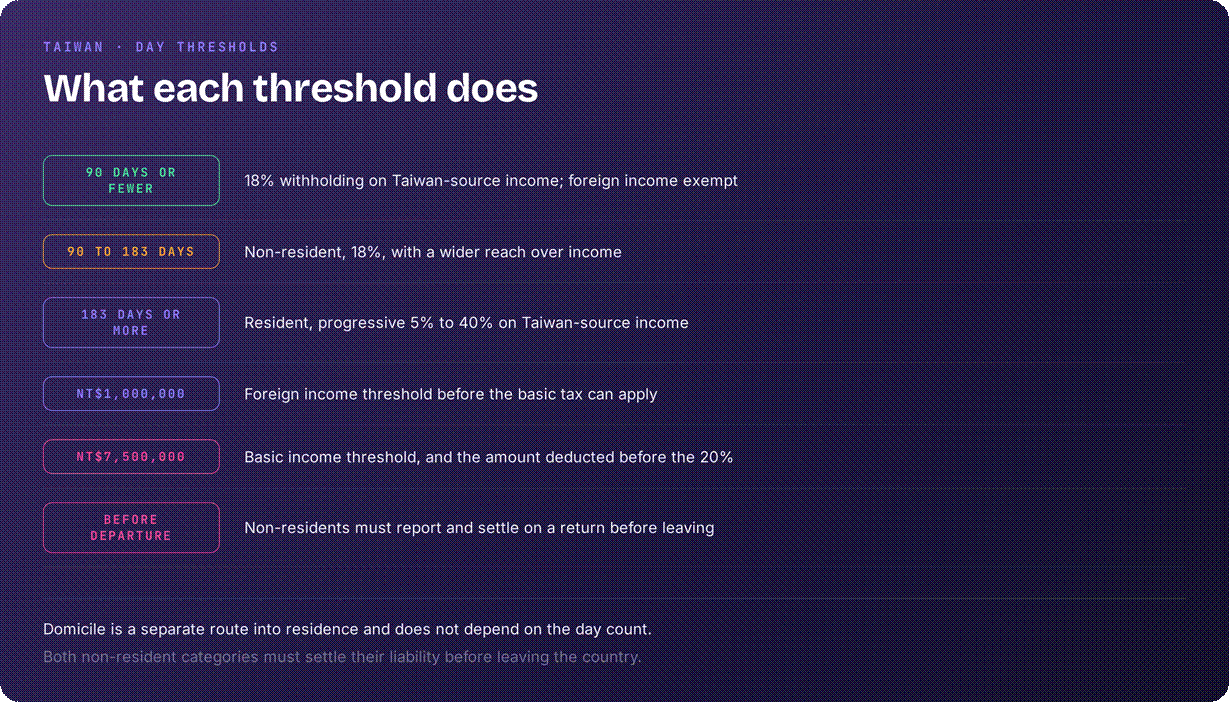
Where the day count puts you.
What Taiwan does not tax
Several categories sit outside the regular charge entirely, and they are the reason many expatriates find the Taiwanese bill lower than expected:
• Foreign-source income of a resident is outside the regular income tax, reached only through the basic income tax where both thresholds are crossed;
• Capital gains on securities are not subject to the regular income tax, with a securities transaction tax applying on the transaction instead;
• Insurance payouts are outside the regular charge, though also added back for basic income purposes; and
• Foreign-source income of a non-resident present for 90 days or fewer is exempt entirely.
The qualification is that the first three of those are add-back items in the basic income computation. They are outside the regular tax, not outside the system altogether, and someone with a large portfolio needs to run both calculations rather than assuming exemption.
What makes Taiwan attractive
For an internationally mobile professional the case is stronger than the 40% headline suggests:
• A territorial design that leaves foreign income outside the regular charge for most people;
• Two substantial thresholds — NT$1,000,000 of foreign income and NT$7,500,000 of basic income — before the alternative charge applies at all;
• No regular income tax on securities gains, which is unusual in a developed economy;
• A clear 90-day exemption for short-stay non-residents on foreign-source income;
• Progressive rates that start at 5%, so lower and middle earners face modest effective rates; and
• Standard deductions and personal exemptions that further reduce the base for residents.
The main caveat is that Taiwan has a limited treaty network and no agreement with several major economies, so relief from double taxation cannot be assumed and needs checking against your own home country position.
Case study: Mei and the threshold she never reaches
Mei teaches in Taipei on a salary equivalent to around USD 48,000 and holds a modest portfolio abroad producing perhaps USD 8,000 a year in dividends and interest.
Her Taiwanese salary is Taiwan-source and taxed at progressive rates. Her foreign income is outside the regular charge, and because it falls well below NT$1,000,000 and her basic income is nowhere near NT$7,500,000, the basic income tax never engages.
Her foreign investment income is therefore untaxed in Taiwan entirely. That is the position for the large majority of expatriate professionals here, and it is why the territorial design matters more than the top rate.
Filing and the compliance calendar
The Taiwanese tax year follows the calendar year, and the annual individual return is filed in the spring for the preceding year. Residents claim personal exemptions and either a standard or itemised deduction, along with a salary special deduction subject to a cap.
Prepare in good time:
• A tax identification arrangement and filing access;
• Day-count records for the taxable year;
• Income separated by source;
• Foreign income figures for the basic income computation;
• Securities transaction records, for the add-back; and
• A non-resident return before departure, if applicable.
Run both computations
Consider:
• Whether you will cross 90 days, 183 days, or neither;
• Whether you have a Taiwanese domicile independent of the day count;
• How much foreign-source income you have, against NT$1,000,000;
• What your basic income totals, against NT$7,500,000;
• That securities gains are added back for basic income purposes;
• That you pay the higher of the two computations, not both; and
• Whether a treaty exists with your home country, since the network is limited.
Your Taiwan checklist
1. Establish whether you have a Taiwanese domicile, separately from days;
2. Track days against the 90-day and 183-day thresholds;
3. Separate Taiwan-source income from foreign-source income;
4. Total foreign income against the NT$1,000,000 threshold;
5. Total basic income against the NT$7,500,000 threshold;
6. Add securities gains back for the basic income computation;
7. Run both calculations and compare, rather than assuming;
8. Claim personal exemptions and the standard or itemised deduction;
9. File a non-resident return before departure if applicable; and
10. Check whether a treaty exists with your home country.
Frequently asked questions
Does Taiwan tax foreign income?
Not through the regular income tax. Residents are charged at progressive rates on Taiwan-source income, and foreign-source income is reached only through the income basic tax, which applies where foreign income exceeds NT$1,000,000 and basic income exceeds NT$7,500,000.
What is the income basic tax?
An alternative minimum charge at a flat 20% on basic income after deducting NT$7,500,000. Basic income adds regular taxable income to add-back items including foreign-source income, securities gains and insurance payouts.
Do I pay both taxes?
No. You pay the higher of the two computations. If the basic tax liability exceeds the regular liability you pay the basic tax; otherwise you pay the regular amount. It is a floor, not an extra layer.
Are capital gains taxed?
Gains on securities are not subject to the regular income tax — a securities transaction tax applies on the transaction instead — though they are added back into the basic income computation.
When am I Taiwanese tax resident?
If you are domiciled in and reside within Taiwan, or have no domicile but reside there for 183 days or more in the taxable year. Domicile is a separate route and does not depend on a day count.
What happens between 90 and 183 days?
You remain a non-resident but the reach of the charge widens. At 90 days or fewer, 18% withholding applies to Taiwan-source income and foreign income is exempt. Above 90 days the position extends further, so the threshold matters.
What are the rates for residents?
Progressive from 5% to 40% on Taiwan-source income, with personal exemptions, a standard or itemised deduction, and a salary special deduction subject to a cap.
Does Taiwan have tax treaties?
A limited network, with no agreement in place with several major economies. Relief from double taxation cannot be assumed and should be checked against your own home country position.
Official sources and further reading
Important information
This article is general information and does not constitute tax, legal, immigration or financial advice, and does not create a client relationship. Tax outcomes depend on travel history, income sources, treaty status and the law applying to the relevant year. Rates, thresholds and regimes change, and some measures described may be proposed rather than enacted; this article reflects our understanding as at the date of publication. Obtain advice from a suitably qualified professional before acting or refraining from action.
