
If you plan to live and work in Thailand, assess your tax position before booking a long stay or transferring foreign income. Three questions matter: will you become a Thai tax resident, will your foreign income be taxable when you bring it in, and what will you need to report and when?
Thailand’s framework rests on a 180-day residency threshold and on rules about remitting foreign income. The rules changed materially from January 2024, and a further relaxation has been announced but not yet enacted.
Immigration status does not settle your tax position. Permission to stay and tax residence are separate concepts, and a long-stay permission leaves the day count and the income analysis exactly where they were — with one statutory exception, covered below.
Start with the day count
You are generally treated as a Thai tax resident if you spend 180 days or more in Thailand during a calendar year. The days need not be consecutive, so several shorter stays can take you over the line together.
Staying at 179 days or fewer keeps you outside residence under this test — but it does not remove every Thai obligation. Income connected to work physically performed in Thailand, to Thai clients, Thai property or a Thai business may still need separate analysis.
Keep records of entry and exit dates, passport stamps, flight confirmations, accommodation bookings and records of your permission to stay. These are what you will be relying on if your position is reviewed.
Case study: Sarah stays below 180 days
Sarah spends 170 days in Thailand, works online for a company established outside Thailand, transfers her salary to a foreign account, and has no Thai rental income or business activity.
She is generally a non-resident under the day-count test. She should still not assume that a foreign employer automatically puts her income outside Thai taxation — where employment duties are physically performed can matter to the source of employment income. She should review the nature of her work, the terms of her employment and any applicable treaty before concluding there is no Thai obligation.
Residence and source are separate questions
Becoming resident does not mean every item of income is treated the same way. The type of income, where it arises, when it was earned, and whether it is remitted all affect the result.
For a remote worker the important distinction is between genuinely foreign-sourced income and income connected with activities performed in Thailand. Consider where the work is physically carried out, not only where your client, employer or bank account sits. "My employer is abroad, so my salary is foreign income" is not a universal rule.
How the remittance rules now work
Departmental Instruction No. Por. 161/2566, effective from 1 January 2024, changed the practical treatment of foreign-sourced income brought into Thailand by Thai tax residents. Before that, foreign income was taxable only if remitted in the same calendar year it was earned — so deferring a transfer to a later year took it outside the charge.
Under the current position, foreign-sourced income earned by a Thai tax resident from 2024 onwards is assessable when it is remitted, whenever that remittance happens. Remittance can include transferring money to a Thai bank account or otherwise bringing funds in for use. Progressive rates run from 5% to 35%.
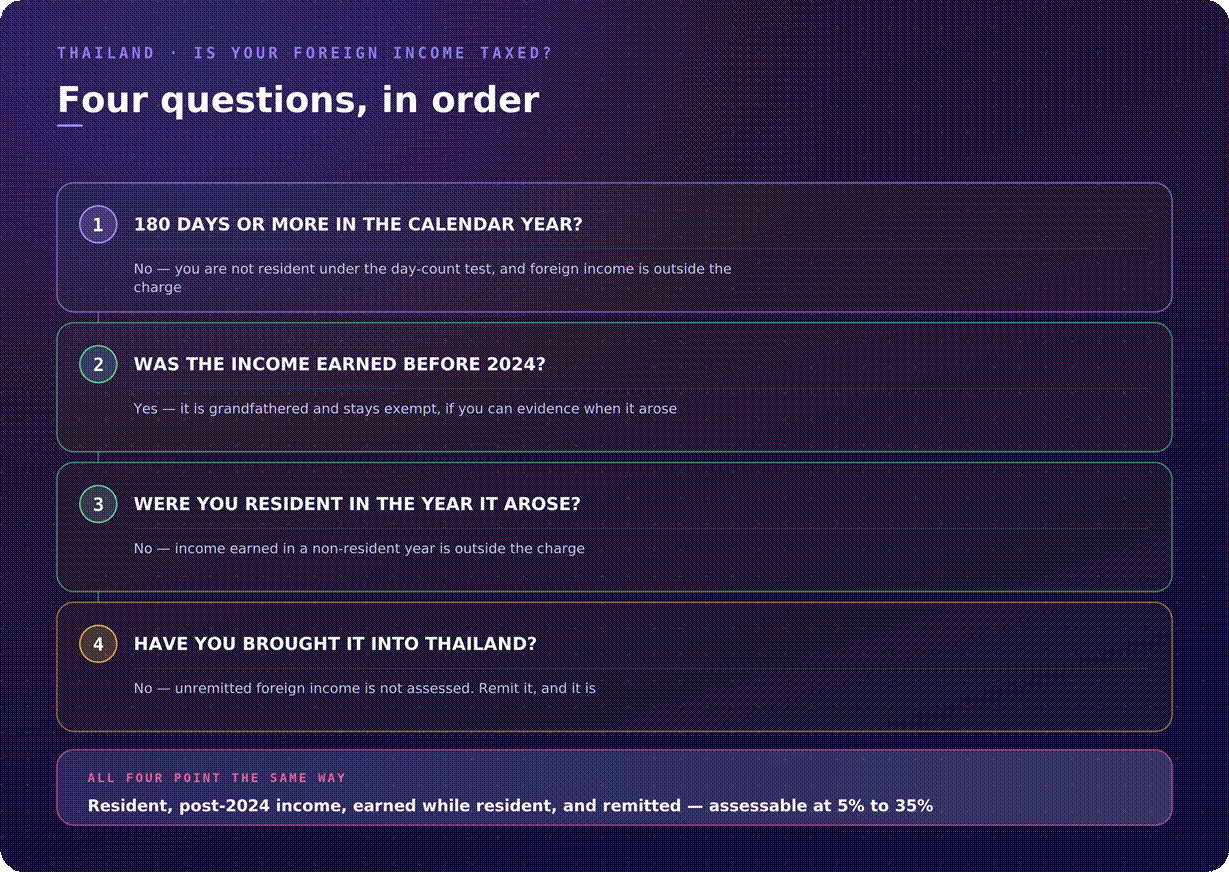
Work through these in order before assuming anything.
Question | Thai position |
Tax year | Calendar year, 1 January to 31 December |
Residency test | 180 days or more, cumulative rather than continuous |
Resident, foreign income kept offshore | Not assessed |
Resident, foreign income remitted | Assessable at progressive rates of 5% to 35% |
Income earned before 2024 | Grandfathered, if you can evidence when it arose |
Income earned in a non-resident year | Outside the charge |
Income within the royal decree exemption | Brought in free of Thai personal income tax |
Two exclusions worth knowing. A companion instruction, Por. 162/2566, confirms that income earned before 1 January 2024 remains exempt even if remitted later but the burden of proving when it arose falls on you. Separately, income earned in a year in which you were not Thai tax resident is also outside the charge. Both make clean record-keeping valuable rather than optional.
Case study: Mark remits his salary monthly
Mark spends 200 days in Thailand, works remotely for a UK company, is paid into a UK account, and transfers part of each month’s salary to a Thai bank account.
He is generally a Thai tax resident, and his remitted income may be subject to Thai personal income tax depending on classification, source, timing and any treaty. He should keep employment contracts and payslips, bank statements showing the original payment and the transfer, records separating salary from pre-existing savings, evidence of tax paid elsewhere, and a day-count record for Thailand and any other relevant country.
Keep pre-2024 savings in a separate account. Once grandfathered savings are mixed with post-2024 income in the same account, demonstrating what you actually remitted becomes very difficult. Separating the two before you move is far easier than reconstructing it later.
The exemption granted by royal decree
There is a statutory exception to all of this, and for many readers it is the most useful thing in this article.
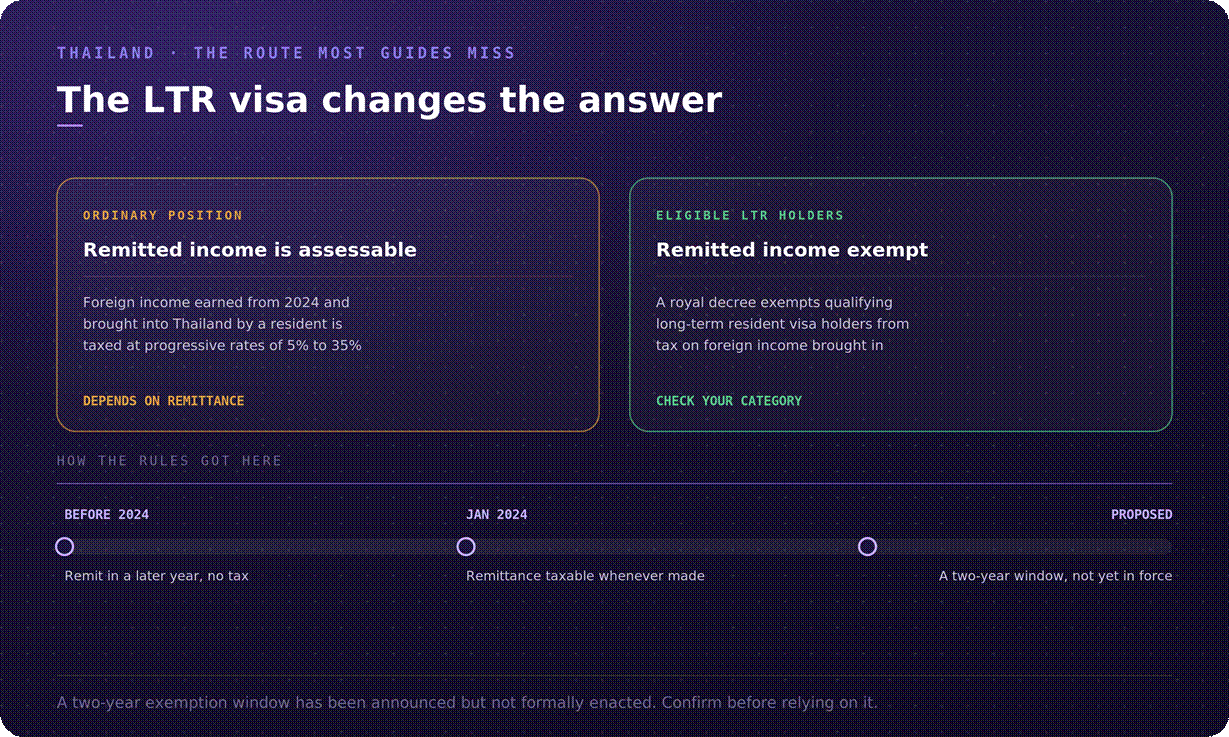
The statutory exemption, and how the rules arrived here.
A royal decree exempts qualifying individuals from Thai personal income tax on foreign income brought into Thailand. The exemption covers income from employment or business carried on abroad, or from property situated abroad, that is brought into Thailand.
This is a genuine structural difference, not a discount. Where the decree applies, the remittance analysis that occupies the rest of this article largely falls away. If you expect to remit substantial foreign income, establishing whether the exemption reaches you is the first question to answer.
The decree defines eligibility by category, and the conditions are specific. Certain skilled-professional categories also attract a preferential flat rate on Thai employment income in place of the ordinary progressive scale. Check the current categories and conditions directly — they have been adjusted since the decree was made.
A relaxation has been announced but not enacted
During 2025 the Revenue Department announced an intention to soften the remittance rule, so that foreign income earned from 2024 onwards would be exempt if brought into Thailand within the year it was earned or the following year. Remittances after that window would remain taxable.
Senior Revenue Department figures confirmed the intent, and the measure was expected to come through secondary legislation — a ministerial regulation or royal decree — rather than primary law. It never completed that route: the draft did not clear Cabinet, Council of State review and publication in the Royal Gazette, and it stalled when Parliament was dissolved ahead of the February 2026 general election.
Do not plan around it until it exists. As matters stand it remains announced rather than in force. Professional interpretations also differ on related points, particularly the treatment of savings accumulated before you became Thai resident. Confirm the current position before making significant transfers, and do not rely on informal commentary.
Treaties and dual residence
If you are treated as resident in Thailand and in another country under domestic law, the applicable treaty may provide a tie-breaker, looking at where you have a permanent home, where your personal and economic relations are closer, where you habitually live, and in some cases your nationality.
A treaty does not remove all taxing rights from the other country. The country where employment duties are physically performed may retain rights over particular workdays. Assess your domestic residence in Thailand, your domestic residence in your former country, the treaty, the location of your workdays, foreign tax credit rules, and your employer’s payroll and social-security obligations together rather than in isolation.
Filing
Thai personal income tax returns are generally filed by the end of March following the calendar tax year, with an extension commonly available for electronic filing. Confirm the current dates with the Revenue Department rather than relying on a date you have read.
Form P.N.D.91 is generally associated with employment income alone. Where you have foreign income, business income, investment income or other assessable income, P.N.D.90 may be the relevant return.
Your planning checklist
1. Forecast your days for the full calendar year, and track actual movements;
2. Classify your income — salary, freelance fees, business profits, dividends, interest, rent and gains;
3. Identify where your work is physically performed, not just who pays you;
4. Separate pre-2024 savings from current income, in different accounts;
5. Record every remittance and what it represents;
6. Check whether the royal decree exemption reaches you before planning around remittances;
7. Review the treaty between Thailand and your other country of residence;
8. Watch for the two-year exemption window being formally enacted;
9. Confirm which return applies and the current deadline; and
10. Take Thai advice in good time if you will exceed 180 days or remit substantial sums.
Frequently asked questions
How many days make me Thai tax resident?
180 days or more in the calendar year, counted cumulatively rather than as one continuous stay. Several shorter trips can add up to residence.
Is my foreign income taxed if I leave it offshore?
No. The charge is on remittance. Foreign income that stays outside Thailand is not assessed — which is why the timing and structure of transfers matters so much.
What changed in 2024?
Before 2024, foreign income was taxable only if remitted in the same year it was earned, so deferring a transfer removed the charge. From January 2024, income earned by a resident is assessable whenever it is remitted.
Are my pre-2024 savings safe?
Income earned before 1 January 2024 remains exempt even if remitted later, but you must be able to evidence when it arose. Keep it in a separate account from post-2024 income.
Is there a statutory exemption I might qualify for?
Yes — a royal decree exempts qualifying categories of individual from Thai personal income tax on foreign income brought into Thailand. If you expect to remit significant sums, check whether it reaches you before doing anything else.
What about the two-year window I have read about?
A relaxation allowing remittance within the year of earning or the following year was announced by the Revenue Department but never enacted. The draft stalled ahead of the February 2026 election and has not been published in the Royal Gazette, so it has no legal effect. Confirm the position before relying on it.
When do I file, and on which form?
Generally by the end of March following the calendar year, with an extension commonly available for e-filing. P.N.D.91 covers employment income alone; P.N.D.90 is the broader return where you have foreign, business or investment income.
Official sources and further reading
• Revenue Department guidance on personal income tax
• Thailand Board of Investment — royal decree exemption categories
Important information
This article is general information and does not constitute tax, legal, immigration or financial advice, and does not create a client relationship. Tax outcomes depend on travel history, income sources, treaty status and the law applying to the relevant year. Rates, thresholds and regimes change, and some measures described may be proposed rather than enacted; this article reflects our understanding as at the date of publication. Obtain advice from a suitably qualified professional before acting or refraining from action.
