
Hold an asset more than twelve months and Trinidad and Tobago does not tax the gain. If you are resident but not domiciled, foreign income is taxed only to the extent you bring it in.
Trinidad and Tobago is usually summarised as 25% and 30%, and left there. Three features matter far more to an internationally mobile person, and none of them appears in the rate table.
The first is a remittance basis. Income arising outside Trinidad and Tobago received by an individual who is resident but not domiciled there is taxable only to the extent that such income is received in Trinidad and Tobago. That is the same structure the UK operated for two centuries.
The second is the capital gains rule. Only gains on the disposal of a chargeable asset within 12 months of its acquisition are taxable. Hold for longer and there is no charge. Gains on any security in Trinidad and Tobago are excluded entirely, as are gains on motor cars and household goods disposed of for TTD 5,000 or under.
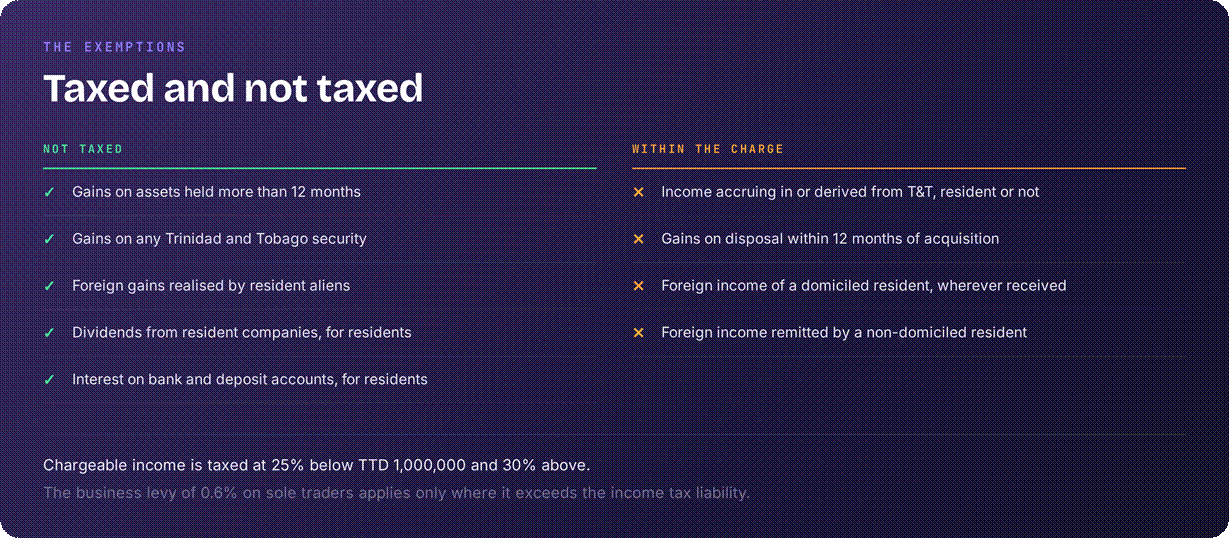
What falls outside the charge, and what does not.
Your residency status is the first step
An individual is resident if they are in the country for 183 days or more in a year of income. Residents, ordinarily residents and domiciled individuals are liable on worldwide income, irrespective of whether earnings are repatriated.
The decisive distinction is domicile, not residence. A person who is not ordinarily resident or not domiciled in Trinidad and Tobago is liable only on income remitted there. Domicile is a separate legal concept from residence and is not changed simply by moving.
Income tax is payable for each year of income on all income accruing in or derived from Trinidad and Tobago regardless of whether the individual is resident or not, so local income is caught either way.
Maintain accurate records of:
• Days present in each year of income;
• Your domicile position and the evidence supporting it;
• Acquisition and disposal dates for every asset, against the 12-month rule;
• Foreign income kept separate from income remitted;
• Every remittance into Trinidad and Tobago, with dates and amounts; and
• Whether you are a resident alien, for the foreign gains exclusion.
The tax rates
Item | Position |
Chargeable income below TTD 1,000,000 | 25% |
Chargeable income above TTD 1,000,000 | 30% |
Gains on assets held over 12 months | Not taxable |
Gains on any Trinidad and Tobago security | Excluded |
Foreign gains of resident aliens | Not taxable |
Dividends from resident companies | Exempt for resident individuals |
Interest on bank and deposit accounts | Exempt for resident individuals |
Business levy on sole traders | 0.6% above TTD 360,000 of gross receipts |
The business levy only bites if it exceeds your income tax liability, does not apply to income exempt from income tax, and is waived for the first three years after starting the business. For a new sole trader that is a meaningful concession.
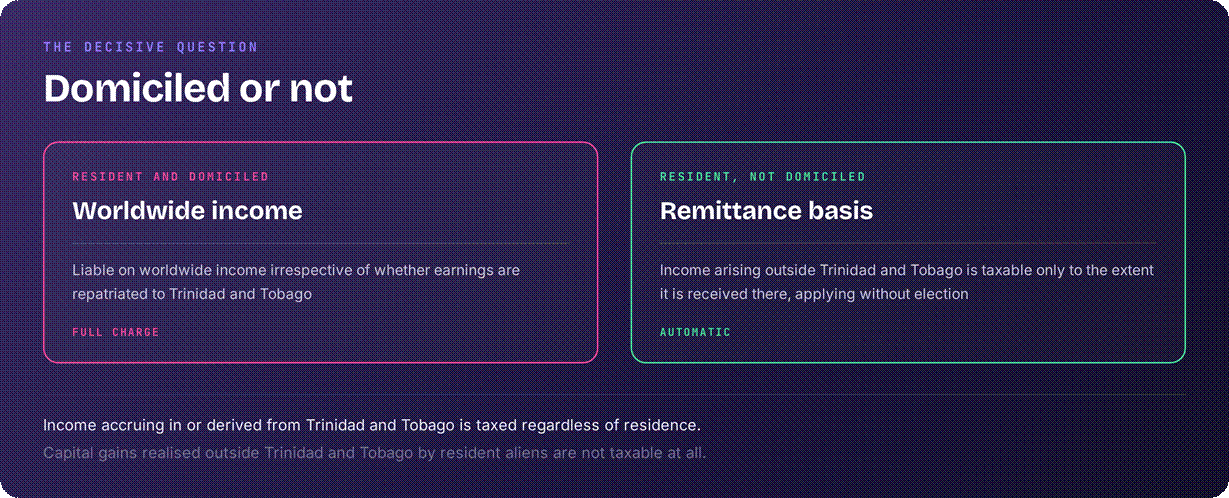
Domicile, not residence, decides the scope.
What Trinidad and Tobago does not tax
The exemptions are extensive and they compound:
• Gains on assets held more than 12 months — the charge applies only to disposals within a year of acquisition;
• Gains on any security in Trinidad and Tobago, whatever the holding period;
• Foreign capital gains realised by resident aliens, which removes overseas portfolios from the charge;
• Dividends from resident companies received by resident individuals, and distributions from a mutual fund established by a locally licensed trust;
• Interest on all classes of savings and other accounts with banks, financial institutions or other deposit-taking institutions, for resident individuals; and
• Interest from bonds issued in Trinidad and Tobago.
What makes Trinidad and Tobago attractive
The combination is stronger than almost anything else in the region:
• A remittance basis for residents who are not domiciled, applying automatically rather than by election;
• No capital gains tax on anything held more than 12 months;
• No tax on foreign gains realised by resident aliens;
• Exempt dividends and exempt bank interest for resident individuals;
• A 25% rate up to TTD 1,000,000, with 30% only above that;
• A personal allowance for residents, revised periodically in the budget; and
• The business levy waived for three years for a new sole trader.
The honest qualification is that domicile governs the remittance basis and is a legal question rather than a choice, and that income accruing in or derived from Trinidad and Tobago is taxed regardless of residence — so local earnings are always in charge.
Case study: Aisha holds for thirteen months
Aisha, resident in Port of Spain but domiciled elsewhere, buys shares in a foreign company. She sells them fourteen months later at a substantial gain.
Two rules protect her. The disposal is outside the 12-month window, so no charge arises on that basis. And as a resident alien, capital gains realised outside Trinidad and Tobago are not taxable at all.
Her foreign dividend income is also outside the charge unless she remits it, because she is resident but not domiciled. What she must watch is the remittance itself — bringing the money in is the taxable event, not earning it.
Filing and the compliance calendar
Residents claim a personal allowance and deductions under the Income Tax Act, and may deduct 70% of National Insurance contributions when calculating taxable income. A health surcharge is deducted at source by employers alongside National Insurance.
Only expenses wholly and exclusively incurred in the production of income are deductible, and expenses are disallowed where intended as capital or where no withholding tax was deducted.
Prepare in good time:
• Registration with the Board of Inland Revenue;
• A TD1 form claiming your allowances and deductions;
• Acquisition and disposal records for every asset;
• A log of remittances into Trinidad and Tobago;
• Evidence supporting your domicile position; and
• The personal allowance figure for the year in question.
Domicile and timing decide everything
Consider:
• Whether you are domiciled in Trinidad and Tobago, since that governs the remittance basis;
• Whether any planned disposal falls inside the 12-month window;
• That foreign gains of resident aliens are not taxable at all;
• That dividends from resident companies and bank interest are exempt;
• How and when you remit foreign income into the country;
• That local income is taxed regardless of residence; and
• Whether the business levy applies, and whether the three-year waiver is running.
Your Trinidad & Tobago checklist
1. Establish your domicile position before anything else;
2. Check whether any disposal falls inside the 12-month window;
3. Record acquisition and disposal dates for every asset;
4. Note that gains on T&T securities are excluded entirely;
5. Note that foreign gains of resident aliens are not taxable;
6. Keep foreign income separate from remitted income;
7. Log every remittance into the country;
8. Claim exempt dividends and exempt bank interest;
9. File a TD1 claiming allowances and deductions; and
10. Check whether the three-year business levy waiver applies.
Frequently asked questions
Is there a remittance basis in Trinidad and Tobago?
Yes. Income arising outside Trinidad and Tobago received by an individual who is resident but not domiciled there is taxable only to the extent that such income is received in Trinidad and Tobago.
How are capital gains taxed?
Only gains on disposal of a chargeable asset within 12 months of acquisition are taxable. Hold longer and no charge arises. Gains on any Trinidad and Tobago security are excluded entirely, as are motor cars and household goods disposed of for TTD 5,000 or under.
What about foreign gains?
Capital gains realised outside Trinidad and Tobago by resident aliens are not taxable at all, which removes overseas portfolios from the charge for many expatriates.
Are dividends and interest taxed?
Not for resident individuals in most cases. Dividends other than preference dividends from resident companies are exempt, as are distributions from a mutual fund established by a locally licensed trust, and interest on all classes of savings and other accounts with banks and deposit-taking institutions.
What are the rates?
25% on chargeable income below TTD 1,000,000 and 30% above. The tiered structure replaced a flat 25% with effect from 1 January 2017.
How do I become tax resident?
By being in the country for 183 days or more in a year of income. Residence determines whether you are in the system; domicile determines how your foreign income is treated once you are.
What is the business levy?
0.6% on sole traders and self-employed individuals whose gross income or receipts exceed TTD 360,000 annually. It is due only if it exceeds the income tax liability, does not apply to exempt income, and is waived for the first three years after starting the business.
Is local income always taxed?
Yes. Income tax is payable for each year of income on all income accruing in or derived from Trinidad and Tobago regardless of whether the individual is resident or not.
Official sources and further reading
• Board of Inland Revenue, Trinidad and Tobago
Important information
This article is general information and does not constitute tax, legal, immigration or financial advice, and does not create a client relationship. Tax outcomes depend on travel history, income sources, treaty status and the law applying to the relevant year. Rates, thresholds and regimes change, and some measures described may be proposed rather than enacted; this article reflects our understanding as at the date of publication. Obtain advice from a suitably qualified professional before acting or refraining from action.
