
Uruguay rebuilt its tax holiday on 1 January 2026. The eleven years survived. The cheap way in did not, and the permanent 7% rate is closed to anyone arriving now.
If you researched Uruguay before 2026, a good deal of what you read is now wrong. The country spent years marketing a low-cost route to tax residence — roughly USD 590,000 in property plus about 60 days a year on the ground — alongside an eleven-year holiday on foreign income and a permanent 7% alternative. Two of those three are gone.
The rewrite came through Law 20.446, the National Budget Law, effective 1 January 2026. It inserted Article 24-BIS into Title 7 of the consolidated tax code, and Decree 188/026 of 10 August 2026 set the conditions. The direction of travel is clear: the new rules favour people who actually live in Uruguay over people who merely buy into it.
Uruguay taxes resident individuals under IRPF. Historically its treatment of foreign income was narrow enough that the country was often described as territorial. From 2026 that description no longer holds for new residents, because foreign capital income is charged at 12% unless the holiday applies.
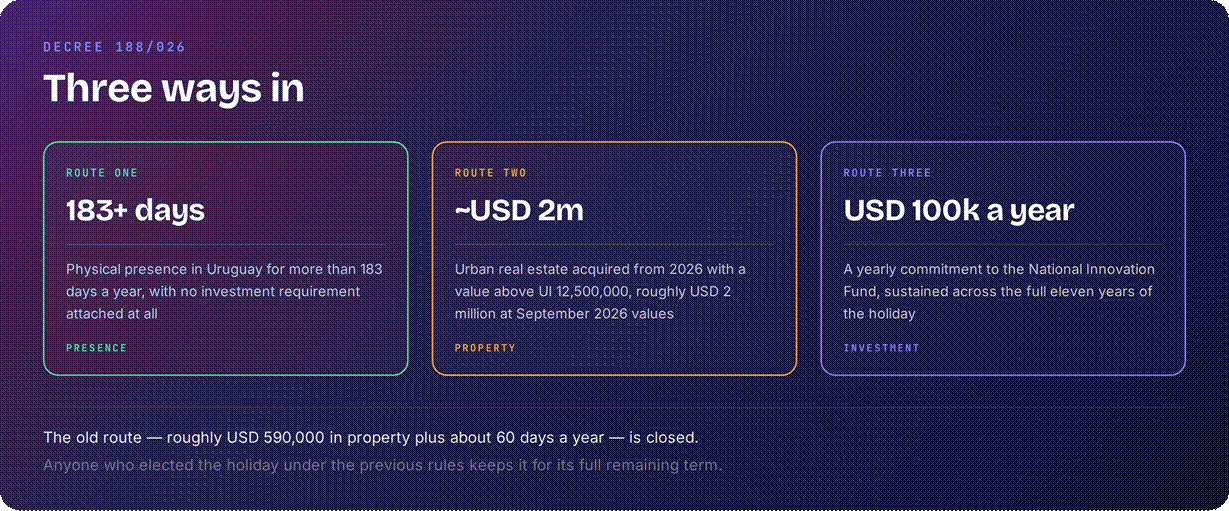
Only one of the three routes costs nothing.
Your residency status is the first step
You become a Uruguayan tax resident if you are present in Uruguay for more than 183 days in the calendar year, or if the main base of your activities or your centre of economic or vital interests is located in Uruguay.
Sporadic absences are counted toward the day total unless residence elsewhere can be demonstrated, so occasional travel does not reduce the count in the way people often assume. The investment-based routes previously allowed residence to be established on far fewer days, which is precisely what the 2026 reform targeted.
Maintain accurate records of:
• Arrival and departure dates within each calendar year;
• Days physically present in Uruguay;
• Property purchase dates and values in indexed units;
• Where your family lives and where your main activities are based;
• The date you acquired tax residence, because the holiday runs from it; and
• Any other country that may also treat you as resident.
What the holiday gives you
A new tax resident may make a one-time election to be taxed as a non-resident on certain foreign capital income. The election covers the year in which residence is acquired and the following ten — eleven years in total.
During that period, foreign-source capital income falls outside the Uruguayan charge:
Income | Treatment during the eleven years |
Foreign dividends | Outside the charge |
Foreign interest | Outside the charge |
Foreign capital gains | Outside the charge |
Foreign rental income | Outside the charge |
Uruguayan-source income | Taxable under the ordinary rules |
Employment income for work in Uruguay | Taxable under the ordinary rules |
Derivative financial instruments | Excluded from the holiday |
The charge is on capital income, not salary. The 12% that applies outside the holiday reaches foreign dividends, interest, rents and certain gains. It is not a tax on foreign salary for remote work, which is a distinction several published summaries have blurred.
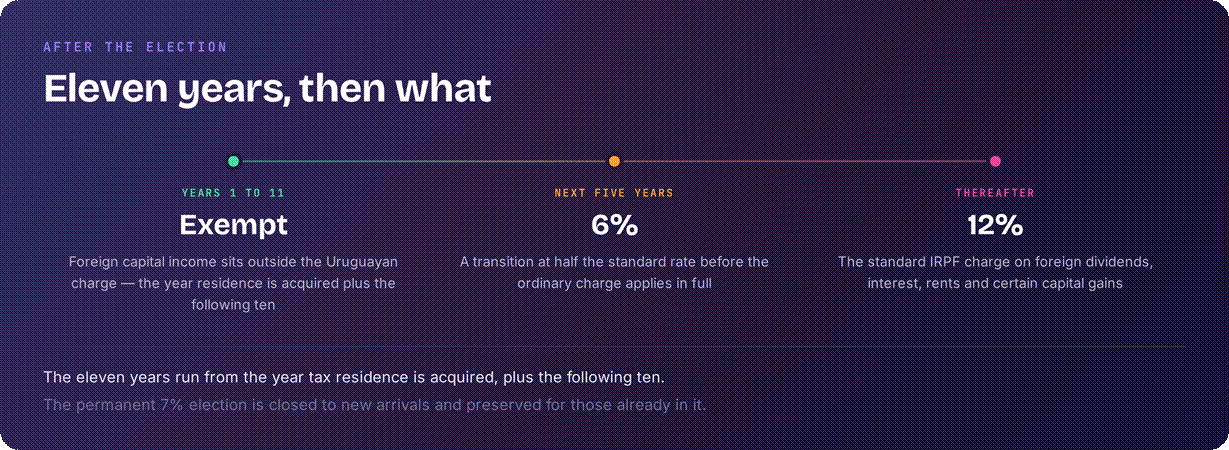
The eleven years, and the two rates that follow them.
The three doors, in detail
Decree 188/026 sets out the qualifying routes, and only one of them is free:
• Presence — more than 183 days a year in Uruguay, with no investment requirement at all;
• Property — urban real estate acquired from 2026 with a value above UI 12,500,000, roughly USD 2 million at September 2026 values; or
• Innovation investment — USD 100,000 a year into the National Innovation Fund, sustained for eleven years.
The previous property route at around USD 590,000 combined with about 60 days a year is closed to new applicants. For most working people the presence route is now the sensible one, and it happens to be the route that produces a genuine relocation rather than a paper one.
What else changed
Two further changes matter as much as the thresholds. The permanent 7% flat rate on foreign investment income is closed to new arrivals, though anyone who had already exercised it keeps it. And a transparency regime now attributes income earned through non-resident entities directly to the Uruguayan individual behind them, which closes the offshore holding company as a deferral tool.
Existing beneficiaries are explicitly grandfathered. If you acquired residence and elected the holiday under the old rules, Law 20.446 confirms your exemption continues for its full remaining term.
Case study: Martín is grandfathered, Claire is not
Martín became a Uruguayan tax resident in 2022 under the old property route and elected the permanent 7% rate on foreign investment income. Law 20.446 does not disturb him — his election survives, and the reform applies prospectively.
Claire arrives in 2026 with a similar portfolio. The 7% election is unavailable to her. She can elect the eleven-year holiday if she clears one of the three doors, and after it ends her foreign capital income enters the charge at 12%, with a five-year transition at 6% along the way.
Same country, same assets, four years apart. Grandfathering is doing a great deal of work here, and anyone quoting a "7% Uruguay" figure today is quoting a closed regime.
Rates outside the holiday
Uruguay taxes individuals under two IRPF categories. Category I covers capital income, with foreign capital income charged at 12% from 2026. Category II covers labour income, taxed on a progressive scale reaching 36% at the top, with deductions and credits that materially affect the effective rate.
There is no general wealth tax on the scale seen elsewhere in the region, though a net wealth tax does apply to assets situated in Uruguay. That combination — no charge on foreign salary, a moderate charge on foreign capital income, and a stable banking system — is much of why the country remains attractive even after the reform.
Filing and the compliance calendar
The Uruguayan tax year follows the calendar year and the authority is the Dirección General Impositiva, the DGI. Withholding and advance payments on foreign capital income began during 2026, and Uruguayan banks, brokers and funds can act as withholding agents on it.
Confirm the dates published for your filing year, because the timetable is set annually. Prepare in good time:
• The date tax residence was acquired and the evidence supporting it;
• Documentation for whichever qualifying route you used;
• Foreign income statements by category, separating capital income from labour income;
• Records of any non-resident entities you hold, given the transparency regime;
• Evidence of foreign tax paid; and
• Day-count records for each calendar year.
Timing matters more than the headline exemption
Model your position before you move, considering:
• Which of the three doors you can realistically satisfy, and at what cost;
• Whether you will acquire residence early or late in a calendar year;
• How much of your income is capital income rather than salary;
• Whether any offshore structures are caught by the transparency regime;
• What the five-year transition at 6% is worth to you;
• Whether the eleven years end before or after you plan to leave; and
• Whether your home country will release you at all.
Your Uruguay checklist
1. Establish which of the three qualifying routes you can satisfy;
2. Record the exact date you acquire Uruguayan tax residence;
3. Track days in each calendar year, counting sporadic absences;
4. Separate foreign capital income from foreign labour income;
5. Check whether any offshore entity is caught by the transparency regime;
6. Confirm whether you elected the holiday or the closed 7% rate, if you are an existing resident;
7. Keep property valuations in indexed units, not only in dollars;
8. Identify which Uruguayan institutions will act as withholding agents;
9. Diarise the end of the eleven years and the 6% transition; and
10. Confirm your former country accepts that you have left.
Frequently asked questions
Is Uruguay still a territorial tax country?
Not for new residents in the way it once was. From 1 January 2026, foreign capital income is charged at 12% unless the eleven-year holiday applies. Foreign salary for remote work is a different question and is not what the 12% charge targets.
Can I still get the permanent 7% rate?
No. It is closed to anyone becoming resident from 2026. People who had already exercised the election keep it, and Law 20.446 grandfathers them explicitly.
What are the three ways to qualify for the holiday?
More than 183 days a year in Uruguay with no investment; urban property acquired from 2026 above UI 12,500,000, roughly USD 2 million; or USD 100,000 a year into the National Innovation Fund for eleven years.
Is the old USD 590,000 property route still available?
No. That route, combined with roughly 60 days a year of presence, was closed by the 2026 reform. It is the change that most affects people planning a low-presence residence.
How long does the holiday last?
Eleven years — the year you acquire tax residence plus the following ten. After it ends there is a five-year transition at 6% before the standard 12% applies to foreign capital income.
Does the 12% apply to my foreign salary?
No. The charge is on foreign capital income — dividends, interest, rents and certain gains. Salary for remote work is not what it targets, though income for work physically performed in Uruguay follows the ordinary rules.
I already have residence under the old rules. Am I affected?
No. Existing beneficiaries are grandfathered, and the exemption continues for its full remaining term. The reform applies to people acquiring residence from 2026.
Does an offshore company still defer Uruguayan tax?
Not as it once did. A transparency regime now attributes income earned through non-resident entities directly to the Uruguayan individual behind them, which removes the deferral that structure used to provide.
Official sources and further reading
• Dirección General Impositiva (DGI)
Important information
This article is general information and does not constitute tax, legal, immigration or financial advice, and does not create a client relationship. Tax outcomes depend on travel history, income sources, treaty status and the law applying to the relevant year. Rates, thresholds and regimes change, and some measures described may be proposed rather than enacted; this article reflects our understanding as at the date of publication. Obtain advice from a suitably qualified professional before acting or refraining from action.
