
Venezuela’s brackets are not expressed in currency. They are set in tax units whose value is revalued repeatedly, which means the real thresholds move constantly.
On paper Venezuela has a conventional progressive scale running from 6% to 34% across eight bands. What makes it behave differently from other progressive systems is that the bands are denominated not in bolívars but in tax units — the unidad tributaria.
The value of a tax unit is set administratively and has been revalued repeatedly. Because the brackets are fixed in units while the unit value changes, the real thresholds shift without any legislative amendment to the scale itself.
The practical consequence is that a taxpayer can move through the bands without their income changing in real terms, and the top 34% band arrives sooner than a reading of the table would suggest.
Two details most guides miss. Non-resident individuals face a flat 34%, with non-business professional income taxed at 34% on 90% of gross payments. And married couples must file a joint return — separate filing is not available.

The scale, and the unit it is written in.
Your residency status is the first step
An individual is a Venezuelan tax resident if they stay in the country for more than 183 days during the calendar year, or during the immediately preceding calendar year. Residence also attaches to individuals who have established their residence or home in the country.
There is an escape from that second limb: someone with an established home in Venezuela is not treated as resident if, in the same calendar year, they spend more than 183 days in another country and can prove that tax residence has been obtained there. Proof is required, not merely absence.
Residents are taxed on worldwide income, with a foreign tax credit available up to the amount of Venezuelan tax payable on that income. Foreign resident individuals with a fixed base in Venezuela pay tax on national or foreign source income attributable to that base.
Maintain accurate records of:
• Days present in the calendar year and the preceding one;
• Days spent in any other country, and proof of tax residence there;
• Whether you have established a residence or home in Venezuela;
• Income in tax units, not only in currency;
• The tax unit value applying to the period; and
• Foreign tax paid, for the credit.
The tax rates
Taxable income (tax units) | Rate |
0 to 1,000 | 6% |
1,000 to 1,500 | 9% |
1,500 to 2,000 | 12% |
2,000 to 2,500 | 16% |
2,500 to 3,000 | 20% |
3,000 to 4,000 | 24% |
4,000 to 6,000 | 29% |
Above 6,000 | 34% |
Corresponding deductions in tax units apply to each band — nil on the first, then 30, 75, 155, 255, 375, 575 and 875 units — which is how the scale is made cumulative rather than applying a single rate to the whole amount.
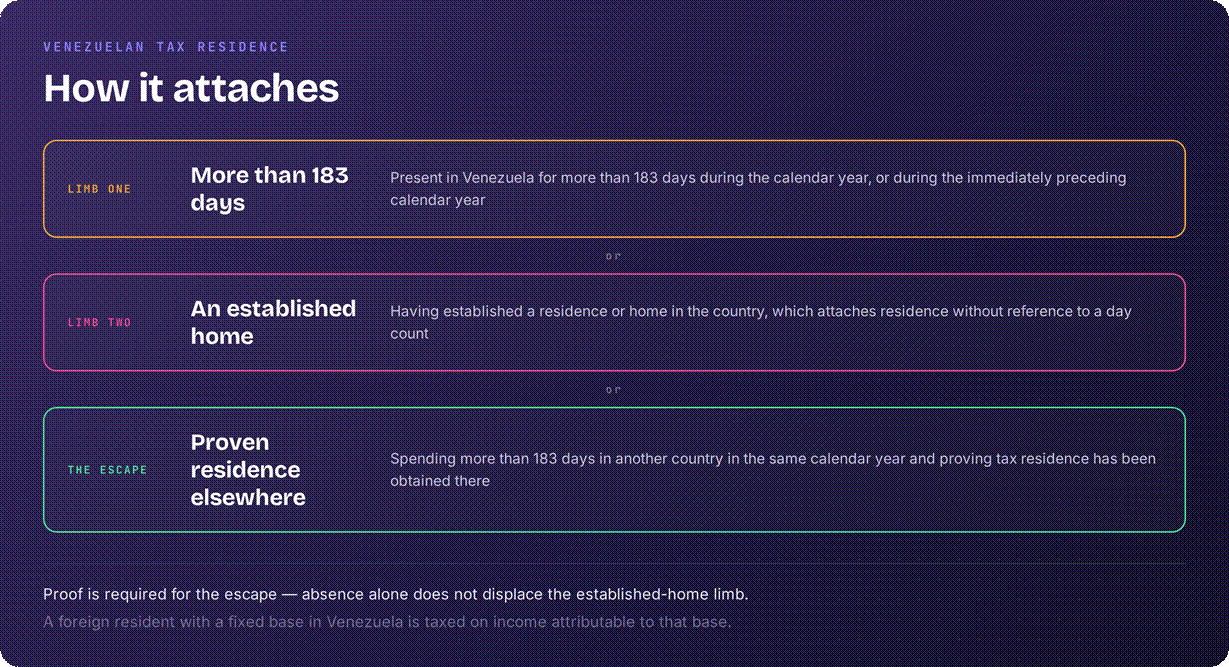
What brings you into Venezuelan residence.
Filing thresholds and capital gains
A resident individual must file where annual net income exceeds 1,000 tax units or gross income exceeds 1,500 tax units, within the first three months after the end of the fiscal year — by 31 March each year.
A self-employed individual with income effectively connected with a Venezuelan trade or business, other than salary, is subject to estimated payment requirements where gross income from those activities exceeded 1,500 tax units, with an estimated return due by 30 June.
Capital gains are included in ordinary income and taxed at normal rates. The exception is gains from the sale of shares listed on the stock market, which are subject to a 1% transaction tax instead.
Non-residents must file a Venezuelan return for all income from or losses sustained in Venezuela, whatever the amount, and a return is frequently required at departure for a non-resident holding a working visa.
What makes Venezuela workable
There are genuine features worth noting alongside the difficulties:
• A 6% entry band, which is low by regional standards at the bottom of the scale;
• A foreign tax credit for residents, up to the Venezuelan tax payable on that income;
• Listed share sales at a 1% transaction tax rather than at ordinary rates;
• Reliefs and rebates for residents, including education costs for the taxpayer and descendants under 25, and premiums for hospitalisation, surgery and maternity insurance with domiciled companies;
• A filing threshold in tax units, below which no return is required; and
• A clear escape from the established-home residence limb where residence elsewhere is proven.
The honest qualifications are substantial. The bands are denominated in a unit whose value is revalued, so real thresholds compress; non-residents face a flat 34% with no deductions; and the wider economic, currency and banking environment presents difficulties that no tax analysis addresses.
Case study: the band that moves
Two taxpayers with identical real income, one year apart, can sit in different bands purely because the tax unit was revalued between them. Nothing about their earnings changed and nothing in the scale was amended.
That is the structural feature to understand. In most progressive systems the thresholds are in currency and move through indexation or legislation, both of which are visible. Here they move through an administrative revaluation of the unit itself.
Anyone modelling a Venezuelan position needs the tax unit value for the period, not just the band table. The table alone tells you very little.
Filing and the compliance calendar
The fiscal year follows the calendar year and the annual return is due by 31 March. Married couples must file jointly. Estimated returns for qualifying self-employed individuals are due by 30 June.
Prepare in good time:
• Registration with the tax administration;
• The tax unit value applying to the period;
• Income expressed in tax units as well as currency;
• Day counts for the year and the preceding year;
• Proof of foreign tax residence, if relying on the escape limb; and
• Documentation for reliefs including education and insurance premiums.
Get the unit value before the band table
Consider:
• That the bands are in tax units, not currency;
• That the unit value is revalued, moving the real thresholds;
• That residence turns on this year or the preceding year;
• That an established home makes you resident unless you prove residence elsewhere;
• That non-residents face a flat 34% with no deductions;
• That married couples must file jointly; and
• That capital gains fall into ordinary income except listed shares at 1%.
Your Venezuela checklist
1. Obtain the tax unit value for the period before modelling anything;
2. Express income in tax units, not only in currency;
3. Count days for this year and the preceding year;
4. Check whether an established home would make you resident;
5. Obtain proof of foreign tax residence if relying on the escape;
6. Note non-residents face a flat 34% with no deductions;
7. Remember married couples must file jointly;
8. Treat capital gains as ordinary income except listed shares;
9. Check the filing thresholds in tax units; and
10. File by 31 March, and by 30 June for estimated returns.
Frequently asked questions
What are the Venezuelan tax rates?
A progressive scale from 6% to 34% across eight bands, with corresponding deductions in tax units. The bands are denominated in tax units rather than in currency.
Why does the tax unit matter?
Because the brackets are fixed in units while the unit value is revalued administratively. The real thresholds therefore move without any amendment to the scale, and a taxpayer can shift bands without their income changing in real terms.
How do I become tax resident?
By staying in Venezuela for more than 183 days during the calendar year or the immediately preceding one, or by having established a residence or home in the country.
Can I escape the established-home limb?
Yes, but proof is required. Someone with an established home in Venezuela is not treated as resident if in the same calendar year they spend more than 183 days in another country and can prove tax residence has been obtained there.
How are non-residents taxed?
At a flat 34% on income caused or originated in Venezuela, with no deductions or credits. Income from non-business professional activities is taxed at 34% on 90% of gross payments.
How are capital gains taxed?
They are included in ordinary income and taxed at normal rates, except for gains from the sale of shares listed on the stock market, which are subject to a 1% transaction tax instead.
When do I have to file?
A resident must file where annual net income exceeds 1,000 tax units or gross income exceeds 1,500 tax units, by 31 March. Non-residents must file for all Venezuelan income or losses whatever the amount.
Can married couples file separately?
No. Married couples must file a joint tax return, which removes the planning flexibility available in systems offering a choice.
Official sources and further reading
Important information
This article is general information and does not constitute tax, legal, immigration or financial advice, and does not create a client relationship. Tax outcomes depend on travel history, income sources, treaty status and the law applying to the relevant year. Rates, thresholds and regimes change, and some measures described may be proposed rather than enacted; this article reflects our understanding as at the date of publication. Obtain advice from a suitably qualified professional before acting or refraining from action.
