
Published guidance on the Algerian income tax scale contradicts itself, two incompatible versions circulate. Here is what is established, what changed in 2026, and what you must get from the DGI.
This article is written differently from the others in this series, and deliberately so. The published versions of the Algerian IRG scale do not agree with one another, and the difference between them is not a rounding error. It is a fundamentally different structure.
Rather than pick one and present it as fact, this piece sets out what is established, what changed in 2026, and precisely what you need to obtain from the Direction Générale des Impôts before you can compute a figure.
That is a more useful position than a confident answer that might be wrong. Anyone modelling an Algerian salary on a scale taken from a secondary source is exposed, and it is better to know that than not.
What is agreed across sources. The tax is the IRG — Impôt sur le Revenu Global. There is a zero band at the bottom. The top marginal rate is 35%. Net taxable income is computed after deducting social contributions and certain allowances. And monthly withholding is calculated by applying the annual grid and dividing by twelve.
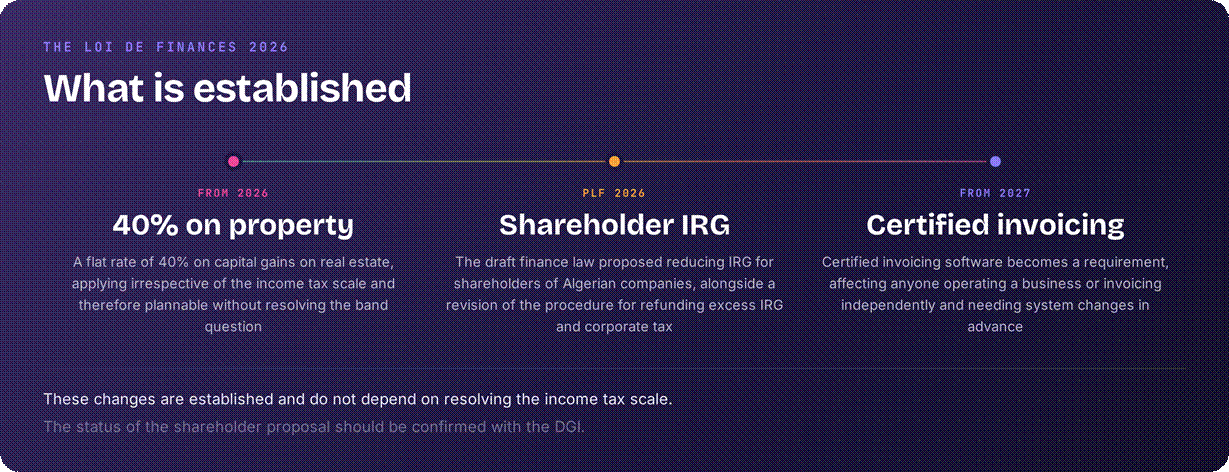
What changed in 2026, and what is coming.
Where the sources disagree
Two incompatible versions of the scale are in circulation, and both appear in material that looks reliable.
The first version shows six bands: a 0% band to DZD 240,000, then 23%, 27%, 30% and 33% across successive tranches, with 35% applying above DZD 3,840,000.
The second version shows four bands: 0%, 20%, 30% and 35%, with the top rate engaging only above DZD 18,000,000.
The gap between DZD 3,840,000 and DZD 18,000,000 as the point at which the top rate begins is enormous; roughly a factor of five. For anyone earning in that range, the two versions produce entirely different answers.
The first version also implies something striking: if correct, the rate immediately above the zero band is 23%, which would be an unusually steep first step with no low entry band in between. The second version has a gentler 20% step. Which is right changes the position for every taxpayer, not only high earners.
What you need from the DGI
Before computing anything, obtain the current *barème de l’IRG* directly from the Direction Générale des Impôts, and confirm:
• The number of bands in the current scale;
• The threshold of the zero band;
• The rate immediately above it (20% or 23%);
• The income level at which 35% engages;
• Whether the Loi de finances 2026 altered any of the above; and
• The version applicable to the specific year you are computing.
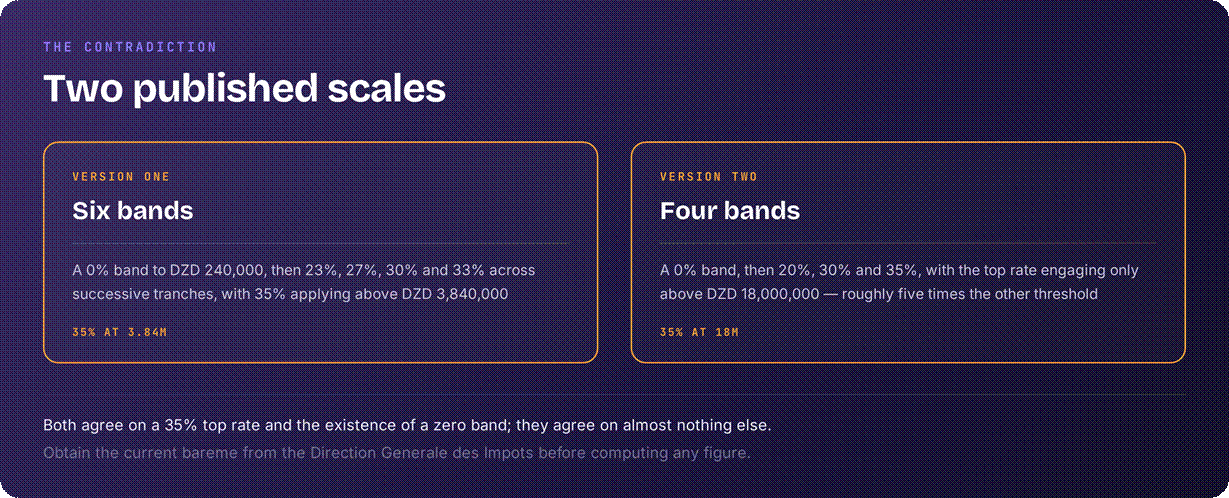
Two published scales that cannot both be right.
What the 2026 finance law changed
Three changes are established and worth knowing regardless of the band question.
First, the Loi de finances 2026 introduces a flat rate of 40% on capital gains on real estate. That is a significant charge and it applies irrespective of the income tax scale, so it can be planned around without resolving the band conflict.
Second, certified invoicing software becomes a requirement from 2027, which affects anyone operating a business or invoicing independently in Algeria and needs building into systems now rather than later.
Third, the draft finance law for 2026 proposed a reduction in IRG for shareholders of Algerian companies, alongside a revision of the procedure for refunding excess IRG and corporate tax. The status of that proposal should be confirmed.
What is settled about the mechanism
The computation itself is not in dispute, even where the rates are:
• Net taxable income is determined after deducting social contributions and certain allowances from gross salary;
• CNAS contributions run at 9% for the employee and 26% for the employer;
• Employers apply the official grid to calculate the correct IRG to withhold from each monthly salary;
• The monthly figure is derived by applying the annual grid and dividing the result by twelve; and
• The system is administered by the Direction Générale des Impôts.
So the shape of the calculation is clear. What is missing is the scale you feed into it.
Case study: why this matters in practice
Consider someone offered a package equivalent to DZD 5,000,000 of annual net taxable income.
Under the first version of the scale, they are above DZD 3,840,000 and therefore into the 35% band, with 23%, 27%, 30% and 33% having applied to the tranches beneath.
Under the second version, DZD 5,000,000 sits well below the DZD 18,000,000 threshold, so the 35% rate does not apply at all and the marginal rate is 30%.
Same income, same country, same year — and a materially different net figure depending on which published scale you happened to find. That is precisely why this needs resolving at source rather than online.
What makes Algeria workable
Setting the scale question aside, several things can be said:
• A zero band exists, so the lowest earners are outside the charge;
• The top rate is 35%, which is moderate by regional standards;
• Social contributions are deductible before the scale is applied, which not every system allows;
• Employers operate withholding through an official grid, so employees have little to administer;
• The Loi de finances 2026 is part of a broader modernisation, including the move to certified invoicing; and
• A large economy with substantial international business presence.
The honest qualification is the one this whole article rests on. Until the current barème is confirmed with the DGI, any net figure you calculate for Algeria carries real uncertainty, and that uncertainty is larger than the differences between many countries in this series.
Filing and the compliance calendar
The IRG is administered by the Direction Générale des Impôts. Employers calculate and withhold monthly using the official grid, deducting CNAS contributions before applying the scale.
Prepare in good time:
• The current barème de l’IRG obtained directly from the DGI;
• Confirmation of which year’s scale applies to your period;
• Payroll records showing CNAS deducted before the scale;
• Records of any real estate disposal, for the 40% charge;
• Certified invoicing arrangements ahead of 2027; and
• Confirmation of the status of the shareholder IRG proposal.
Get the scale before anything else
Consider:
• That two incompatible versions of the scale are in circulation;
• That they disagree on the number of bands and the top threshold;
• That the difference is roughly a factor of five at the top;
• That the top rate of 35% and the existence of a zero band are agreed;
• That real estate gains bear a flat 40% from 2026;
• That certified invoicing is required from 2027; and
• That no reliable net figure is possible until the DGI confirms the scale.
Your Algeria checklist
1. Obtain the current bareme directly from the DGI;
2. Confirm the number of bands in the current scale;
3. Confirm the threshold of the zero band;
4. Establish whether the rate above it is 20% or 23%;
5. Establish where the 35% rate actually engages;
6. Confirm which year’s scale applies to your period;
7. Note the flat 40% on real estate gains from 2026;
8. Plan certified invoicing arrangements ahead of 2027;
9. Deduct CNAS at 9% before applying the scale; and
10. Treat any net figure from a secondary source as provisional.
Frequently asked questions
Why does this article not give the tax bands?
Because two incompatible versions are in circulation and both appear in material that looks reliable. One shows six bands with 35% from DZD 3,840,000; the other shows four bands with 35% only above DZD 18,000,000. Presenting either as fact would risk being badly wrong.
What is agreed across sources?
That the tax is the IRG, that a zero band exists, that the top marginal rate is 35%, that net taxable income is computed after social contributions and certain allowances, and that monthly withholding applies the annual grid divided by twelve.
How big is the discrepancy?
Large. The two versions disagree on the number of bands, on the rate immediately above the zero band — 20% or 23% and on the income level at which 35% engages, where the gap is roughly a factor of five.
What changed under the 2026 finance law?
A flat rate of 40% on capital gains on real estate was introduced, and certified invoicing software becomes a requirement from 2027. The draft law also proposed reducing IRG for company shareholders.
Can I plan around the property gains rate?
Yes. The 40% charge on real estate gains applies irrespective of the income tax scale, so it can be modelled without resolving the band question.
What social contributions apply?
CNAS at 9% from the employee and 26% from the employer. The employee contribution is deducted before the income tax scale is applied.
How is monthly tax calculated?
Employers apply the official annual grid to the employee’s taxable income and divide the resulting annual tax by twelve. The mechanism is not in dispute only the grid itself.
What should I do before accepting an Algerian package?
Obtain the current barème de l’IRG directly from the Direction Générale des Impôts and confirm which year it applies to. Until then, treat any net figure calculated from a secondary source as provisional.
Official sources and further reading
• Direction Générale des Impôts, Algérie
Important information
This article is general information and does not constitute tax, legal, immigration or financial advice, and does not create a client relationship. Tax outcomes depend on travel history, income sources, treaty status and the law applying to the relevant year. Rates, thresholds and regimes change, and some measures described may be proposed rather than enacted; this article reflects our understanding as at the date of publication. Obtain advice from a suitably qualified professional before acting or refraining from action.
