
The lowest-tax countries for employees in 2026 are Brunei, Kuwait, Oman, Qatar, Saudi Arabia and the UAE, where a foreign employee on a US$100k salary pays 0% in income tax and social security. Next come Bahrain (1.0%), the Bahamas (2.0%), the Maldives (3.5%), Macao (4.3%), the Cayman Islands (5.0%) and Singapore (7.2%).
This guide ranks all 153 countries TaxPilot covers by the all-in cost to an employee: income tax plus the compulsory social security and health contributions that come out of your pay. You'll find the top 20, a short profile of the best options, and the full list of the 40 countries rated Excellent or Good.
The scenario is the same everywhere: a US$100k salary for a job done in that country, under 2026 rules. Where a tax break for people hired from abroad is open to a typical hire on that salary, we count it, and we say so.
What's changed: several countries in this list changed their rules for 2026. Bermuda's new payroll tax bands from 1 April 2026 cut the employee portion on a $100,000 salary from $5,080 to $4,270. Kazakhstan's new Tax Code took effect on 1 January 2026, with 15% on income above 8,500 MCI a year (KZT 36,762,500) instead of a flat 10%. Cyprus raised its tax-free band to €22,000 and moved the 35% rate up to €72,000. Singapore's CPF ordinary wage ceiling rose to S$8,000 a month, which matters if you become a permanent resident. Luxembourg's employee pension contribution rose to 8.5%. The Dutch 30% ruling is now worked out on no more than €262,000 of salary and falls to 27% from 2027 for rulings that started in 2024 or later. Oman's 5% income tax is law and starts on 1 January 2028.
📋 The 20 lowest-tax countries for employees in 2026
Rank | Country | All-in rate | Rating | Why |
|---|---|---|---|---|
=1 | 0% | Excellent | No income tax on salary, and expat employees don't pay social security. | |
=1 | 0% | Excellent | Salaries are outside the Income Tax Law, and non-Qataris pay no social insurance. | |
=1 | 0% | Excellent | No income tax, and expat employees aren't insured with the social security institution. | |
=1 | 0% | Excellent | No income tax in 2026 and no employee social insurance for expats. | |
=1 | 0% | Excellent | No income tax on salary, and SPK pension covers only citizens and permanent residents. | |
=1 | 0% | Excellent | Salaries aren't taxed, and non-Saudi employees pay no social insurance. | |
7 | 1.0% | Excellent | No income tax. The only deduction is 1% unemployment insurance. | |
8 | 2.0% | Excellent | No income tax. The 4.65% National Insurance stops at $830 a week. | |
9 | 3.5% | Excellent | The first MVR 720,000 is tax free and the top rate is 15%. | |
10 | 4.3% | Excellent | A 25% deduction, a MOP 144,000 exempt slice and a 30% cut in the tax bill. | |
11 | 5.0% | Excellent | No income tax. You pay 5% pension and up to half your health insurance. | |
12 | 7.2% | Excellent | Resident rates up to 24%, and no CPF for foreigners on work passes. | |
13 | 8.7% | Excellent | No income tax. Payroll tax, social insurance and your share of health cover. | |
14 | 9.6% | Excellent | Income tax at 0%, 8% and 10%, and no pension contributions for temporary foreign workers. | |
15 | 10.0% | Excellent | A flat 10% income tax and no employee social contributions. | |
16 | 10.3% | Good | 5% and 7% income tax plus 4.83% IGSS. Just over the 10% line. | |
17 | 10.4% | Good | For a foreign employee on a work permit, outside the health insurance system. | |
18 | 12.0% | Good (Excellent with IT Park) | 12% income tax, and the 12% social tax is paid by your employer. | |
19 | 12.1% | Good | Counts the newly settled relief: tax and contributions on 30% of pay for five years. | |
20 | 12.7% | Good | Salaries tax at 2% to 25% plus capped NSSF health contributions. |
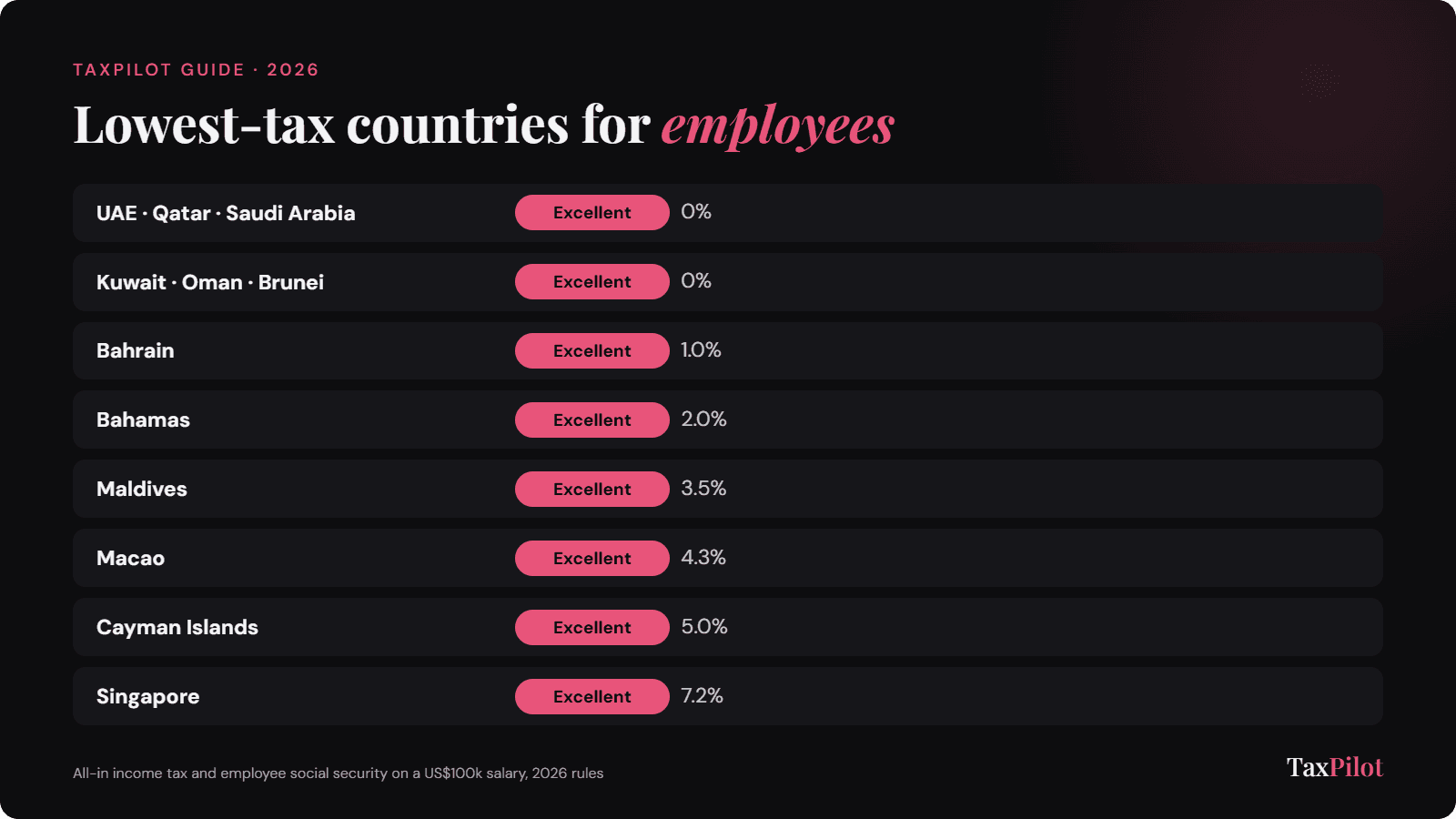
The graphic shows the 12 lowest-tax countries for employees in 2026: Brunei, Kuwait, Oman, Qatar, Saudi Arabia and the UAE at 0%, then Bahrain at 1.0%, the Bahamas at 2.0%, the Maldives at 3.5%, Macao at 4.3%, the Cayman Islands at 5.0% and Singapore at 7.2%, all rated Excellent. Figures are the all-in tax and social security on a US$100k salary.
How do we compare countries for employees?
Every country is tested on the same example: a single employee earning US$100k a year for work done in that country, converted at the exchange rate in the country post. The all-in rate is income tax plus any compulsory social security and health contributions you pay, as a share of your gross salary. What your employer pays on top (such as Moldova's 24% social contribution or Bulgaria's 18.92% to 19.62%) isn't counted, because it doesn't come out of your pay.
The ratings are relative to the 153 countries we cover:
Excellent: 10% or less
Good: over 10%, up to 20%
Moderate: over 20%, up to 30%
Poor: over 30%
Each band includes its upper bound, so exactly 10.0% is Excellent and exactly 20.0% is Good. The unrounded figure decides.
Tax breaks for people moving from abroad count when a typical US$100k hire would qualify, like the Dutch 30% ruling. Breaks limited to certain roles, sectors or approved employers don't set the rating. They're shown in brackets instead, for example "Good (Excellent with IT Park)". A break that ends within five years is flagged but doesn't change the rating.
Which countries are best for employees? The top options explained
Six countries come out at exactly 0%. Brunei and Kuwait aren't profiled below, but they work the same way: no income tax on salary, and nothing comes out of a foreign employee's pay, because Brunei's SPK pension covers only citizens and permanent residents and Kuwait doesn't insure expat employees. Here are the ten we'd look at first.
UAE: 0%
The UAE has no personal income tax, so your salary, bonuses, pension, investment income and gains are all untaxed. Expat employees don't pay social security. Your employer pays an end-of-service gratuity instead. You'll pay 5% VAT on most spending.
The catch is at home, not in the UAE. If your old country still treats you as resident, you may need a UAE Tax Residency Certificate to rely on a treaty, and the Federal Tax Authority's portal now flags treaty applications with fewer than the 183 days required.
👉 Federal Tax Authority: UAE tax guidance
Saudi Arabia: 0%
Salaries aren't taxed in Saudi Arabia, and non-Saudi employees pay no social insurance. The only contribution for expats is 2% occupational hazards cover, and your employer pays it. On a US$100k salary (SAR 375,000), nothing comes off your pay.
Residence changes nothing for an employee here, because salary isn't taxed either way. It still helps to get a Saudi Tax Residency Certificate if you need to show your old country that you've gone. From 22 January 2026, non-Saudis can also own property, with limits in Makkah and Madinah.
👉 GOSI: employer FAQs on contributions and cover for non-Saudi workers
👉 Saudi Arabia expat tax guide
Qatar: 0%
Salaries, wages and allowances are outside Qatar's Income Tax Law altogether, and non-Qatari employees aren't covered by social insurance. If you've worked for an employer for a year or more, the Labour Law gives you an end-of-service gratuity of at least three weeks' pay for each year of service.
Watch the permanent home test when you leave. If you keep your Doha apartment after you move, Qatar may still treat you as resident.
👉 Al Meezan (Qatar legal portal): Labour Law No. 14 of 2004, Article 54 on end-of-service gratuity
Oman: 0% until 2028
Oman charges no income tax in 2026 or 2027, and expats pay no employee social insurance. That changes on 1 January 2028, when a 5% personal income tax applies to income above OMR 42,000 a year (about US$109,000).
A US$100k salary (about OMR 38,450) stays under that threshold, so it would still pay nothing from 2028. A bigger package, or salary plus investment income, could cross it.
👉 Oman Tax Authority: Personal Income Tax Law and regulations
Bahrain: 1.0%
Bahrain has no income tax. The only deduction from your pay is 1% unemployment insurance, which gives about 1% all-in on a US$100k salary (BD 37,600). Your employer pays work injury cover and your end-of-service gratuity, which since 1 March 2024 goes into the Social Insurance Organisation every month.
The trap is proof. Bahrain's certificate of residence needs at least 183 days in the country in that year, and the National Bureau for Revenue calls the rule absolute. A long summer back home can leave you without one.
👉 National Bureau for Revenue: certificate of residence for tax purposes
Bahamas: 2.0%
There's no income tax in the Bahamas. Employees pay 4.65% National Insurance, but only up to the insurable wage ceiling of $830 a week (raised from $810 on 1 July 2026), so on a US$100k salary it works out at about 2%.
Your tax status follows your immigration permit, so the real question is how you get the right to work and stay.
Macao: 4.3%
Macao's Professional Tax has a 12% top rate, but three reliefs shrink it: a 25% deduction, a MOP 144,000 exempt slice and a 30% cut in the tax bill. The 2026 Budget Law keeps both the exempt slice and the 30% cut. That brings the rate at the margin down to 6.3%, and about 4.3% all-in on a US$100k salary (MOP 808,000). Resident employees add MOP 30 a month to social security.
👉 Macao Financial Services Bureau: 2026 tax relief measures
Cayman Islands: 5.0%
Cayman has no income tax, but two things come out of your pay. Once you've worked there for nine months, you pay 5% into a pension on earnings up to CI$87,000, and your employer can deduct up to half your health insurance premium. On US$100k (about CI$83,333), that stays under 10% unless your health share tops about CI$347 a month.
New work permits from 1 May 2026 tie you to your employer for two years.
👉 Department of Labour and Pensions: pension FAQs (rates, CI$87,000 cap, nine-month rule)
👉 Cayman Islands expat tax guide
Singapore: 7.2%
A resident foreigner on a work pass pays about 7% all-in on a US$100k salary (S$128,000). Resident rates run from 0% to 24%, and foreigners on work passes don't pay CPF.
That changes if you become a permanent resident. From your third year as a PR you pay 20% CPF on wages up to S$8,000 a month, taking the all-in cost to a little over 20%. Working in Singapore for a foreign employer is still taxable in Singapore.
👉 IRAS: working out your tax residency
Kosovo: 9.6%
Kosovo has the lowest all-in figure in Europe in our ranking. On a temporary residence permit you pay income tax at 0%, 8% and 10%, and no pension contributions, because the pension law doesn't allow them for foreign workers staying temporarily. That's about 9.6% on a US$100k salary (€87,000).
A Kosovo citizen or permanent resident pays about 14.1%, including the 5% employee pension contribution.
👉 Official Gazette: Law No. 04/L-101 on Pension Funds, article 6 (in Albanian)
Which tax breaks for new arrivals are counted?
A few countries only reach this list because of a regime for people hired from abroad. We count it when most people moving in on a US$100k salary would qualify. These are the regimes counted for employees in 2026:
📋 Employee regimes counted in the 2026 ratings
Country | Regime | With it | Without it |
|---|---|---|---|
Newly settled taxpayer relief (5 years) | 12.1% (Good) | about 27.8% | |
50% exemption (up to 17 years) | 12.8% (Good) | about 28% | |
Impatriate regime (50% of pay exempt) | 15.8% (Good) | about 34% | |
30% ruling (up to 5 years) | 18.8% (Good) | about 34% | |
Article 5C exemption (7 years) | 22.4% (Moderate) | about 40% | |
Impatriate regime (5 years) | 22.4% (Moderate) | about 42% | |
Impatriate regime (up to 9 years) | 28.1% (Moderate) | about 35% | |
Inbound regime | 33.0% (Poor) | about 45% | |
Return relief (first 4 years) | 33.8% (Poor) | about 40% |
Four of them put a country in the Good band. In Serbia, a newly settled employee pays tax and contributions on only 30% of pay for five years, if the salary is above RSD 439,692 a month in 2026. Cyprus exempts half your salary for up to 17 years on a first job there paying more than €55,000. Luxembourg exempts 50% of pay, capped at €400,000, for a specialist recruited from abroad. The Netherlands 30% ruling needs a salary above €48,013 in 2026 and lasts up to five years.
👉 Income Tax Law, article 8: the 50%, 20% and 25% exemptions (in Greek)
Other breaks depend on your role, sector or employer, so they don't set the rating. If one applies to you, the cost can be much lower:
Uzbekistan: 7.5% income tax if you work for an IT Park resident company.
Moldova: the company's 7% single tax covers your income tax at an IT Park resident.
Kyrgyzstan: about 5% all-in at a High Technology Park company.
Taiwan: about 13.6% for approved foreign specialist professionals.
Ukraine: 10% for Diia City IT staff, against 23.0% normally.
Malta: about 18% in a qualifying highly skilled role.
Cape Verde: about 18% for a non-habitual resident in a listed high-value role.
Sweden: about 20.5% with expert relief.
Portugal: about 29% in a qualifying IFICI role, against about 41% without it.
Israel is a special case. Olim who moved between 5 November 2025 and the end of 2026 pay no income tax on this salary in 2027 (about 13% all-in), but the relief ends in 2030, so it isn't counted.
The full list: every country rated Excellent or Good
These are all 40 countries where an employee on a US$100k salary pays 20% or less all-in in 2026, lowest first.
☑️ Excellent for employees in 2026 (15 countries, 10% or less)
Country | All-in rate | Rating | Note |
|---|---|---|---|
0% | Excellent | No income tax | |
0% | Excellent | No tax on salaries | |
0% | Excellent | No income tax | |
0% | Excellent | No income tax until 2028 | |
0% | Excellent | No income tax | |
0% | Excellent | No tax on salaries | |
1.0% | Excellent | 1% unemployment insurance | |
2.0% | Excellent | Capped National Insurance | |
3.5% | Excellent | Top rate 15% | |
4.3% | Excellent | 30% cut in the tax bill | |
5.0% | Excellent | Pension and health cover | |
7.2% | Excellent | No CPF on a work pass | |
8.7% | Excellent | Payroll tax, no income tax | |
9.6% | Excellent | No pension for temporary foreign workers | |
10.0% | Excellent | Flat 10% |
☑️ Good for employees in 2026 (25 countries, over 10% up to 20%)
Country | All-in rate | Rating | Note |
|---|---|---|---|
10.3% | Good | Just over 10% | |
10.4% | Good | Work permit holder | |
12.0% | Good (Excellent with IT Park) | IT Park not counted | |
12.1% | Good | Newly settled relief counted | |
12.7% | Good | No new-arrival regime | |
12.8% | Good | 50% exemption counted | |
13.0% | Good | Includes MPF | |
13.4% | Good | Includes 4% social security | |
13.7% | Good | Contributions capped | |
13.7% | Good | Tajik employer, resident | |
14.3% | Good | Specialist break not counted | |
14.8% | Good | No income tax, contributions only | |
14.8% | Good | Vaduz, health premiums extra | |
15.8% | Good | Impatriate regime counted | |
16.4% | Good | NSSF not counted | |
17.2% | Good | FNPF optional for non-citizens | |
17.8% | Good | Before deductions | |
18.3% | Good | Social insurance capped | |
18.8% | Good | 30% ruling counted | |
19.0% | Good | High Technology Park not counted | |
19.9% | Good | Just under 20% | |
19.9% | Good (Excellent in the IT Park) | IT Park not counted | |
19.9% | Good | Zurich; Zug lower, Geneva higher | |
20.0% | Good | Flat 20%, pension for citizens and PRs only | |
20.0% | Good | At the Central Bank reference rate |
The other 113 countries rate Moderate (59) or Poor (54). The nearest misses are Chile at 20.5% and the USA at 20.8%.
What should you check before you move for a low-tax job?
Have you really left your home country?
A 0% rate abroad doesn't stop your old country taxing you. If it still treats you as resident, it can tax your salary wherever you earn it. Treaties can help, but you usually need a tax residency certificate, and the UAE and Bahrain both want 183 days in the country for one.
Will your status change your contributions?
Several low figures rely on you being a foreigner. Become a permanent resident and you may join the national scheme: 8.5% SPK in Brunei, 20% CPF in Singapore from your third year, about 19.7% all-in in Kazakhstan, and about 14.1% in Kosovo. In Bermuda, a Bermudian or someone married to one pays the 5% occupational pension, about 14% all-in.
Is your job done in the country?
These figures are for a job done locally. Singapore taxes work done there for a foreign employer, and Lebanon taxes a salary even if a foreign employer pays it abroad. Remote work for an overseas company doesn't escape local tax just because the payroll is elsewhere.
Are you close to a rating line?
Some countries sit right on a boundary. Mauritius (19.9%) would cross 20% if the rupee weakened past about Rs 48.8 to the US dollar. Guatemala (10.3%) and Kazakhstan (10.4%) sit just over 10%. Georgia and Myanmar sit exactly on 20%, which still counts as Good. Georgian citizens and permanent residents also pay 2% into the pension scheme (21.6% all-in), and Myanmar's figure uses the Central Bank reference rate; at the market trading rate it's about 22%. A different salary or exchange rate can move them.
What's coming next?
Oman: 5% on income above OMR 42,000 from 1 January 2028. This is law.
Netherlands: the 30% ruling falls to 27% from 2027 for rulings that started in 2024 or later, which takes this salary to about 20%.
Kuwait: proposals to tax money expats send home have come up before. None is law.
Luxembourg: a single tax class from 2028. Proposed, not law.
Can you actually get in?
A low rate only helps if you can live and work there. In Kuwait and Brunei your residence usually depends on a sponsor, new Cayman work permits tie you to your employer for two years, Liechtenstein issues residence permits by quota with half drawn by lottery, Monaco is expensive to settle in, and Turkmenistan is very hard in practice.
Frequently asked questions
Which country has the lowest tax for employees?
Six countries tie at 0% on a US$100k salary in 2026: Brunei, Kuwait, Oman, Qatar, Saudi Arabia and the UAE. None taxes salaries, and foreign employees pay no social security. Bahrain is next at about 1%.
Do expats pay social security in the UAE?
No. Expat employees in the UAE pay no income tax and no social security. Your employer pays an end-of-service gratuity instead. UAE expat tax guide
Will Oman start taxing salaries?
Yes, from 1 January 2028 Oman charges 5% on income above OMR 42,000 a year (about US$109,000). A US$100k salary, about OMR 38,450, stays under the threshold. Oman expat tax guide
What is the lowest-tax country in Europe for employees?
Kosovo, at about 9.6% all-in on a US$100k salary for a foreign employee on a temporary residence permit. Next come Serbia (12.1%) and Cyprus (12.8%), both using a regime for new arrivals, and Bulgaria (13.7%).
Is Singapore a low-tax country for employees?
Yes, for a foreigner on a work pass: about 7% all-in on a US$100k salary, with no CPF. A permanent resident from their third year pays 20% CPF on capped wages, which takes the total to a little over 20%.
Do tax breaks for new residents count in these rankings?
Only when a typical US$100k hire from abroad would qualify, like the Dutch 30% ruling or the Cypriot 50% exemption. Breaks limited to particular roles, sectors or employers are shown in brackets but don't set the rating.
If I move to a 0% country, do I stop paying tax at home?
Not automatically. Your home country can still tax your salary if you stay resident there under its rules. You usually need to break residence at home, and a tax residency certificate from your new country helps if you rely on a treaty.
Where to go next
👉 Lowest-tax countries for expats: 153 ranked
👉 Countries with no income tax
👉 Special tax regimes for new residents
👉 Low tax, high social security countries
👉 Best countries for freelancers
Important information
This article is general information and does not constitute tax, legal, immigration or financial advice, and does not create a client relationship. Tax outcomes depend on travel history, income sources, treaty status and the law applying to the relevant year. Rates, thresholds and regimes change, and some measures described may be proposed rather than enacted; this article reflects our understanding as at the date of publication. Obtain advice from a suitably qualified professional before acting or refraining from action.

TaxPilot
Residency turns on days, and days are easy to lose track of. TaxPilot logs where you are, holds the thresholds for 150+ countries, and warns you as you approach one so the count never catches you out at the end of the year.
🌐 150+ countries
📅 Day counting built in
☑️ Updated as rules change